Citation: Longjian Li, Ping Zhang, Yongchong Yu, Reyila Tuerhong, Xiaoping Su, Lijuan Han, Enzhou Liu, Jizhou Jiang. Electron trap-induced charge accumulation and surface reaction kinetics synergistically enhance overall nitrogen photofixation[J]. Chinese Chemical Letters, ;2025, 36(8): 111118. doi: 10.1016/j.cclet.2025.111118 shu

Electron trap-induced charge accumulation and surface reaction kinetics synergistically enhance overall nitrogen photofixation

    * Corresponding authors.
    E-mail addresses: zhangping@xbmu.edu.cn (P. Zhang), 027wit@163.com (J. Jiang).
  • Received Date: 13 December 2024
    Revised Date: 17 March 2025
    Accepted Date: 19 March 2025
    Available Online: 20 March 2025

Figures(8)

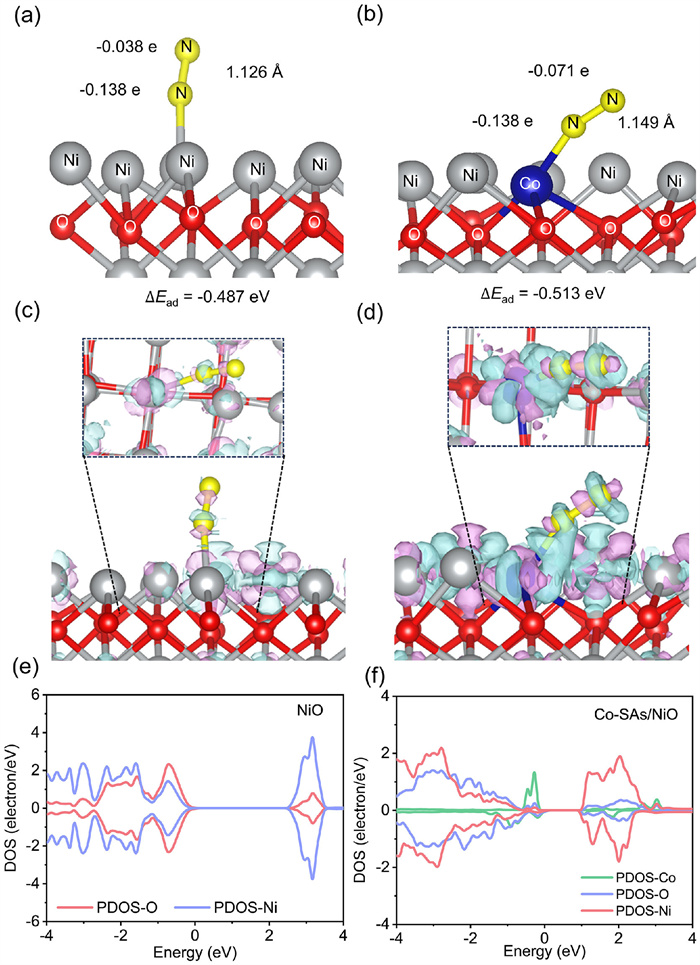
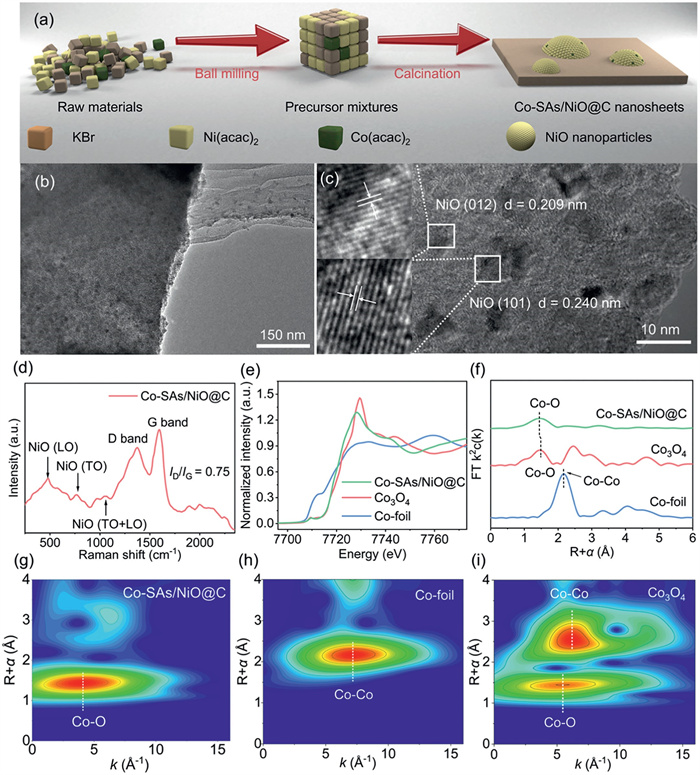
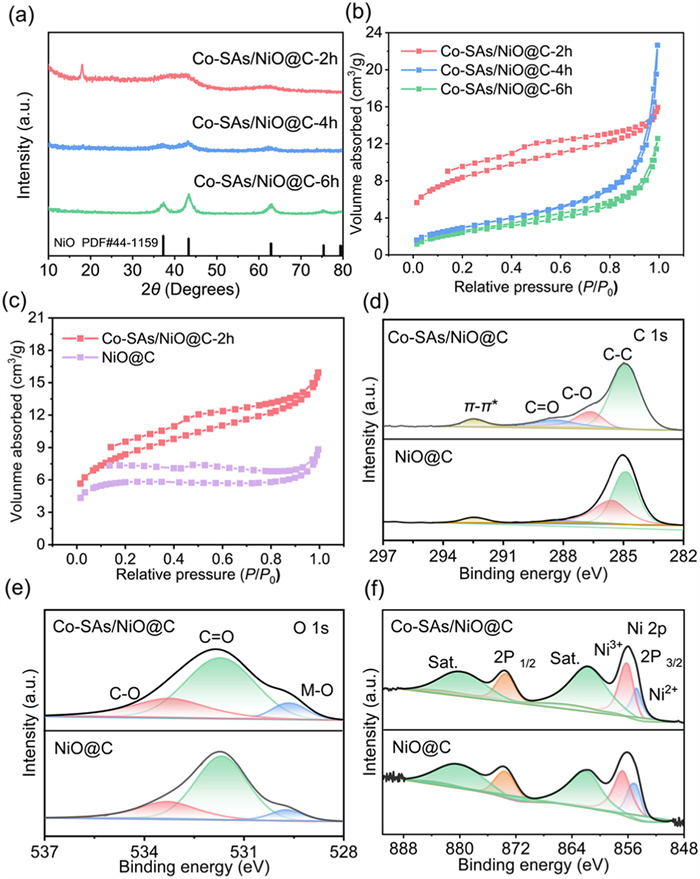
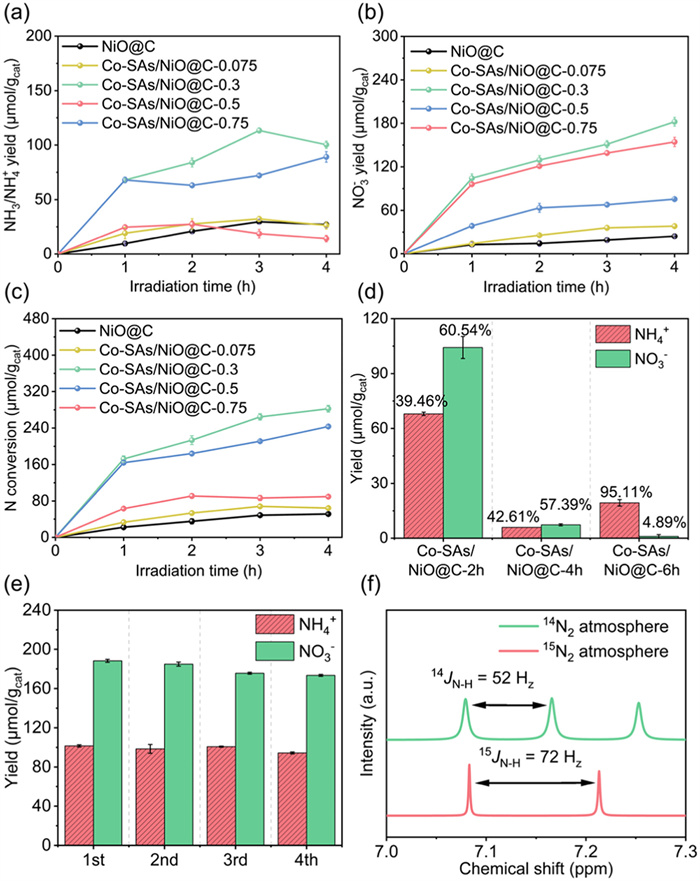
  • Available online Further oxidation of NH3 produced via photocatalytic N2 fixation represents a promising strategy to enhance the economic value of N2 fixation. This work employs first-principles density functional theory (DFT) calculations to demonstrate that incorporating Co into NiO improves both N2 adsorption and activation as well as M-N electron exchange intensity. Guided by these predictions, a novel Co single-atom photocatalyst supported by nanoconfined NiO@C nanosheets was synthesized using a direct metal atomization method, achieving high HNO3 production (60.54%). NH4+ and NO3 production rates during N2 photofixation reached 67.97 µmol gcat−1 h−1 and 104.28 µmol gcat−1 h−1, respectively. The overall N2 → NH3 → HNO3 photofixation pathway was validated through in-situ diffuse reflectance infrared Fourier transform spectroscopy (DRIFTS) and 15N isotopic labeling. Mechanistic studies reveal that Co single-atom introduction serves as an electron trap, enhancing photogenerated electron accumulation with a five-fold increase in carrier density compared to NiO@C, as observed via in-situ X-ray photoelectron spectroscopy (XPS). This synergistic effect between electron traps and N2 adsorption/activation sites at Co single-atom centers supports rapid N2 reduction kinetics. Additionally, nanoconfined ink-bottle pores in the carbon layer impede NH3 desorption, further boosting NO3 production. This work offers a comprehensive approach to optimizing N2 photofixation through electron regulation and surface reaction kinetics.
  • 加载中
    1. [1]

      K.A. Brown, D.F. Harris, M.B. Wilker, et al., Science 352 (2016) 448–450.  doi: 10.1126/science.aaf2091

    2. [2]

      K. Lakshmanamoorthy, S. Manivannan, Carbon Lett. 34 (2024) 141–151.  doi: 10.1007/s42823-023-00627-8

    3. [3]

      F. Li, G. Zhu, J. Jiang, et al., J. Mater. Sci. Technol. 177 (2024) 142–180.

    4. [4]

      N. Song, J. Jiang, S. Hong, et al., Chin. J. Catal. 59 (2024) 38–81.

    5. [5]

      B. Lin, H. Chen, Y. Zhou, et al., Chin. Chem. Lett. 32 (2021) 3128–3132.

    6. [6]

      H. Ou, Y. Jin, B. Chong, et al., Adv. Mater. 36 (2024) 2404851.

    7. [7]

      X. Gong, W. Teng, W. Liu, et al., Adv. Mater. 37 (2025) 2412924.

    8. [8]

      M. Luo, B. Wang, J. Shao, et al., Carbon Lett. 34 (2024) 2291–2303.  doi: 10.1007/s42823-024-00755-9

    9. [9]

      A. Pashkova, B.O. Burek, J.Z. Bloh, Catal. Sci. Technol. 12 (2022) 2755–2760.  doi: 10.1039/d2cy00350c

    10. [10]

      J. Lim, C.A. Fernández, S.W. Lee, M.C. Hatzell, ACS Energy Lett. 6 (2021) 3676–3685.  doi: 10.1021/acsenergylett.1c01614

    11. [11]

      J. Yang, Y. Guo, R. Jiang, et al., J. Am. Chem. Soc. 140 (2018) 8497–8508.  doi: 10.1021/jacs.8b03537

    12. [12]

      X. Chen, N. Li, Z. Kong, W.J. Ong, X. Zhao, Mater. Horiz. 5 (2018) 9–27.

    13. [13]

      C. Chen, R. Chen, L. Long, et al., Chin. Chem. Lett. 35 (2024) 108795.

    14. [14]

      Y. Niu, C. Yue, S. Li, et al., Carbon Lett. 33 (2023) 957–9729.  doi: 10.1007/s42823-023-00486-3

    15. [15]

      C. Zhao, L. Yue, S. Yuan, et al., J. Ind. Eng. Chem. 132 (2024) 135–147.

    16. [16]

      M. Lan, X. Dong, N. Zheng, et al., J. Mater. Sci. Technol. 167 (2023) 237–247.

    17. [17]

      P. Xia, X. Pan, S. Jiang, et al., Adv. Mater. 34 (2022) 2200563.

    18. [18]

      H. Li, M. Xia, B. Chong, et al., ACS Catal. 12 (2022) 10361–10372.  doi: 10.1021/acscatal.2c02282

    19. [19]

      K. Ba, D. Pu, X. Yang, et al., Appl. Catal. B: Environ. 317 (2022) 121755.

    20. [20]

      J. Xiao, X. Pan, S. Guo, P. Ren, X. Bao, J. Am. Chem. Soc. 137 (2015) 477–482.  doi: 10.1021/ja511498s

    21. [21]

      X. Wang, S. Qiu, J. Feng, et al., Adv. Mater. 32 (2020) 2004382.

    22. [22]

      P. Liu, Z. Huang, S. Yang, et al., ACS Catal. 12 (2022) 8139–8146.  doi: 10.1021/acscatal.2c01704

    23. [23]

      J. Luo, H. Han, X. Wang, et al., Appl. Catal. B: Environ. 328 (2023) 122495.

    24. [24]

      W. Ding, Y. Yang, X. Li, et al., Langmuir 41 (2025) 340–349.  doi: 10.1021/acs.langmuir.4c03624

    25. [25]

      Z. Zhang, H. Sui, W. Shi, et al., Angew. Chem. Int. Ed. 64 (2024) e202416711.

    26. [26]

      S. Xu, W. Shi, J. Huang, et al., Angew. Chem. Int. Ed. 63 (2024) e202406223.

    27. [27]

      Q. Zhao, W. Shi, J. Zhang, et al., Nat. Synth. 3 (2024) 497–506.  doi: 10.1038/s44160-024-00486-9

    28. [28]

      T. Kandemir, M.E. Schuster, A. Senyshyn, M. Behrens, R. Schlögl, Angew. Chem. Int. Ed. 52 (2013) 12723–12726.  doi: 10.1002/anie.201305812

    29. [29]

      T. Cai, Q. Chang, C. Xue, et al., J. Colloid Interf. Sci. 630 (2023) 182–190.

    30. [30]

      B. Huang, N. Li, W. Lin, H. Li, J. Hazard. Mater. 360 (2018) 578–586.

    31. [31]

      F. Sastre, A. Corma, H. García, Angew. Chem. Int. Ed. 52 (2013) 12983–12987.  doi: 10.1002/anie.201307851

    32. [32]

      M. Yadav, A. Pophali, N. Verma, T. Kim, J. Ind. Eng. Chem. 105 (2022) 313–323.

    33. [33]

      S. Wang, H. Maimaiti, B. Xu, et al., J. Phys. Chem. C 123 (2019) 31119–31129.  doi: 10.1021/acs.jpcc.9b10189

    34. [34]

      Z. Liu, X. Li, S. Su, et al., Appl. Surf. Sci. 611 (2023) 155627.

    35. [35]

      P. Arod, S.A. Shivashankar, RSC Adv. 6 (2016) 65366–65372.

    36. [36]

      Z. Lin, C. Du, B. Yan, C. Wang, G. Yang, Nat. Commun. 9 (2018) 4036.

    37. [37]

      J.P. Perdew, K. Burke, M. Ernzerhof, Phys. Rev. Lett. 77 (1996) 3865–3868.

    38. [38]

      P. Giannozzi, S. Baroni, N. Bonini, et al., J. Phys. Condens. Matter 21 (2009) 395502.  doi: 10.1088/0953-8984/21/39/395502

    39. [39]

      G. Kresse, D. Joubert, Phys. Rev. B 59 (1999) 1758–1775.

    40. [40]

      L. Zhang, R. Li, L. Guo, et al., ACS Catal. 14 (2024) 5696–5709.  doi: 10.1021/acscatal.3c05633

    41. [41]

      T. Kamachi, T. Tatsumi, T. Toyao, et al., J. Phys. Chem. C 123 (2019) 20988–20997.  doi: 10.1021/acs.jpcc.9b05707

    42. [42]

      M.J. Hoffmann, A.J. Medford, T. Bligaard, J. Phys. Chem. C 120 (2016) 13087–13094.  doi: 10.1021/acs.jpcc.6b03375

    43. [43]

      Q. Wang, X. Kong, H. Han, et al., Phys. Chem. Chem. Phys. 21 (2019) 12597–12605.  doi: 10.1039/c9cp02491c

    44. [44]

      A. Shah, S. Senapati, H.C.A. Murthy, L.R. Singh, M. Mahato, ACS Omega 8 (2023) 33380–33391.  doi: 10.1021/acsomega.3c03044

    45. [45]

      Z. Yang, T. Huang, M. Li, et al., Adv. Mater. 36 (2024) 2313513.

    46. [46]

      J. Shi, Y. Wei, D. Zhou, et al., ACS Catal. 12 (2022) 7760–7772.  doi: 10.1021/acscatal.2c01873

    47. [47]

      X. Chang, M. Fan, C. Gu, et al., Angew. Chem. Int. Ed. 61 (2022) e202202558.

    48. [48]

      Z. Wu, T. Wang, J. Zou, Y. Li, C. Zhang, ACS Catal. 12 (2022) 5911–5920.  doi: 10.1021/acscatal.2c01829

    49. [49]

      J. Hou, C. Cao, F. Idrees, X. Ma, ACS Nano 9 (2015) 2556–2564.  doi: 10.1021/nn506394r

    50. [50]

      M. Kruk, M. Jaroniec, Chem. Mater. 13 (2001) 3169–3183.

    51. [51]

      X. He, J. Liao, Z. Tang, et al., J. Power Sources 396 (2018) 533–541.

    52. [52]

      K. Du, M. Hao, Z. Li, J. Fan, et al., Chin. J. Catal. 40 (2019) 1057–1062.

    53. [53]

      J. Jiang, L. Ou-yang, L. Zhu, et al., Carbon 80 (2014) 213–221.

    54. [54]

      Y. Li, H. Chen, L.Y. Voo, et al., J. Mater. Chem. 22 (2012) 15021–15024.  doi: 10.1039/c2jm32307a

    55. [55]

      J. Jiang, Z. Xiong, H. Wang, et al., J. Mater. Sci. Technol. 118 (2022) 15–24.

    56. [56]

      J. Zheng, D. Meng, J. Guo, et al., Adv. Mater. 36 (2024) 2405129.

    57. [57]

      F. Jafarzadeh, L.A. Castriotta, E. Calabrò, et al., Commun. Mater. 5 (2024) 186.

    58. [58]

      R. Ge, Y. Wang, Z. Li, et al., Angew. Chem. Int. Ed. 134 (2022) e202200211.

    59. [59]

      S. Li, R. Ma, J. Hu, et al., Nat. Commun. 13 (2022) 2916.

    60. [60]

      T. Ma, C. Yang, L. Guo, R.A. Soomro, et al., Appl. Catal. B: Environ. 330 (2023) 122643.

    61. [61]

      Y. Li, J. Fan, J. Peng, et al., Nano Res. 18 (2025) 94907054.  doi: 10.26599/nr.2025.94907054

    62. [62]

      J. Zou, S. Wu, Y. Liu, et al., Carbon 130 (2018) 652–663.

    63. [63]

      D.P.H. Tran, M.T. Pham, Y. Wang, S. You, J. Ind. Eng. Chem. 127 (2023) 343–355.

    64. [64]

      X. Chen, Y. Wu, Y. Tang, et al., Chin. Chem. Lett. 35 (2024) 109245.

    65. [65]

      K. Wang, T. Sun, H. Ma, et al., Chem. Eng. J. 497 (2024) 154711.

    66. [66]

      H. Ren, F. Qi, A. Labidi, et al., Appl. Catal. B: Environ. 330 (2023) 122587.

    67. [67]

      F. Zhang, Y. Li, B. Ding, et al., Small 19 (2023) 2303867.

    68. [68]

      P. Li, Z. Zhou, Q. Wang, et al., J. Am. Chem. Soc. 142 (2020) 12430–12439.  doi: 10.1021/jacs.0c05097

    69. [69]

      S. Wang, X. Hai, X. Ding, et al., Adv. Mater. 29 (2017) 1701774.

    70. [70]

      K. Ding, A.W. Pierpont, W.W. Brennessel, et al., J. Am. Chem. Soc. 131 (2009) 9471–9472.  doi: 10.1021/ja808783u

  • 加载中
    1. [1]

      Qian-Qian TangLi-Fang FengZhi-Peng LiShi-Hao WuLong-Shuai ZhangQing SunMei-Feng WuJian-Ping Zou . Single-atom sites regulation by the second-shell doping for efficient electrochemical CO2 reduction. Chinese Chemical Letters, 2024, 35(9): 109454-. doi: 10.1016/j.cclet.2023.109454

    2. [2]

      Yuxiang Zhang Jia Zhao Sen Lin . Nitrogen doping retrofits the coordination environment of copper single-atom catalysts for deep CO2 reduction. Chinese Journal of Structural Chemistry, 2024, 43(11): 100415-100415. doi: 10.1016/j.cjsc.2024.100415

    3. [3]

      Jingying WangJianhui ZhaoShaopo WangJingjie YuNing Li . Single-atom catalysts for CO2-to-methanol conversion: A critical review. Chinese Chemical Letters, 2026, 37(2): 111859-. doi: 10.1016/j.cclet.2025.111859

    4. [4]

      Lifei HouSiyuan YouRui LiHaoyun LuYanan ShangXing Xu . Synergy between Si-O-C bonding and graphitic N enables exceptional Fenton-like activity rivaling single-atom catalysis. Chinese Chemical Letters, 2026, 37(5): 111903-. doi: 10.1016/j.cclet.2025.111903

    5. [5]

      Wensheng LiZhiqiang SunYidi ChenXiaoguang DuanChuling GuoZhi DangShih-Hsin HoShishu Zhu . Fenton-like catalysis of single-atom Co-N4 for polymeric transformation and recovery of benzohydroxamic acid in mineral processing wastewater. Chinese Chemical Letters, 2026, 37(5): 111791-. doi: 10.1016/j.cclet.2025.111791

    6. [6]

      Xiujuan WangYijie WangLuyun CuiWenqiang GaoXiao LiHong LiuWeijia ZhouJingang Wang . Coordination-based synthesis of Fe single-atom anchored nitrogen-doped carbon nanofibrous membrane for CO2 electroreduction with nearly 100% CO selectivity. Chinese Chemical Letters, 2024, 35(12): 110031-. doi: 10.1016/j.cclet.2024.110031

    7. [7]

      Yangyang SunTianyu HuangHouqiang JiTian TianXingwang ZhuWenlin XuHuan Pang . Efficient charge separation by Ti3C2 MXene modified nano MIL-125(Ti) Schottky photocatalysts for N2 reduction and tetracycline hydrochloride removal. Chinese Chemical Letters, 2026, 37(3): 111391-. doi: 10.1016/j.cclet.2025.111391

    8. [8]

      Muhammad Humayun Mohamed Bououdina Abbas Khan Sajjad Ali Chundong Wang . Designing single atom catalysts for exceptional electrochemical CO2 reduction. Chinese Journal of Structural Chemistry, 2024, 43(1): 100193-100193. doi: 10.1016/j.cjsc.2023.100193

    9. [9]

      Jieyu LiuJunze ZhangHaigang DengShuoao WangXingxing JiangLi WangChanghong Wang . Understanding the activity origin of Pd-anchored single-atom alloy catalysts for NO-to-NH3 conversion by DFT studies and machine learning. Chinese Chemical Letters, 2025, 36(12): 110656-. doi: 10.1016/j.cclet.2024.110656

    10. [10]

      Ge SongHuizhong WuChaohui ZhangXuechun WangShuaishuai LiJiangli SunXiuwu ZhangMinghua Zhou . Chlorinated antibiotics electrocatalytic dechlorination by construction of Co3O4/g-C3N4 heterojunctions for stable atomic hydrogen production. Chinese Chemical Letters, 2026, 37(2): 111373-. doi: 10.1016/j.cclet.2025.111373

    11. [11]

      Xiaoli CaiQihui ZhengYu WuXin ChengChengzhou Zhu . H2O2 self-supplying cascade catalysis based on single-atom Cu nanozyme for augmented cancer therapy. Chinese Chemical Letters, 2026, 37(4): 111670-. doi: 10.1016/j.cclet.2025.111670

    12. [12]

      Yiwen XuChaozheng HeChenxu ZhaoLing Fu . Single-atom Ti doping on S-vacancy two-dimensional CrS2 as a catalyst for ammonia synthesis: A DFT study. Chinese Chemical Letters, 2025, 36(4): 109797-. doi: 10.1016/j.cclet.2024.109797

    13. [13]

      Ya Ren Cong Zhang Haiyan Wang Jin-Xia Liang Chun Zhu Han-Shi Hu Jun Li . Defective Ru1@Mo2COx Single-Atom Catalyst for Efficient Thermal Catalysis for Ammonia Synthesis. Chinese Journal of Structural Chemistry, 2025, 44(8): 100649-100649. doi: 10.1016/j.cjsc.2025.100649

    14. [14]

      Mingze ANBingbing ZHANGZhao YANGHao PUWeijie CHENBin XUESheng WANGXiaoyan DINGLulu SHI . Construction of an S-scheme g-C3N4/TiO2 heterostructure for tetracycline degradation and hydrogen production. Chinese Journal of Inorganic Chemistry, 2026, 42(4): 843-860. doi: 10.11862/CJIC.20250301

    15. [15]

      Xinyuan LiZhuozhu LiWenzhong HuangJiantao LiWei ZhangShihao FengHao FanZhuo ChenSungsik LeeCongcong CaiLiang Zhou . Solvent-free synthesis of Co single atom and nanocluster decorated N-doped carbon for efficient oxygen reduction. Chinese Chemical Letters, 2025, 36(9): 110716-. doi: 10.1016/j.cclet.2024.110716

    16. [16]

      Hao ChenHaiyuan LiaoQi ZhouYang LiuGuojun LiuYuan Yao . Electronegativity-oriented coordination regulation of main-group metal single-atom catalysts for oxygen reduction to H2O2: A combined study of first-principles and machine learning. Chinese Chemical Letters, 2026, 37(3): 110711-. doi: 10.1016/j.cclet.2024.110711

    17. [17]

      Xingyan LiuChaogang JiaGuangmei JiangChenghua ZhangMingzuo ChenXiaofei ZhaoXiaocheng ZhangMin FuSiqi LiJie WuYiming JiaYouzhou He . Single-atom Pd anchored in the porphyrin-center of ultrathin 2D-MOFs as the active center to enhance photocatalytic hydrogen-evolution and NO-removal. Chinese Chemical Letters, 2024, 35(9): 109455-. doi: 10.1016/j.cclet.2023.109455

    18. [18]

      Lin XuLifen LiuGuohua ChenDeming XiaIn-situ grown high-load single-atom Fe on MoS2/CFC with super high activity in ammonia synthesis via electrochemical nitrate reduction. Chinese Chemical Letters, 2026, 37(3): 111188-. doi: 10.1016/j.cclet.2025.111188

    19. [19]

      Zhimin YuanXingling ZhaoXianglin ZhuKaili WangYa-Qian LanZaiyong Jiang . Solar-driven hydrogen peroxide production on designed g-C3N4: Strategies, mechanisms, and perspectives. Chinese Chemical Letters, 2026, 37(6): 112572-. doi: 10.1016/j.cclet.2026.112572

    20. [20]

      Jinshu HuangZhuochun HuangTengyu LiuYu WenJili YuanSong YangHu Li . Modulating single-atom Co and oxygen vacancy coupled motif for selective photodegradation of glyphosate wastewater to circumvent toxicant residue. Chinese Chemical Letters, 2025, 36(5): 110179-. doi: 10.1016/j.cclet.2024.110179

Metrics
  • PDF Downloads(0)
  • Abstract views(1095)
  • HTML views(47)

通讯作者: 陈斌, bchen63@163.com
  • 1. 

    沈阳化工大学材料科学与工程学院 沈阳 110142

  1. 本站搜索
  2. 百度学术搜索
  3. 万方数据库搜索
  4. CNKI搜索
Address:Zhongguancun North First Street 2,100190 Beijing, PR China Tel: +86-010-82449177-888
Powered By info@rhhz.net

/

DownLoad:  Full-Size Img  PowerPoint
Return