Citation: Xiao Yang, Wenjing Liu, Jiarui Kong, Xiangcheng Shan, Qiupei Lei, Zhipeng Yin, Runzeng Liu, Min Zhang, Qingzhe Zhang, Yongguang Yin, Chuanyong Jing, Yong Cai. Synthesis of amine-functionalized polystyrene resin-based globular adsorbents for efficient and selective removal of As and Sb species[J]. Chinese Chemical Letters, ;2025, 36(11): 110856. doi: 10.1016/j.cclet.2025.110856 shu

Synthesis of amine-functionalized polystyrene resin-based globular adsorbents for efficient and selective removal of As and Sb species

    * Corresponding authors.
    E-mail addresses: shanxc@mail.sdu.edu.cn (X. Shan), zpyin@sdu.edu.cn (Z. Yin), qzz@sdu.edu.cn (Q. Zhang).
    1 These authors contributed equally to this work.
  • Received Date: 7 August 2024
    Revised Date: 27 December 2024
    Accepted Date: 14 January 2025
    Available Online: 15 January 2025

Figures(8)

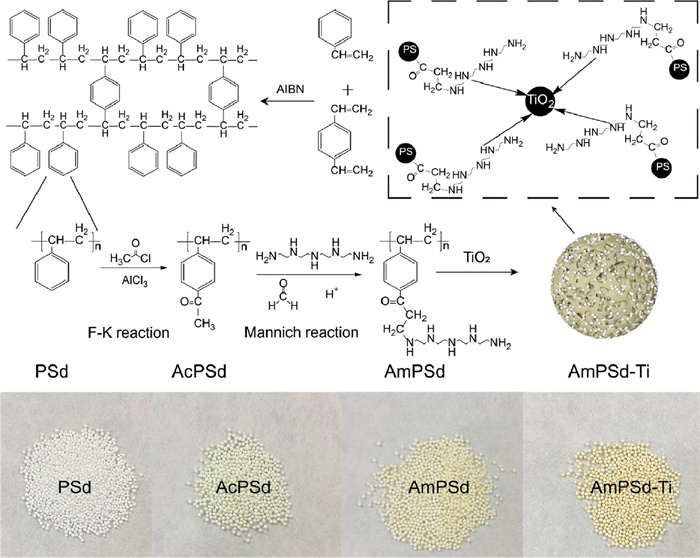
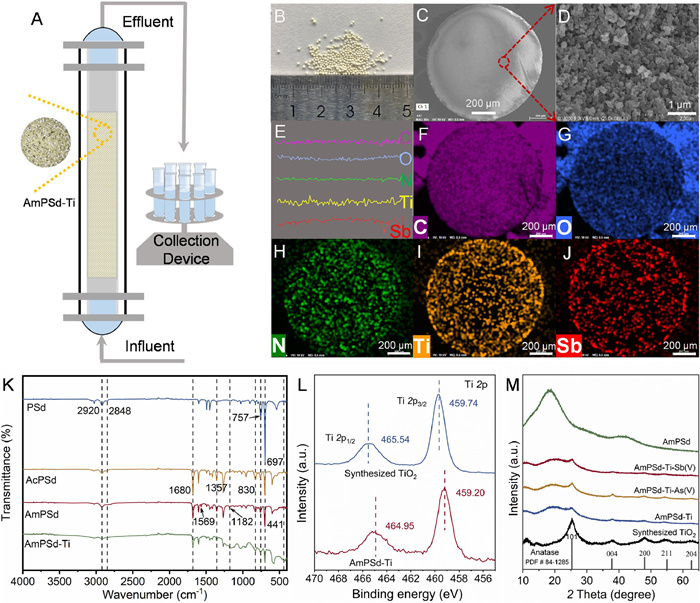
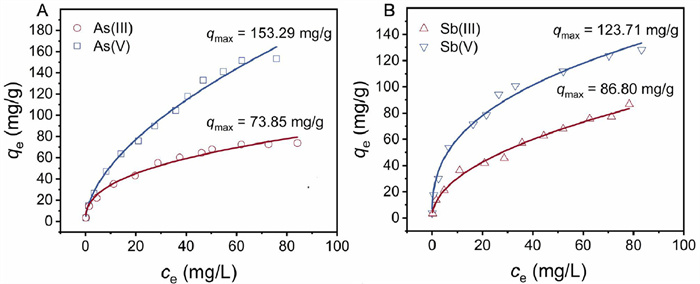
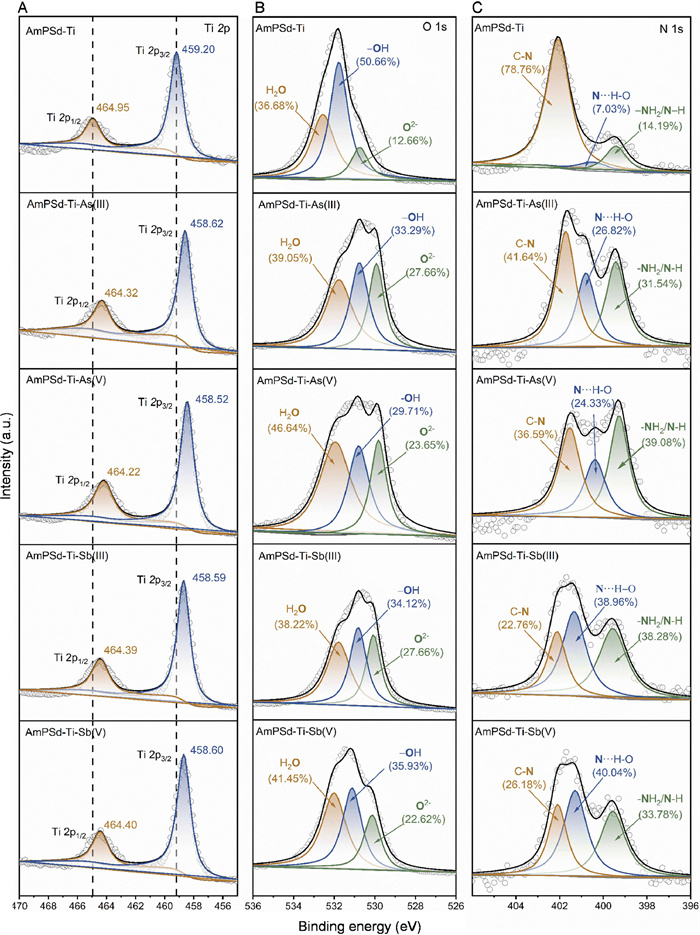
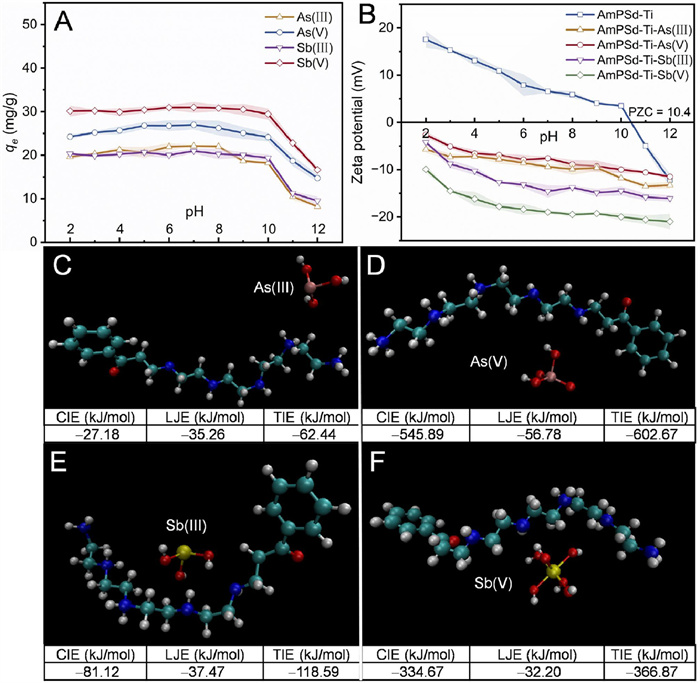
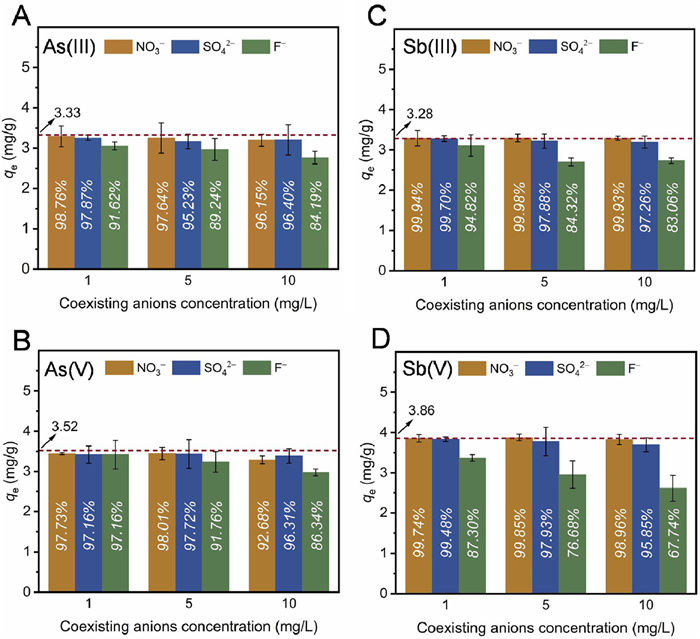
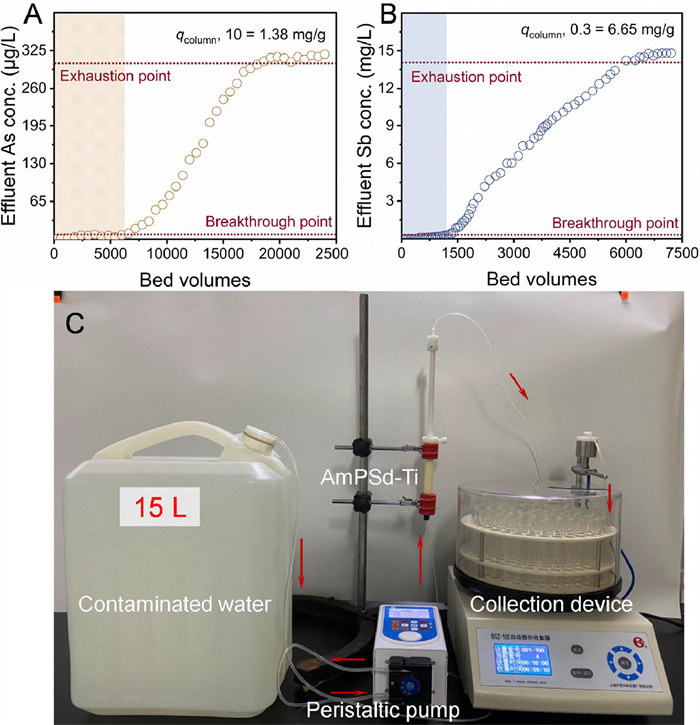
  • The removal of highly toxic arsenic (As) and antimony (Sb) contaminants in water by adsorption presents a great challenge worldwide. Conventional adsorbents exhibit insufficient efficacy for removing pentavalent oxyanions, As(Ⅴ) and Sb(Ⅴ), which are predominant compared with the trivalent species, As(Ⅲ) and Sb(Ⅲ), in surface waters. Here, we synthesized a novel composite adsorbent, amine-functionalized polystyrene resin loaded with nano TiO2 (AmPSd-Ti). The mm-scale spheres showed outstanding adsorption capacities for As(Ⅲ), As(Ⅴ), Sb(Ⅲ), and Sb(Ⅴ) at 73.85, 153.29, 86.80, and 123.71 mg/g, respectively. AmPSd-Ti exhibited selective adsorption for As and Sb in the presence of Cl, NO3, SO42−, and F. As and Sb were adsorbed by the nano-sized TiO2 confined in the porous resin via forming inner-sphere complexes. The protonated amine groups enhanced the adsorption of As(Ⅴ) and Sb(Ⅴ) by electrostatic attraction and hydrogen bonding, which was confirmed by experimental results and molecular dynamics simulations. Fixed-bed column tests showed breakthrough curves with adsorption capacities of 1.38 mg/g (6600 BV) and 6.65 mg/g (1260 BV) upon treating real As-contaminated groundwater and Sb-contaminated industrial wastewater. Our study highlights a feasible strategy by incorporating inorganic metal oxides into organic polymers to achieve highly efficient removal of As and Sb in real-world scenarios.
  • 加载中
    1. [1]

      J. Podgorski, M. Berg, Science 368 (2020) 845-850.  doi: 10.1126/science.aba1510

    2. [2]

      L. Yan, T. Chan, C. Jing, Environ. Sci. Technol. 56 (2022) 3138-3146.  doi: 10.1021/acs.est.1c07801

    3. [3]

      X. Cai, L.K. ThomasArrigo, X. Fang, et al., Environ. Sci. Technol. 55 (2021) 1319-1328.  doi: 10.1021/acs.est.0c05329

    4. [4]

      Y. Meng, J.N. Wang, C. Cheng, et al., Chin. Chem. Lett. 23 (2012) 863-866.

    5. [5]

      Q. Zhang, X. Tan, T. Yu, Chin. Chem. Lett. 34 (2023) 107748.

    6. [6]

      T. Davydiuk, J. Tao, X. Lu, et al., Environ. Health 1 (2023) 236-248.  doi: 10.1021/envhealth.3c00090

    7. [7]

      Y. Zhang, C. Ding, D. Gong, et al., Environ. Technol. Innov. 24 (2021) 102026.

    8. [8]

      Y. Li, M. Zhang, R. Xu, et al., Environ. Int. 153 (2021) 106522.

    9. [9]

      M.A. Dovick, R.S. Arkle, T.R. Kulp, et al., Environ. Sci. Technol. 54 (2020) 7983-7991.  doi: 10.1021/acs.est.0c00558

    10. [10]

      K. Wan, T. Fang, W. Zhang, et al., Chem. Eng. J. 465 (2023) 143018.

    11. [11]

      M. Yan, Y. Xi, N. Jiang, et al., J. Membr. Sci. 703 (2024) 122847.

    12. [12]

      X. Li, J. Fan, F. Zhu, et al., J. Hazard. Mater. 471 (2024) 134302.

    13. [13]

      M. Mitrakas, Z. Mantha, N. Tzollas, et al., Water 10 (2018) 1328-1339.  doi: 10.3390/w10101328

    14. [14]

      Y. Liu, C. Li, Z. Lou, et al., Sep. Purif. Technol. 275 (2021) 119037.

    15. [15]

      X. Zhu, W. Jiang, W. Cui, et al., Chin. Chem. Lett. 30 (2019) 1133-1136.

    16. [16]

      A.P. Panda, P. Rout, K.K. Jena, et al., J. Mater. Chem. A 7 (2019) 9933-9947.  doi: 10.1039/c9ta00428a

    17. [17]

      S. Fajal, W. Mandal, S. Mollick, et al., Angew. Chem. Int. Ed. 61 (2022) e202203385.

    18. [18]

      S. Hu, Q. Shi, C. Jing, Environ. Sci. Technol. 49 (2015) 9707-9713.  doi: 10.1021/acs.est.5b01520

    19. [19]

      L. Yan, J. Song, T. Chan, et al., Environ. Sci. Technol. 51 (2017) 6335-6341.  doi: 10.1021/acs.est.7b00807

    20. [20]

      T.T. Lim, P.S. Yap, M. Srinivasan, et al., Crit. Rev. Environ. Sci. Technol. 41 (2011) 1173-1230.  doi: 10.1080/10643380903488664

    21. [21]

      M.E. Pena, G.P. Korfiatis, M. Patel, et al., Water Res. 39 (2005) 2327-2337.

    22. [22]

      T. Zhao, Z. Tang, X. Zhao, et al., Environ. Sci. 6 (2019) 834-850.  doi: 10.1039/c8en00869h

    23. [23]

      S.M. Miller, J.B. Zimmerman, Water Res. 44 (2010) 5722-5729.

    24. [24]

      Y.X. Ma, D. Xing, C.P. Lu, et al., Polym. Compos. 39 (2018) 2232-2240.  doi: 10.1002/pc.24187

    25. [25]

      M. Wang, M. Fu, J. Li, et al., Chin. Chem. Lett. 35 (2024) 108442.

    26. [26]

      O.S. Chowdhury, P.J. Schmidt, W.B. Anderson, et al., Environ. Health 2 (2024) 441-452.  doi: 10.1021/envhealth.3c00174

    27. [27]

      S. Wang, N.S. Al-Hasni, Z. Liu, et al., Environ. Health 2 (2024) 688-701.

    28. [28]

      L. Zhang, S. Lou, X. Hao, et al., Sep. Purif. Technol. 303 (2022) 122253.

    29. [29]

      S. Liu, A. Motta, M. Delferro, et al., J. Am. Chem. Soc. 135 (2013) 8830-8833.  doi: 10.1021/ja4039505

    30. [30]

      K.A. Gebru, C. Das, Chemosphere 191 (2018) 673-684.

    31. [31]

      E. Bayer, X.N. Liu, U. Tallarek, et al., Polym. Bull. 37 (1996) 565-572.

    32. [32]

      Q. Teng, S. Ma, M. Ni, et al., Water. Sci. Technol. 82 (2020) 440-453.

    33. [33]

      A.K. Rappe, C.J. Casewit, K.S. Colwell, et al., J. Am. Chem. Soc. 114 (1992) 10024-10035.  doi: 10.1021/ja00051a040

    34. [34]

      T. Lu, F. Chen, J. Comput. Chem. 33 (2012) 580-592.  doi: 10.1002/jcc.22885

    35. [35]

      M.J. Abraham, T. Murtola, R. Schulz, et al., SoftwareX 1-2 (2015) 19-25.

    36. [36]

      B. Hess, H. Bekker, H.J.C. Berendsen, et al., J. Comput. Chem. 18 (1997) 1463-1472.

    37. [37]

      W. Humphrey, A. Dalke, K. Schulten, J. Mol. Graph. 14 (1996) 33-38.

    38. [38]

      Q. Shi, Y. Mi, S. Wang, et al., Fuel 358 (2024) 130250.

    39. [39]

      A. Kawasaki, J. Furukawa, T. Tsuruta, et al., Polymer 1 (1960) 315-329.

    40. [40]

      H. Ning, Y. Fan, H. Liu, et al., J. Chromatogr. A 1671 (2022) 462994.

    41. [41]

      X.N. Liu, E. Bayer, G. Xue, Spectrosc. Lett. 30 (1997) 289-295.  doi: 10.1080/00387019708006988

    42. [42]

      P. Liu, Y.B. Hu, X.Y. Li, et al., Angew. Chem,. Int. Ed. 61 (2022) e202208587.

    43. [43]

      Y. Zhao, X. Shan, Q. An, et al., Chem. Eng. J. 398 (2020) 125561.

    44. [44]

      A. Modwi, N.M. Basith, M.G. Ghoniem, et al., Mater. Sci. Eng. B 289 (2023) 116191.

    45. [45]

      L. Ma, L.-J. Yu, J. Liu, et al., Energy Storage Mater. 44 (2022) 180-189.  doi: 10.3390/separations9070180

    46. [46]

      V. Etacheri, M.K. Seery, S.J. Hinder, et al., Chem. Mater. 22 (2010) 3843-3853.  doi: 10.1021/cm903260f

    47. [47]

      X. Zeng, L. Huang, C. Wang, et al., ACS Appl. Mater. Interfaces 8 (2016) 20274-20282.  doi: 10.1021/acsami.6b05746

    48. [48]

      N.T. Nolan, D.W. Synnott, M.K. Seery, et al., J. Hazard. Mater. 211-212 (2012) 88-94.

    49. [49]

      Y. Liu, M. Ren, X. Zhang, et al., Appl. Surf. Sci. 614 (2023) 156118.

    50. [50]

      S. Wang, Z. Xiao, S. Zhai, et al., J. Mater. Chem. A 7 (2019) 17345-17356.  doi: 10.1039/c9ta05145g

    51. [51]

      Y. Wang, J. Liang, S. Liu, et al., Langmuir 40 (2024) 9265-9279.  doi: 10.1021/acs.langmuir.4c00702

    52. [52]

      Y. Cao, Q. Guo, M. Liang, et al., Appl. Surf. Sci. 196 (2020) 105766.

    53. [53]

      B. Liu, Z. Liu, H. Wu, et al., Sci. Total Environ. 742 (2020) 140508.

    54. [54]

      X. Shan, L. Yang, Y. Zhao, et al., J. Colloid Interface Sci. 606 (2022) 736-747.

    55. [55]

      M.J. Ahmed, S.K. Theydan, J. Anal. Appl. Pyrolysis 99 (2013) 101-109.

    56. [56]

      S.G. Johnston, W.W. Bennett, N. Doriean, et al., Sci. Total Environ. 710 (2020) 136354.

    57. [57]

      G. Okkenhaug, Y.G. Zhu, J. He, et al., Environ. Sci. Technol. 46 (2012) 3155-3162.  doi: 10.1021/es2022472

    58. [58]

      M. He, N. Wang, X. Long, et al., J. Environ. Sci. 75 (2019) 14-39.

    59. [59]

      L. Yan, S. Hu, C. Jing, J. Environ. Sci. 49 (2016) 74-85.

    60. [60]

      M. Filella, N. Belzile, Y.-W. Chen, Earth-Sci. Rev. 57 (2002) 125-176.

    61. [61]

      M.A. Dovick, T.R. Kulp, R.S. Arkle, et al., Environ. Chem. 13 (2016) 149-159.

    62. [62]

      H. Wang, C. Qiao, C. Chen, et al., Chin. Chem. Lett. 36 (2025) 110244.  doi: 10.1016/j.cclet.2024.110244

    63. [63]

      G.M. Walker, L. Hansen, J.A. Hanna, et al., Water Res. 37 (2003) 2081-2089.

    64. [64]

      Z. Wang, X. Bi, X. He, et al., Water Res. 228 (2023) 119290.

    65. [65]

      D. Mitoraj, H. Kisch, Angew. Chem. Int. Ed. 47 (2008) 9975-9978.  doi: 10.1002/anie.200800304

    66. [66]

      H. Guo, Q. Fei, M. Lian, et al., Adv. Mater. 35 (2023) e2301418.

    67. [67]

      L. Ma, S.X. Tu, Environ. Chem. Lett. 9 (2011) 465-472.  doi: 10.1007/s10311-010-0303-1

    68. [68]

      X. Song, L. Nong, Q. Zhang, et al., J. Environ. Chem. Eng. 11 (2023) 110874.

    69. [69]

      K. Liu, Z. Huang, J. Dai, et al., Chem. Eng. J. 382 (2020) 122775.

    70. [70]

      L. Xiaojing, T. Wang, M. He, Environ. Tech. 44 (2022) 1-33.  doi: 10.21656/1000-0887.420388

    71. [71]

      L. Zhang, R. Li, L. Zhou, et al., Environ. Technol. Innov. 24 (2021) 102001.

    72. [72]

      X. Long, T. Wang, M. He, Environ. Technol. 44 (2023) 2913-2923.  doi: 10.1080/09593330.2022.2048084

    73. [73]

      J. Zheng, L. Li, S. Chen, et al., Langmuir 20 (2004) 8931-8938.

    74. [74]

      National Primary Drinking Water StandardsCriteria and Standards Division, U.S. Environmental Protection Agency, Washington DC, 2009.

    75. [75]

      Standardization Administration of ChinaEmission Standards of Pollutants for Stannum, Antimony, and Mercury Industries, Science Press of the Chinese Academy of Sciences, GB 30770-2014, Beijing, 2014.

    76. [76]

      J. Chen, L. Hu, Q. Chen, et al., Surf. Interfaces 46 (2024) 104184.

    77. [77]

      A. Farsad, M. Marcos-Hernandez, S. Sinha, et al., Environ. Sci. Technol. 57 (2023) 20410–20420.  doi: 10.1021/acs.est.3c06586

    78. [78]

      R. Duan, L. Tian, Y. Liu, et al., Sep. Purif. Technol. 343 (2024) 127187.

  • 加载中
    1. [1]

      Haijing CuiWeihao ZhuChuning YueMing YangWenzhi RenAiguo Wu . Recent progress of ultrasound-responsive titanium dioxide sonosensitizers in cancer treatment. Chinese Chemical Letters, 2024, 35(10): 109727-. doi: 10.1016/j.cclet.2024.109727

    2. [2]

      Zhu WangShuangqiu HuangDanni GuoWenhao LaoYiping FengTong LiZhao-Qing LiuChun Hu . Reductive sequestration of Cr(Ⅵ) from water by an all-in-one polypyrrole/NiFe-layered double hydroxide filter. Chinese Chemical Letters, 2025, 36(12): 111090-. doi: 10.1016/j.cclet.2025.111090

    3. [3]

      Hongping ZhaoHanzhaobing WuBaolong ShiJiayue WangChunzheng WuChaohai WangXiaoyan WangWei LiuChaoqing DaiDalei Wang . Fast and controllable anatase-to-rutile phase transition irradiated by NIR light. Chinese Chemical Letters, 2025, 36(11): 110815-. doi: 10.1016/j.cclet.2025.110815

    4. [4]

      Tiancheng Yang Yang Yang Chunhua Qu Rui Chu Yue Xia . Wandering through the Kingdom of Chinese Mineral Medicines. University Chemistry, 2024, 39(9): 94-101. doi: 10.12461/PKU.DXHX202403015

    5. [5]

      Bingke ZhangDongbo WangJiamu CaoWen HeGang LiuDonghao LiuChenchen ZhaoJingwen PanSihang LiuWeifeng ZhangXuan FangLiancheng ZhaoJinzhong Wang . Tuning Stark effect by defect engineering on black titanium dioxide mesoporous spheres for enhanced hydrogen evolution. Chinese Chemical Letters, 2024, 35(11): 110254-. doi: 10.1016/j.cclet.2024.110254

    6. [6]

      Jinhui XuYanting ZhangKecheng WenXinyu WangZhiwei YangYuan HuangGuozhong ZhengLupeng HuangJing Zhang . Enhanced removal of polystyrene nanoplastics by air flotation modified by dodecyltrimethylammonium chloride: Performance and mechanism. Chinese Chemical Letters, 2025, 36(5): 110240-. doi: 10.1016/j.cclet.2024.110240

    7. [7]

      Yuan DongMutian MaZhenyang JiaoSheng HanLikun XiongZhao DengYang Peng . Effect of electrolyte cation-mediated mechanism on electrocatalytic carbon dioxide reduction. Chinese Chemical Letters, 2024, 35(7): 109049-. doi: 10.1016/j.cclet.2023.109049

    8. [8]

      Chao LiuChao JiaShi-Xian GanQiao-Yan QiGuo-Fang JiangXin Zhao . A luminescent one-dimensional covalent organic framework for organic arsenic sensing in water. Chinese Chemical Letters, 2024, 35(11): 109750-. doi: 10.1016/j.cclet.2024.109750

    9. [9]

      Xiaoxia WANGYa'nan GUOFeng SUChun HANLong SUN . Synthesis, structure, and electrocatalytic oxygen reduction reaction properties of metal antimony-based chalcogenide clusters. Chinese Journal of Inorganic Chemistry, 2024, 40(6): 1201-1208. doi: 10.11862/CJIC.20230478

    10. [10]

      Qin WangHan LuoLuli WangLing HuangLiling CaoXuehua DongGuohong Zou . KSb2F7·2KNO3: Unveiling the peak birefringence in inorganic antimony oxysalts. Chinese Chemical Letters, 2025, 36(7): 110173-. doi: 10.1016/j.cclet.2024.110173

    11. [11]

      Hua Tong Haibo Li Wei Liu Gangfeng Ouyang . Lead-free organic antimony halide with dual-band intrinsic white light emission for warm WLED directly. Chinese Journal of Structural Chemistry, 2025, 44(10): 100678-100678. doi: 10.1016/j.cjsc.2025.100678

    12. [12]

      Hong-Zhao Zan Hai-Xin Zhao Xi-Gui Gao Xiao-Zhong Wang Yun-Zhi Zhu Guo-Kun Li Xu-Yang Yao Chen Li Xiang-Wen Kong Xiao-Wu Lei . Thermochromic luminescence in low-dimensional antimony halide for detection of trace amount of water and anti-counterfeiting. Chinese Journal of Structural Chemistry, 2025, 44(12): 100734-100734. doi: 10.1016/j.cjsc.2025.100734

    13. [13]

      Wenjie Zhang Jiong Zhou . Enhanced oxygen reduction through axial chlorine engineering of p-block antimony atomic sites. Chinese Journal of Structural Chemistry, 2026, 45(1): 100732-100732. doi: 10.1016/j.cjsc.2025.100732

    14. [14]

      Pu ZhangXiang MaoXuehua DongLing HuangLiling CaoDaojiang GaoGuohong Zou . Two UV organic-inorganic hybrid antimony-based materials with superior optical performance derived from cation-anion synergetic interactions. Chinese Chemical Letters, 2024, 35(9): 109235-. doi: 10.1016/j.cclet.2023.109235

    15. [15]

      Lu ChengJinghua QuanHongyan Li . Recent advances in antimony-based anode materials for potassium-ion batteries: Material selection, structural design and storage mechanisms. Chinese Chemical Letters, 2025, 36(9): 110685-. doi: 10.1016/j.cclet.2024.110685

    16. [16]

      Daheng WenWeiwei FangYongmei LiuTao Tu . Valorization of carbon dioxide with alcohols. Chinese Chemical Letters, 2024, 35(7): 109394-. doi: 10.1016/j.cclet.2023.109394

    17. [17]

      Feng CuiFangman ChenXiaochun XieChenyang GuoKai XiaoZiping WuYinglu ChenJunna LuFeixia RuanChuanxu ChengChao YangDan Shao . Scalable production of mesoporous titanium nanoparticles through sequential flash nanocomplexation. Chinese Chemical Letters, 2024, 35(4): 108681-. doi: 10.1016/j.cclet.2023.108681

    18. [18]

      Rui HuYidan QiXingyu WangYunhui YangCongyang Wang . Titanium-promoted conversion of N2 into N-methylimides. Chinese Chemical Letters, 2026, 37(1): 111197-. doi: 10.1016/j.cclet.2025.111197

    19. [19]

      Chengyao ZhaoJingyuan LiaoYuxiang ZhuYiying ZhangLianjie ZhaiJunrong HuangHengzhi You . Polystyrene-supported phosphoric-acid catalyzed atroposelective construction of axially chiral N-aryl benzimidazoles. Chinese Chemical Letters, 2025, 36(6): 110337-. doi: 10.1016/j.cclet.2024.110337

    20. [20]

      Tian FengShu-Yi GuLu-Fei ShiYao-Hua GuBi-Feng Yuan . Mass spectrometry analysis reveals changes in patterns and correlations of nucleic acid epigenetic modifications in mouse tissues exposed to polystyrene microplastics. Chinese Chemical Letters, 2026, 37(3): 111546-. doi: 10.1016/j.cclet.2025.111546

Metrics
  • PDF Downloads(0)
  • Abstract views(801)
  • HTML views(27)

通讯作者: 陈斌, bchen63@163.com
  • 1. 

    沈阳化工大学材料科学与工程学院 沈阳 110142

  1. 本站搜索
  2. 百度学术搜索
  3. 万方数据库搜索
  4. CNKI搜索
Address:Zhongguancun North First Street 2,100190 Beijing, PR China Tel: +86-010-82449177-888
Powered By info@rhhz.net

/

DownLoad:  Full-Size Img  PowerPoint
Return