Citation: Futao Yi, Ying Liu, Yao Chen, Jiahao Zhu, Quanguo He, Chun Yang, Dongge Ma, Jun Liu. Dual S-Scheme g-C3N4/Ag3PO4/g-C3N5 photocatalysts for removal of tetracycline pollutants through enhanced molecular oxygen activation[J]. Chinese Chemical Letters, ;2025, 36(8): 110544. doi: 10.1016/j.cclet.2024.110544 shu

Dual S-Scheme g-C3N4/Ag3PO4/g-C3N5 photocatalysts for removal of tetracycline pollutants through enhanced molecular oxygen activation

    * Corresponding authors.
    E-mail addresses: yangchunyc@hut.edu.cn (C. Yang), madongge@btbu.edu.cn (D. Ma), junliu@hut.edu.cn (J. Liu).
    1 These authors contributed equally to this work.
  • Received Date: 8 June 2024
    Revised Date: 6 September 2024
    Accepted Date: 10 October 2024
    Available Online: 11 October 2024

Figures(7)

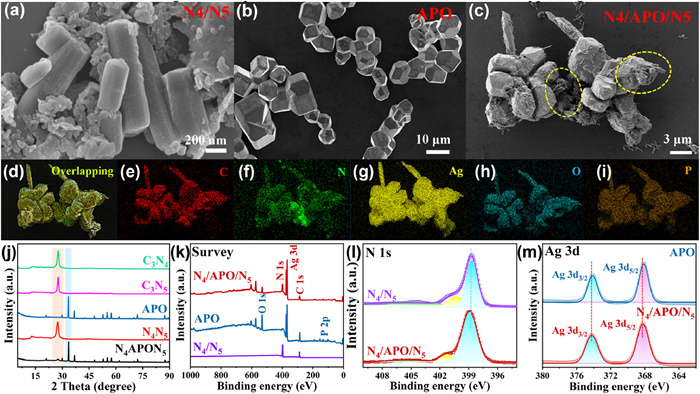
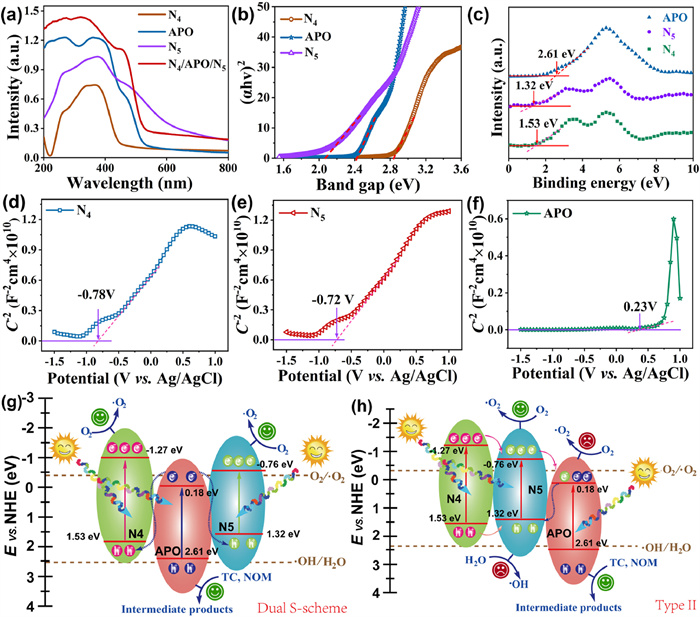
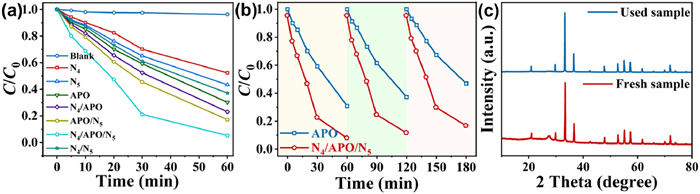
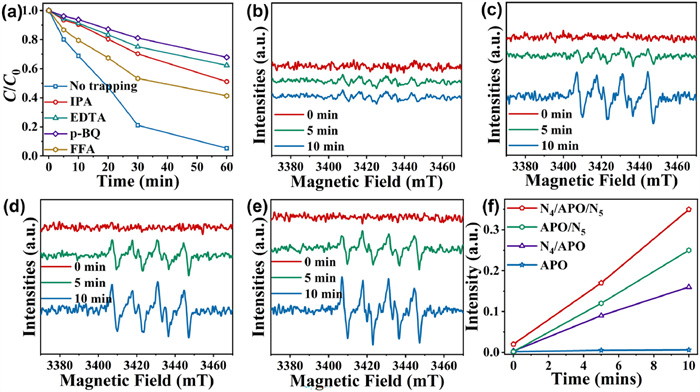
  • A dual S-scheme g-C3N4/Ag3PO4/g-C3N5 heterojunction was prepared by decomposition methods, and it displayed enhanced performance to degrade tetracycline hydrochloride with the ideal stability under different water substrates and ions. Comparing with three single components, as g-C3N4, g-C3N5, and Ag3PO4, the dual S-scheme g-C3N4/Ag3PO4/g-C3N5 heterojunction displayed 4.4-, 3.4-, and 2.5-times enhancements in the tetracycline hydrochloride removal. Based on the dynamics analyses for charge carriers and band structure calculations, two channels of molecular oxygen activation (MOA) between Ag3PO4 and g-C3N4 (and g-C3N5) were confirmed. More importantly, according to this double consumption process of excited electrons, dual S-scheme g-C3N4/Ag3PO4/g-C3N5 could suppress the charge recombination, which was the key point to boosting photocatalytic activity. Moreover, the determination of intermediates also supported the vital role of MOA during these photocatalytic reactions. this report of two reactive sites in MOA that generate reactive oxygen species in a "V" type band structure. The electronic dynamic in the reaction was also testified by several detections, indicating the enhanced charge separation and migration from internal field effect and electron trapping from dual S-scheme mechanism. This work provides a new research direction for the design and mechanism analysis of dual S-scheme photocatalysts
  • 加载中
    1. [1]

      J.J. Sun, L.B. Yang, S.Z. Xiao, et al., Water Res. 217 (2022) 118411.

    2. [2]

      L. Yao, Z.Y. Chen, W.Y. Dou, et al., Water Res. 207 (2021)117803.

    3. [3]

      P. Kumari, N. Bahadur, X.A. Conlan, et al., Water Res. 218 (2022) 118519.

    4. [4]

      M. Geng, H. Gao, B. Wang, et al., Sci. Total Environ. 838 (2022) 156146.

    5. [5]

      L. Xing, A. Li, J. Sun, et al., Sci. Total Environ. 837 (2022) 155824.

    6. [6]

      Z. Wang, Y. Li, J. Wang, et al., Sci. Total Environ. 949 (2022) 175126.

    7. [7]

      J. Yang, J.Q. Long, H.Z. Huang, et al., Colloid. Surface. A 660 (2023) 130846.

    8. [8]

      W.X. Li, Z.Z. Wang, Y. Li, et al., J. Hazard. Mater. 424 (2022) 127595.

    9. [9]

      L. Wei, X.Q. Zhang, J. Wang, et al., Inorg. Chem. Commun. 159 (2024) 111890.

    10. [10]

      X.T. Wang, Z.Z. Wang, Y. Li, et al., Appl. Catal. B: Environ. 319 (2022) 121895.

    11. [11]

      Y. Lin, H.Y. Liu, C. Yang, et al., Appl. Catal. B: Environ. 264 (2020) 118479.

    12. [12]

      X.D. Yang, Y.J. Qin, L. Wei, et al., Inorg. Chem. Commun. 155 (2023) 110996.

    13. [13]

      C. Chen, H. Zeng, M. Yi, et al., Appl. Catal. B: Environ. 252 (2019) 47-54.

    14. [14]

      W. Shi, C. Liu, M. Li, et al., J. Haz. Mater. 389 (2020) 121907.

    15. [15]

      Z. Yang, X. Xia, L. Shao, et al., Chem. Eng. J. 410 (2021) 128454.

    16. [16]

      J. Yang, J. Wang, H.Z. Huang, et al., New J. Chem. 47 (2023) 5759-5772.  doi: 10.1039/d2nj05733f

    17. [17]

      M. Ding, J. Zhou, H. Yang, et al., Chin. Chem. Lett. 31 (2020) 71-76.

    18. [18]

      H. Yin, Y. Cao, T. Fan, et al., Sci. Total Environ. 754 (2021) 141926.

    19. [19]

      C. Yang, X. Liu, J. Liu, et al., Ecotox. Environ. Safe. 242 (2022) 113951.

    20. [20]

      Q. Xu, L. Zhang, B. Cheng, et al., Chem 6 (2020) 1543-1559.

    21. [21]

      J. Fu, Q.L. Xu, J. Low, et al., Appl. Catal. B: Environ. 243 (2019) 556-565.

    22. [22]

      Y. Kim, W. Jo, J. Hazard. Mater. 361 (2019) 64-72.

    23. [23]

      Z. Zhuang, Y. Li, Z. Li, et al., Angew. Chem. Int. Ed. 57 (2018) 496-500.  doi: 10.1002/anie.201708748

    24. [24]

      P. Kumar, E. Vahidzadeh, W. Thakur, et al., J. Am. Chem. Soc. 141 (2019) 5415-5436.  doi: 10.1021/jacs.9b00144

    25. [25]

      A. Kumar, A. Khosla, S. Kumar Sharma, et al., Fuel 333 (2023) 126267.

    26. [26]

      F.T. Yi, J. Liu, G.P. Liang, et al., J. Alloy Comp. 905 (2022) 164064.

    27. [27]

      T. Cai, L. Wang, Y. Liu, et al., Appl. Catal. B: Environ. 239 (2018) 545-554.

    28. [28]

      B. Kim, S. Choi, X. Zhu, et al., J. Am. Chem. Soc. 133 (2011) 19864-19877.  doi: 10.1021/ja207751w

    29. [29]

      S. Li, S. Shi, G. Huang, et al., Appl. Surf. Sci. 455 (2018) 1137-1149.

    30. [30]

      F.W. Huang, Y.X. Wang, X.Y. Dong, et al., Sci. Chin. Chem. 66 (2023) 3290-3296.  doi: 10.1007/s11426-023-1644-x

    31. [31]

      Y. Lin, C. Yang, S. Wu, et al., Adv. Funct. Mater. 30 (2020), 2002918.

    32. [32]

      X. Miao, X. Yue, Z. Ji, et al., Appl. Catal. B: Environ. 227 (2018), 459-469.

    33. [33]

      D. Li, Y. Liu, D. Xu, et al., Ceram. Int. 48 (2022) 2169-2176.

    34. [34]

      Y. Chen, Y.J. Qin, J. Yang, et al., J. Electroanal. Chem. 952 (2024) 117967.

    35. [35]

      M. Shalom, S. Inal, C. Fettkenhauer, et al., J. Am. Chem. Soc. 135 (2013) 7118-7121.  doi: 10.1021/ja402521s

    36. [36]

      F.L. Zhang, X. Li, X.Y. Dong, et al., Chin. J. Catal. 43 (2022) 2395-2404.

    37. [37]

      A. Syafiuddin, Salmiati, M. Salim, et al., J. Chin. Chem. Soc. 64 (2017) 732-756.  doi: 10.1002/jccs.201700067

    38. [38]

      Y. He, L.H. Zhang, B. Teng, et al., Environ. Sci. Technol. 49 (2015) 649-656.  doi: 10.1021/es5046309

    39. [39]

      L. Zhang, J. Zhang, H. Yu, et al., Adv. Mater. 34 (2022) 2107668.

    40. [40]

      Y. Fu, K. Zhang, Y. Zhang, et al., Chem. Eng. J. 412 (2021) 128722.

    41. [41]

      Z. Chen, H. Guo, H. Liu, et al., Chem. Eng. J. 438 (2022) 135471.

    42. [42]

      B. Xia, F. Deng, S. Zhang, et al., J. Hazard. Mater. 392 (2020) 122345.

    43. [43]

      H. Wei, X. Li, F.W. Huang, et al., Chin. Chem. Lett. 34 (2023) 108564.

    44. [44]

      S. Li, M. Cai, Y. Liu, et al., Inorg. Chem. Front. 9 (2022) 2479-2497.  doi: 10.1039/d2qi00317a

    45. [45]

      Y. Yang, Z. Zeng, C. Zhang, et al., Chem. Eng. J. 349 (2018) 808-821.

    46. [46]

      Z. Wang, L. Jiang, K. Wang, et al., J. Hazard. Mater. 410 (2021) 124948.

    47. [47]

      A. Akbarzadeh, M. Samiei, S. Davaran, Nanoscale Res. Lett. 7 (2012) 1-13.

    48. [48]

      L. Jiang, X. Yuan, G. Zeng, et al., Appl. Catal. B: Environ. 227 (2018) 376-385.

    49. [49]

      X. Xiao, Y. Gao, L. Zhang, et al., Adv. Mater. 32 (2020) 2003082.

    50. [50]

      L. Jiang, X. Yuan, G. Zeng, et al., ACS Sustain. Chem. Eng. 5 (2017) 5831-5841.  doi: 10.1021/acssuschemeng.7b00559

    51. [51]

      M. Zhang, C. Lai, B. Li, et al., Chem. Eng. J. 422 (2021) 130120.

    52. [52]

      C. Wang, K. Maeda, L. Chang, et al., Carbon N Y 188 (2022) 482-491.  doi: 10.1039/d1nr06729j

    53. [53]

      G. Liu, T. Zhang, T. Wang, et al., Appl. Catal. B: Environ. 296 (2021) 120370.

    54. [54]

      F. Wang, C. Chen, W. Wang, et al., J. Mater. Chem. A 9 (2021) 1678-1691.  doi: 10.1039/d0ta09759d

    55. [55]

      L. Kruckemeier, Z. Liu, B. Krogmeier, et al., Adv. Ener. Mater. 11 (2021) 2102290.

    56. [56]

      M. Pei, Q. Dong, M. Wang, et al., ACS Appl. Mater. Interfaces 14 (2022) 16920-16927.  doi: 10.1021/acsami.2c02250

    57. [57]

      P. Barnes, K. Miettunen, X. Li, et al., Adv. Mater. 25 (2013) 1881-1922.  doi: 10.1002/adma.201201372

    58. [58]

      Z. Xin, Y. Gao, Y. Gao, et al., Adv. Mater. 34 (2022) 2106662.

    59. [59]

      P. Nordlander, C. Oubre, E. Prodan, et al., Nano Lett. 4 (2004) 899-903.

    60. [60]

      F. Yi, J. Ma, C. Lin, et al., Chem. Eng. J. 427 (2022) 132028.

    61. [61]

      V. Strauss, J. Margraf, C. Dolle, et al., J. Am. Chem. Soc. 136 (2014)17308-17316.  doi: 10.1021/ja510183c

  • 加载中
    1. [1]

      Qiang Zhang Weiran Gong Huinan Che Bin Liu Yanhui Ao . S doping induces to promoted spatial separation of charge carriers on carbon nitride for efficiently photocatalytic degradation of atrazine. Chinese Journal of Structural Chemistry, 2023, 42(12): 100205-100205. doi: 10.1016/j.cjsc.2023.100205

    2. [2]

      Yun Wang Huage Lin Jiaxiang Zong Mengjiao Yu Guangyu Wu Weinan Xing . Interface design of S-scheme Co9S8/flower-like g-C3N4 van der Waals heterojunction with enhanced photocatalytic hydrogen production and tetracycline hydrochloride degradation. Chinese Journal of Structural Chemistry, 2026, 45(2): 100798-100798. doi: 10.1016/j.cjsc.2025.100798

    3. [3]

      Weixia Wang Yongji Zhang Fei Zhao Libo Wang Fanpeng Meng Shuchao Qin Jinsheng Zhao . Engineering π-delocalized network in fused-thiophene based polymers/g-C3N4 S-scheme heterojunctions for photocatalytic H2 evolution. Chinese Journal of Structural Chemistry, 2026, 45(3): 100833-100833. doi: 10.1016/j.cjsc.2025.100833

    4. [4]

      Sijia ZhangGuangyu BiWen-Qiang LiYang WangXian-Yang Shi . Activated energy transfer pathway in carbon nitride nanosheets promotes molecular oxygen activation for robust and efficient water decontamination. Chinese Chemical Letters, 2026, 37(4): 111463-. doi: 10.1016/j.cclet.2025.111463

    5. [5]

      Xiaoming Fu Haibo Huang Guogang Tang Jingmin Zhang Junyue Sheng Hua Tang . Recent advances in g-C3N4-based direct Z-scheme photocatalysts for environmental and energy applications. Chinese Journal of Structural Chemistry, 2024, 43(2): 100214-100214. doi: 10.1016/j.cjsc.2024.100214

    6. [6]

      Ziruo Zhou Wenyu Guo Tingyu Yang Dandan Zheng Yuanxing Fang Xiahui Lin Yidong Hou Guigang Zhang Sibo Wang . Defect and nanostructure engineering of polymeric carbon nitride for visible-light-driven CO2 reduction. Chinese Journal of Structural Chemistry, 2024, 43(3): 100245-100245. doi: 10.1016/j.cjsc.2024.100245

    7. [7]

      Linyu ZhuXu TianGuang ShiWenchi ZhangPeisong TangMohamed BououdinaSajjad AliPengfei Xia . Assembling 3D cross-linked network by carbon nitride nanowires for visible-light photocatalytic H2 evolution from dyestuffs wastewater. Chinese Chemical Letters, 2025, 36(12): 111088-. doi: 10.1016/j.cclet.2025.111088

    8. [8]

      Yue PanWenping SiYahao LiHaotian TanJi LiangFeng Hou . Promoting exciton dissociation by metal ion modification in polymeric carbon nitride for photocatalysis. Chinese Chemical Letters, 2024, 35(12): 109877-. doi: 10.1016/j.cclet.2024.109877

    9. [9]

      Wen-Jing LiJun-Bo WangYu-Heng LiuMo ZhangZhan-Hui Zhang . Molybdenum-doped carbon nitride as an efficient heterogeneous catalyst for direct amination of nitroarenes with arylboronic acids. Chinese Chemical Letters, 2025, 36(3): 110001-. doi: 10.1016/j.cclet.2024.110001

    10. [10]

      Bin LeiZongxing TuDou ChenQin LuoXiaoying PengSuqin WuGuiming Peng . Nitrogen-defective carbon nitride nanorod arrays for continuous-flow photosynthesis of H2O2. Chinese Chemical Letters, 2026, 37(6): 112004-. doi: 10.1016/j.cclet.2025.112004

    11. [11]

      Hao LvZhi LiPeng YinPing WanMingshan Zhu . Recent progress on non-metallic carbon nitride for the photosynthesis of H2O2: Mechanism, modification and in-situ applications. Chinese Chemical Letters, 2025, 36(1): 110457-. doi: 10.1016/j.cclet.2024.110457

    12. [12]

      Xingyan LiuKaili WuYacen TangNing QiYumeng ZhangYouzhou HeMin FuYanhui Ao . Ti3C2 MXene-derived TiO2@C attached on Bi2WO6 with oxygen vacancies to fabricate S-scheme heterojunction for photocatalytic antibiotics degradation and NO removal. Chinese Chemical Letters, 2025, 36(11): 110882-. doi: 10.1016/j.cclet.2025.110882

    13. [13]

      Fan FanHao XiuYuting WangYongpeng CuiYajun Wang . Construction of NH2-MIL-125/Na-doped g-C3N4 composite S-scheme heterojunction and its performance in photocatalytic hydrogen peroxide production. Acta Physico-Chimica Sinica, 2026, 42(2): 100143-0. doi: 10.1016/j.actphy.2025.100143

    14. [14]

      Lu ZhangBaohua WangWei YangLunan JuZihan FuLei ZhaoYunqi JiangHongyan WangXiansheng WangCong Lyu . CoOOH@COFs S−scheme heterojunction for efficient triclosan degradation in photocatalytic-peroxymonosulfate activation system: Enhanced interfacial electron transfer mechanism. Chinese Chemical Letters, 2026, 37(1): 111142-. doi: 10.1016/j.cclet.2025.111142

    15. [15]

      Guie LiChunyan YangQiu YangQingzhu ZhengMenghan LiJianhua QuGuangshan Zhang . A magnetically recyclable CoFe2O4/BiOBr S-scheme heterojunction for efficient photocatalytic degradation of diuron: Performance, durability and mechanism exploration. Chinese Chemical Letters, 2026, 37(1): 111207-. doi: 10.1016/j.cclet.2025.111207

    16. [16]

      Xibao LiYiyang WanFang DengYingtang ZhouPinghua ChenFan DongJizhou Jiang . Advances in Z-scheme and S-scheme heterojunctions for photocatalytic and photoelectrocatalytic H2O2 production. Chinese Chemical Letters, 2025, 36(10): 111418-. doi: 10.1016/j.cclet.2025.111418

    17. [17]

      Yu WangChangjiang LuDanhua JiaoFei WangXiaojian GongTianhua YuAnping WangChong-Chen Wang . Efficient degradation of tetracycline hydrochloride via high-redox S-scheme MOF-on-MOF heterojunction catalyst. Chinese Chemical Letters, 2026, 37(6): 111979-. doi: 10.1016/j.cclet.2025.111979

    18. [18]

      Ruru LiQian LiuHui LiFengbin SunZhurui Shen . Rational design of dual sites induced local electron rearrangement for enhanced photocatalytic oxygen activation. Chinese Chemical Letters, 2024, 35(11): 109679-. doi: 10.1016/j.cclet.2024.109679

    19. [19]

      Mingze ANBingbing ZHANGZhao YANGHao PUWeijie CHENBin XUESheng WANGXiaoyan DINGLulu SHI . Construction of an S-scheme g-C3N4/TiO2 heterostructure for tetracycline degradation and hydrogen production. Chinese Journal of Inorganic Chemistry, 2026, 42(4): 843-860. doi: 10.11862/CJIC.20250301

    20. [20]

      Fabrice Nelly HabarugiraDucheng YaoWei MiaoChengcheng ChuZhong ChenShun Mao . Synergy of sodium doping and nitrogen defects in carbon nitride for promoted photocatalytic synthesis of hydrogen peroxide. Chinese Chemical Letters, 2024, 35(8): 109886-. doi: 10.1016/j.cclet.2024.109886

Metrics
  • PDF Downloads(2)
  • Abstract views(1158)
  • HTML views(67)

通讯作者: 陈斌, bchen63@163.com
  • 1. 

    沈阳化工大学材料科学与工程学院 沈阳 110142

  1. 本站搜索
  2. 百度学术搜索
  3. 万方数据库搜索
  4. CNKI搜索
Address:Zhongguancun North First Street 2,100190 Beijing, PR China Tel: +86-010-82449177-888
Powered By info@rhhz.net

/

DownLoad:  Full-Size Img  PowerPoint
Return