Citation: Qi Zhang, Bin Han, Yucheng Jin, Mingrun Li, Enhui Zhang, Jianzhuang Jiang. 2D and 3D phthalocyanine covalent organic frameworks for electrocatalytic carbon dioxide reduction[J]. Chinese Chemical Letters, ;2025, 36(9): 110330. doi: 10.1016/j.cclet.2024.110330 shu

2D and 3D phthalocyanine covalent organic frameworks for electrocatalytic carbon dioxide reduction

    * Corresponding authors.
    E-mail addresses: hanbin@ustb.edu.cn (B. Han), jianzhuang@ustb.edu.cn (J. Jiang).
  • Received Date: 11 June 2024
    Revised Date: 21 July 2024
    Accepted Date: 8 August 2024
    Available Online: 10 August 2024

Figures(4)

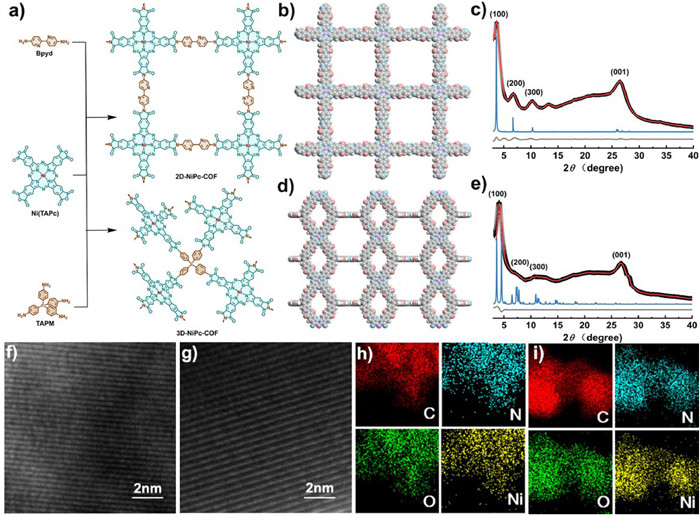
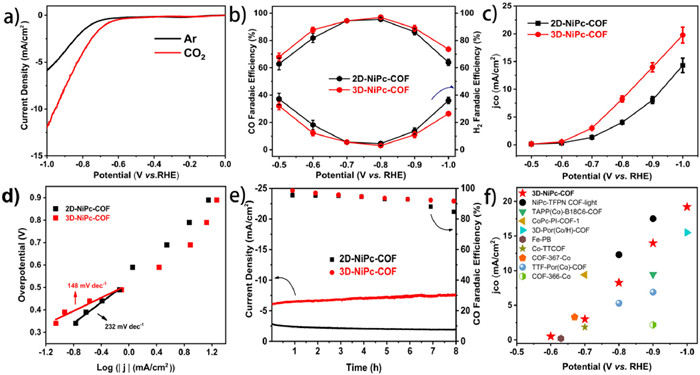
  • Dimensionality has great influence on the photo/electro-catalysts properties of covalent organic frameworks (COFs) because of the different electronic and porous structures. However, very rare attention has been paid on the dimensionality and function correlations of COF materials. In the present work, one new two-dimensional phthalocyanine COF, namely 2D-NiPc-COF, and one new three-dimensional phthalocyanine COF, namely 3D-NiPc-COF, were fabricated according to the imide reaction between tetraanhydrides of 2, 3, 9, 10, 16, 17, 23, 24-octacarboxyphthalocyaninato nickel(Ⅱ) with [2, 2-bipyridine]-5, 5-diamine and tetrakis(4-aminophenyl) methane, respectively. The crystalline structures of both COFs are verified by the powder X-ray diffraction analysis, computational simulation, and high resolution transmission electron microscopy measurement. Notably, 3D-NiPc-COF with dispersed conjugated modules has high utilization efficiency of NiPc electroactive sites of 26.8%, almost two times higher than the in-plane stacking 2D-NiPc-COF measured by electrochemical measurement, in turn resulting in its superior electrocatalytic performance with high CO2-to-CO Faradaic efficiency over 90% in a wide potential window, a large partial CO current density of −13.97 mA/cm2 at −0.9 V (vs. reversible hydrogen electrode) to 2D-NiPc-COF. Moreover, 3D-NiPc-COF has higher turnover number and turnover frequency of 5741.6 and 0.18 s-1 at −0.8 V during 8 h lasting measurement. The present work provides an example for the investigation on the correlation between dimensionality and electrochemical properties of 2D and 3D phthalocyanine COFs.
  • 加载中
    1. [1]

      C. Ding, Y. Du, S. Agarwal, et al., Adv. Funct. Mater. 34 (2024) 2309938.

    2. [2]

      J. Pérez-Carvajal, G. Boix, I. Imaz, et al., Adv. Energy Mater. 9 (2019) 1901535.

    3. [3]

      C. Kang, Z. Zhang, A.K. Usadi, et al., J. Am. Chem. Soc. 144 (2022) 20363–20371.  doi: 10.1021/jacs.2c08214

    4. [4]

      J. Li, Y. He, Y. Zou, et al., Chin. Chem. Lett. 33 (2022) 3017–3020.

    5. [5]

      S. Wang, Y. Yang, X. Liang, et al., Adv. Funct. Mater. 33 (2023) 2300386.

    6. [6]

      D.W. Burke, Z. Jiang, A.G. Livingston, et al., Adv. Mater. 36 (2024) 2300525.

    7. [7]

      H. Yang, L. Yang, H. Wang, et al., Nat. Commun. 10 (2019) 2101–2110.

    8. [8]

      L. Liang, F. Qin, S. Wang, et al., Coord. Chem. Rev. 478 (2023) 214998.

    9. [9]

      M. Liu, Y.J. Chen, D.X. Huang, et al., Angew. Chem. Int. Ed. 61 (2022) e202115308.

    10. [10]

      M. Zheng, K.A. Mirica, Chem. Soc. Rev. 50 (2021) 13498–13558.

    11. [11]

      A. Zadehnazari, A. Khosropour, A. Altaf, et al., Adv. Mater. 36 (2024) 2311042.

    12. [12]

      T. He, Z. Zhao, R. Liu, et al., J. Am. Chem. Soc. 145 (2023) 6057–6066.  doi: 10.1021/jacs.2c10233

    13. [13]

      C. Wang, Z. Lv, W. Yang, et al., Chem. Soc. Rev. 52 (2023) 1382–1427.  doi: 10.1039/d2cs00843b

    14. [14]

      Y. Jin, X. Zhan, Y. Zheng, et al., Appl. Catal. B: Environ. 327 (2023) 122446.

    15. [15]

      B. Han, X. Ding, B. Yu, et al., J. Am. Chem. Soc. 143 (2021) 7104–7113.  doi: 10.1021/jacs.1c02145

    16. [16]

      S. Gao, B. Fan, R. Feng, et al., Nano Energy. 40 (2017) 462–470.

    17. [17]

      Q. Zhi, W. Liu, R. Jiang, et al., J. Am. Chem. Soc. 144 (2022) 21328–21336.  doi: 10.1021/jacs.2c09482

    18. [18]

      W.K. Haug, E.M. Moscarello, E.R. Wolfson, et al., Chem. Soc. Rev. 49 (2020) 839–864.  doi: 10.1039/c9cs00807a

    19. [19]

      X. Ren, G. Liao, Z. Li, et al., Coord. Chem. Rev. 435 (2021) 213781.

    20. [20]

      X. Yang, L. Gong, X. Liu, et al., Angew. Chem. Int. Ed. 61 (2022) e202207043.

    21. [21]

      N. Li, C. Pan, G. Lu, et al., Adv. Mater. 36 (2024) 2311023.

    22. [22]

      Q. Guan, L.L. Zhou, Y.B. Dong, et al., Chem. Soc. Rev. 51 (2022) 6307–6416.  doi: 10.1039/d1cs00983d

    23. [23]

      K. Geng, T. He, R. Liu, et al., Chem. Rev. 120 (2020) 8814–8933.  doi: 10.1021/acs.chemrev.9b00550

    24. [24]

      F. Haase, B.V. Lotsch, Coord. Chem. Soc. Rev. 49 (2020) 8469–8500.  doi: 10.1039/d0cs01027h

    25. [25]

      X. Guan, F. Chen, Q. Fang, et al., Chem. Soc. Rev. 49 (2020) 1357–1384.  doi: 10.1039/c9cs00911f

    26. [26]

      S. Wang, X.X. Li, L. Da, et al., J. Am. Chem. Soc. 143 (2021) 15562–15566.  doi: 10.1021/jacs.1c06986

    27. [27]

      H. Li, J. Ding, X. Guan, et al., J. Am. Chem. Soc. 142 (2020) 13334–13338.  doi: 10.1021/jacs.0c06485

    28. [28]

      Y. Yang, C. Schäfer, K. Börjesson, Chem. 8 (2022) 2217–2227.

    29. [29]

      Z. Li, L. Sheng, H. Wang, et al., J. Am. Chem. Soc. 143 (2021) 92–96.

    30. [30]

      X. Xu, P. Cai, H. Chen, et al., J. Am. Chem. Soc. 144 (2022) 18511–18517.  doi: 10.1021/jacs.2c07733

    31. [31]

      S. Xue, X. Ma, Y. Wang, et al., Coord. Chem. Rev. 504 (2024) 215659.

    32. [32]

      W. Gao, S. Liang, R. Wang, et al., Chem. Soc. Rev. 49 (2020) 8584–8686.  doi: 10.1039/d0cs00025f

    33. [33]

      R. Osbourne, BMJ. 379 (2022) o2414.

    34. [34]

      M.I. Hoffert, Science 329 (2010) 1292–1294.  doi: 10.1126/science.1195449

    35. [35]

      P. Voosen, Science 366 (2019) 170–175.  doi: 10.1126/science.366.6462.170

    36. [36]

      A. Ozden, J. Li, S. Kandambeth, et al., Nat. Energy 8 (2023) 179–190.  doi: 10.1038/s41560-022-01188-2

    37. [37]

      Y. Wang, T. Zheng T. Sun et al., ACS Mater. Lett. 6 (2024) 140–152.

    38. [38]

      T. Zheng, X. Ding, T. Sun, et al., Small 20 (2023) 2307743.

    39. [39]

      X. Wang, X. Ding, Y. Jin, et al., Angew. Chem. Int. Ed. 62 (2023) e202302808.

    40. [40]

      Z. Liu, K. Wang, Y. Chen, T. Tan, et al., Nat. Catal. 3 (2020) 274–288.  doi: 10.1038/s41929-019-0421-5

    41. [41]

      Y.L. Yang, Y.R. Wang, G.K. Gao, et al., Chin. Chem. Lett. 33 (2022) 1439–1444.  doi: 10.3390/nano12091439

    42. [42]

      J. Zhang, Y. Wang, H. Wang, et al., Chin. Chem. Lett. 33 (2022) 2065–2068.

    43. [43]

      S.G. Han, M. Zhang, Z.H. Fu, et al., Adv. Mater. 34 (2022) 2202830.

    44. [44]

      Z. Liang, H.Y. Wang, H. Zheng, et al., Chem. Soc. Rev. 50 (2021) 2540–2581.  doi: 10.1039/d0cs01482f

    45. [45]

      N. Li, D.H. Si, Q. j. Wu, et al., CCS Chem. 5 (2022) 1130–1143.  doi: 10.3390/mi13071130

    46. [46]

      Q.J. Wu, D.H. Si, Q. Wu, et al., Angew. Chem. Int. Ed. 62 (2023) e202215687.

    47. [47]

      Q.X. Li, D.H. Si, W. Lin, et al., Sci. China. Chem. 65 (2022) 1584–1593.  doi: 10.1007/s11426-022-1263-5

    48. [48]

      W. Lai, Y. Qiao, Y. Wang, et al., Adv. Mater. 35 (2023) 2306288.

    49. [49]

      Q. Li, D.D. Ma, W.B. Wei, et al., Adv. Eng. Mater. 14 (2024) 2401314.

    50. [50]

      R. Sahoo, S. Mondal, S.C. Pal, et al., Adv. Eng. Mater. 11 (2021) 2102300.

    51. [51]

      S. Haldar, D. Rase, P. Shekhar, et al., Adv. Eng. Mater. 12 (2022) 2200754.

    52. [52]

      C.Y. Lin, L. Zhang, Z. Z, et al., Adv. Mater. 29 (2017) 1606635.

    53. [53]

      C. Jain, R. Kushwaha, D. Rase, et al., J. Am. Chem. Soc. 146 (2024) 487–499.  doi: 10.1021/jacs.3c09937

    54. [54]

      D.D. Ma, S.G. Han, S.H. Zhou, et al., CCS Chem. 5 (2023) 1827–1840.  doi: 10.31635/ccschem.022.202202294

    55. [55]

      M. Lu, M. Zhang, C.G. Liu, et al., Angew. Chem. Int. Ed. 60 (2021) 4864–4871.  doi: 10.1002/anie.202011722

    56. [56]

      Z. Lei, F.W.S. Lucas, E.C. Moya, et al., Chin. Chem. Lett. 32 (2021) 3799–3802.

    57. [57]

      B. Han, Y. Jin, B. Chen, et al., Angew. Chem. Int. Ed. 61 (2022) e202114244.

  • 加载中
    1. [1]

      Mingrun LiBin HanLei GongYucheng JinMingyue WangXu DingDongdong QiJianzhuang Jiang . 1D COFs with phthalocyanine functional building blocks and imide linkage for superior electrocatalytic nitrate reduction. Chinese Chemical Letters, 2026, 37(2): 110590-. doi: 10.1016/j.cclet.2024.110590

    2. [2]

      Chen Lu Zefeng Yu Jing Cao . Advancement in porphyrin/phthalocyanine compounds-based perovskite solar cells. Chinese Journal of Structural Chemistry, 2024, 43(3): 100240-100240. doi: 10.1016/j.cjsc.2024.100240

    3. [3]

      Jiangqi Ning Junhan Huang Yuhang Liu Yanlei Chen Qing Niu Qingqing Lin Yajun He Zheyuan Liu Yan Yu Liuyi Li . Alkyl-linked TiO2@COF heterostructure facilitating photocatalytic CO2 reduction by targeted electron transport. Chinese Journal of Structural Chemistry, 2024, 43(12): 100453-100453. doi: 10.1016/j.cjsc.2024.100453

    4. [4]

      Dongdong Liu Ziqi Tang Haoyu Wang Xinjie Li Jingyang Li Chao Zhu Shan Ding Yuan-sheng Cheng Hui Zhang Peipei Li Ju Wu Guozan Yuan . Rational design of ZnIn2S4-COF heterojunction to inhibit photogenerated carrier dynamics for enhanced photocatalytic CO2 reduction. Chinese Journal of Structural Chemistry, 2026, 45(1): 100762-100762. doi: 10.1016/j.cjsc.2025.100762

    5. [5]

      Jundi Qin Dezhong Hu Dong Xiang Xiongwu Kang . CuMoRuFeW high entropy alloy surfaced nanorods: Superior electrochemical CO2 reduction to ethylene. Chinese Journal of Structural Chemistry, 2025, 44(5): 100571-100571. doi: 10.1016/j.cjsc.2025.100571

    6. [6]

      Maomao Liu Guizeng Liang Ningce Zhang Tao Li Lipeng Diao Ping Lu Xiaoliang Zhao Daohao Li Dongjiang Yang . Electron-rich Ni2+ in Ni3S2 boosting electrocatalytic CO2 reduction to formate and syngas. Chinese Journal of Structural Chemistry, 2024, 43(8): 100359-100359. doi: 10.1016/j.cjsc.2024.100359

    7. [7]

      Xiaojuan Sun Ke Kong Jun Liang Dan Wang Beibei Dong Ruihu Wang . Periodic Janus structure based on ionic covalent organic framework for selective removal of perfluoroalkyl substances. Chinese Journal of Structural Chemistry, 2025, 44(9): 100652-100652. doi: 10.1016/j.cjsc.2025.100652

    8. [8]

      Guan-Nan Xing Di-Ye Wei Hua Zhang Zhong-Qun Tian Jian-Feng Li . Pd-based nanocatalysts for oxygen reduction reaction: Preparation, performance, and in-situ characterization. Chinese Journal of Structural Chemistry, 2023, 42(11): 100021-100021. doi: 10.1016/j.cjsc.2023.100021

    9. [9]

      Shouchao ZhongYue WangMingshu XieYiqian WuJiuqiang LiJing PengLiyong YuanMaolin ZhaiWeiqun Shi . Radiation reduction modification of sp2 carbon-conjugated covalent organic frameworks for enhanced photocatalytic chromium(VI) removal. Chinese Chemical Letters, 2025, 36(5): 110312-. doi: 10.1016/j.cclet.2024.110312

    10. [10]

      Li-Ying WangJun-Jie YuShuai WangYang LiuKe-Xian SongJi-Pan YuLi-Yong YuanZhi-Rong LiuWei-Qun Shi . Pyridine-based ionic sp2 carbon-conjugated covalent organic frameworks for selective extraction of Pu(Ⅳ) from high-level liquid waste. Chinese Chemical Letters, 2025, 36(8): 110706-. doi: 10.1016/j.cclet.2024.110706

    11. [11]

      Shanru Feng Ling Wen Li Zhang Qinyu Jiang Bozhao Zhang Guohao Wu Yue Wu Jiabin Chen Youcai Han Chuhao Liu Yu-Wu Zhong Jiannian Yao . Magnetic field controlled electrocatalysis from a multidimensional catalytic perspective: Mechanisms, applications, and prospects for energy conversion. Chinese Journal of Structural Chemistry, 2025, 44(11): 100662-100662. doi: 10.1016/j.cjsc.2025.100662

    12. [12]

      Xiang Ao Fucheng Wu Lin Yu Kai Zhao Muhammad Humayun Chundong Wang . Tailoring antiperovskite carbide for electrocatalysis hydrogen evolution applications. Chinese Journal of Structural Chemistry, 2026, 45(4): 100851-100851. doi: 10.1016/j.cjsc.2025.100851

    13. [13]

      Anni WuChengyi HongHu ZhengWei Teng . Multi-site synergistic relay electrocatalysis with high-entropy nanoalloys for effective nitrate reduction to ammonia. Chinese Chemical Letters, 2025, 36(12): 111066-. doi: 10.1016/j.cclet.2025.111066

    14. [14]

      Wei SuXiaoyan LuoPeiyuan LiYing ZhangChenxiang LinKang WangJianzhuang Jiang . Phthalocyanine self-assembled nanoparticles for type Ⅰ photodynamic antibacterial therapy. Chinese Chemical Letters, 2024, 35(12): 109522-. doi: 10.1016/j.cclet.2024.109522

    15. [15]

      Xinyu WuJianfeng LuZihao ZhuSuijun LiuHerui Wen . Recent advances of metal-organic frameworks and MOF-derived materials based on p-block metal for the electrochemical reduction of carbon dioxide. Chinese Chemical Letters, 2025, 36(7): 110151-. doi: 10.1016/j.cclet.2024.110151

    16. [16]

      Wei-Jia WangKaihong Chen . Molecular-based porous polymers with precise sites for photoreduction of carbon dioxide. Chinese Chemical Letters, 2025, 36(1): 109998-. doi: 10.1016/j.cclet.2024.109998

    17. [17]

      Quanyou GuoYue YangTingting HuHongqi ChuLijun LiaoXuepeng WangZhenzi LiLiping GuoWei Zhou . Regulating local electron transfer environment of covalent triazine frameworks through F, N co-modification towards optimized oxygen reduction reaction. Chinese Chemical Letters, 2025, 36(1): 110235-. doi: 10.1016/j.cclet.2024.110235

    18. [18]

      Ting WangXin YuYaqiang Xie . Unlocking stability: Preserving activity of biomimetic catalysts with covalent organic framework cladding. Chinese Chemical Letters, 2024, 35(6): 109320-. doi: 10.1016/j.cclet.2023.109320

    19. [19]

      Yinyin XuYuanyuan LiJingbo FengChen WangYan ZhangYukun WangXiuwen Cheng . Covalent organic frameworks doped with manganese-metal organic framework for peroxymonosulfate activation. Chinese Chemical Letters, 2024, 35(4): 108838-. doi: 10.1016/j.cclet.2023.108838

    20. [20]

      Chao LiuChao JiaShi-Xian GanQiao-Yan QiGuo-Fang JiangXin Zhao . A luminescent one-dimensional covalent organic framework for organic arsenic sensing in water. Chinese Chemical Letters, 2024, 35(11): 109750-. doi: 10.1016/j.cclet.2024.109750

Metrics
  • PDF Downloads(5)
  • Abstract views(2117)
  • HTML views(82)

通讯作者: 陈斌, bchen63@163.com
  • 1. 

    沈阳化工大学材料科学与工程学院 沈阳 110142

  1. 本站搜索
  2. 百度学术搜索
  3. 万方数据库搜索
  4. CNKI搜索
Address:Zhongguancun North First Street 2,100190 Beijing, PR China Tel: +86-010-82449177-888
Powered By info@rhhz.net

/

DownLoad:  Full-Size Img  PowerPoint
Return