Citation: Huifang Ma, Tao Xu, Saifei Yuan, Shujuan Li, Jiayao Wang, Yuping Zhang, Hao Ren, Shulai Lei. Interlayer interactions and electron transfer effects on sodium adsorption on 2D heterostructures surfaces[J]. Chinese Chemical Letters, ;2025, 36(8): 110219. doi: 10.1016/j.cclet.2024.110219 shu

Interlayer interactions and electron transfer effects on sodium adsorption on 2D heterostructures surfaces

Figures(4)

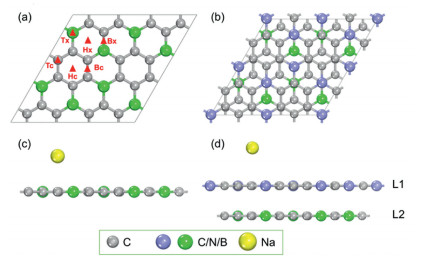
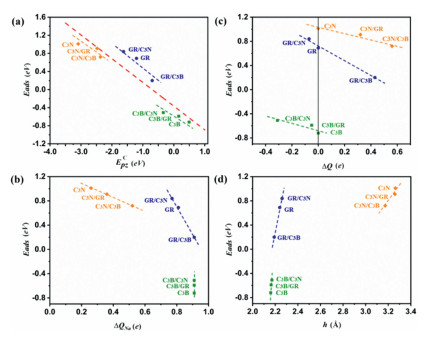
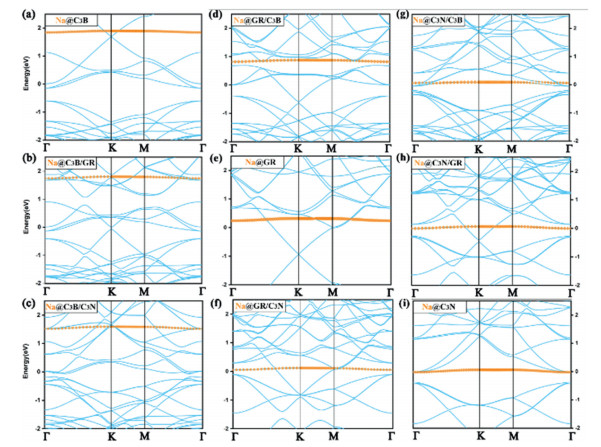
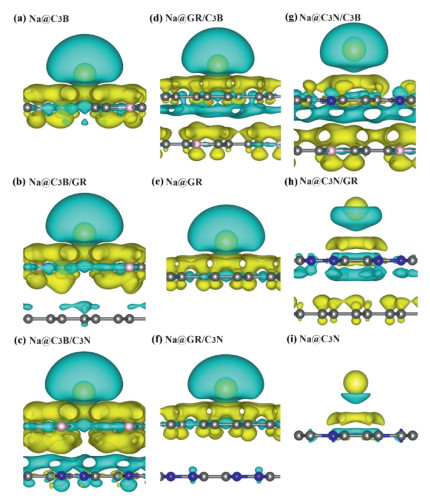
  • Surface adsorption plays a crucial role in various natural and industrial processes, particularly in the field of energy storage. The adsorption of sodium atoms on 2D layered materials can significantly impact their performance as carriers and electrodes in ion batteries. While it is commonly acknowledged that pristine graphene is not favorable for sodium ion adsorption, the suitability of other 2D materials with similar honeycomb symmetry remains unclear. In this study, we employ systematic first-principles calculations to explore interlayer interactions and electron transfer effects on sodium adsorption on 2D van der Waals (vdW) heterostructures (HTSs) surfaces. Our results demonstrate that sodium adsorption is energetically favorable on these substrates. Moreover, we find that the adsorption strength can be effectively tuned by manipulation of the electron accumulation or depletion of the layer directly interacting with the sodium atom. By stacking these layered materials with different electron abundancy to form vdW HTSs, the charge density of the substrate becomes tunable through interlayer charge transfer. In these vdW HTSs, the adsorption behavior of sodium is primarily controlled by the absorption layer and exhibits a linear correlation with its pz-band center. Additionally, we identify linear correlations between the sodium adsorption energies, the electron loss of the sodium atom, the interlayer charge transfer, and the heights of the adsorbed sodium atom. These discoveries underscore the impact of interlayer electron transfer and interactions on sodium ion adsorption on 2D vdW HTSs and providing new insights into material design for alkali atom adsorption.
  • 加载中
    1. [1]

      J. Xiao, J. Han, C. Zhang, et al., Adv. Energy Mater. 12 (2022) 2100775.

    2. [2]

      J. Zhou, S. Guo, SmartMat 2 (2021) 176–201.  doi: 10.1002/smm2.1042

    3. [3]

      H.S. Hirsh, Y. Li, D.H.S. Tan, et al., Adv. Energy Mater. 10 (2020) 2001274.

    4. [4]

      L. Lin, J. Chen, D. Liu, et al., Adv. Energy Mater. 10 (2020) 2002621. .

    5. [5]

      X. Yang, R. Zhang, S. Xu, et al., Chem. Eur. J. 26 (2020) 5818–5823.  doi: 10.1002/chem.201905311

    6. [6]

      S. Sarkar, S. Roy, Y. Hou, et al., ChemSusChem 14 (2021) 3693–3723.  doi: 10.1002/cssc.202101270

    7. [7]

      H. Qi, C. Zhao, J. Huang, et al., Nanoscale 14 (2022) 780–789.  doi: 10.1039/d1nr06705b

    8. [8]

      Q. Liu, R. Xu, D. Mu, et al., Carbon Energy 4 (2022) 458–479.  doi: 10.1002/cey2.120

    9. [9]

      X. Li, J. Li, L. Ma, et al., Energy Environ. Mater. 5 (2022) 458–469.

    10. [10]

      X. Gong, Y. Zheng, J. Zheng, et al., ChemElectroChem 7 (2020) 1465–1472.  doi: 10.1002/celc.201902098

    11. [11]

      J. Yang, R.U.R. Sagar, T. Anwar, et al., Int. J. Energy Res. (2021), https://doi.org/10.1002/er.7514.  doi: 10.1002/er.7514

    12. [12]

      M.J. Lee, K. Lee, J. Lim, et al., Adv. Funct. Mater. 31 (2021) 2009397.

    13. [13]

      D. Wang, H. Hu, Y. Liao, et al., Sci. China Mater. 64 (2021) 318–328.

    14. [14]

      D. Kong, H. Fan, X. Ding, et al., ACS Appl. Mater. Interfaces 12 (2020) 46065–46072.  doi: 10.1021/acsami.0c12389

    15. [15]

      J. Zhang, J. Han, Q. Yun, et al., Small Sci. 1 (2021) 2000063.

    16. [16]

      C. Xia, W. Xiong, W. Xiao, et al., Phys. Rev. Appl. 10 (2018) 24028.

    17. [17]

      Y. Ren, F. Cheng, X. Zhou, K. Chang, G. Zhou, Carbon 143 (2019) 14–20.

    18. [18]

      Y. Qie, J. Liu, S. Wang, S. Gong, Q. Sun, Carbon N Y 129 (2018) 38–44.

    19. [19]

      K.S. Novoselov, A. Mishchenko, A. Carvalho, A.H. Castro Neto, Science 353 (2016) aac9439.

    20. [20]

      A. Gao, J. Lai, Y. Wang, et al., Nat. Nanotechnol. 14 (2019) 217–222.  doi: 10.1038/s41565-018-0348-z

    21. [21]

      K. Bushick, S. Chae, Z. Deng, J.T. Heron, E. Kioupakis, npj Comput. Mater. 6 (2020) 3.

    22. [22]

      X. Yu, G. Zhao, C. Liu, et al., Adv. Funct. Mater. 31 (2021) 2103214.

    23. [23]

      S. Gao, Z. Wang, H. Wang, et al., Adv. Mater. Interf. 8 (2021) 2001730.

    24. [24]

      D.X. Song, Y.Z. Du, W.G. Ma, X. Zhang, Int. J. Energy Res. 45 (2021) 3421–3429.  doi: 10.1002/er.6027

    25. [25]

      J. Yu, M. Zhou, M. Yang, et al., Adv. Mater. Interf. 9 (2022) 2102088.

    26. [26]

      X. Wang, Y. Li, S. Wang, et al., Adv. Energy Mater. 10 (2020) 2000081.

    27. [27]

      F. Zou, T. Xu, Z. Wu, et al., J. Phys. Chem. C 124 (2020) 28074–28082.  doi: 10.1021/acs.jpcc.0c08143

    28. [28]

      G. Kresse, J. Hafner, Phys. Rev. B 47 (1993) 558–561.

    29. [29]

      G. Kresse, J. Furthmüller, Comput. Mater. Sci. 6 (1996) 15–50.

    30. [30]

      J.P. Perdew, K. Burke, M. Ernzerhof, Phys. Rev. Lett. 77 (1996) 3865–3868.

    31. [31]

      P.E. Blöchl, Phys. Rev. B 50 (1994) 17953–17979.

    32. [32]

      G. Kresse, D. Joubert, Phys. Rev. B 59 (1999) 1758–1775.

    33. [33]

      S. Ehrlich, J. Moellmann, S. Grimme, Acc. Chem. Res. 46 (2013) 916–926.  doi: 10.1021/ar3000844

    34. [34]

      S. Grimme, J. Antony, S. Ehrlich, H. Krieg, J. Chem. Phys. 132 (2010) 154104.

    35. [35]

      W. Tang, E. Sanville, G. Henkelman, J. Phys. Condens. Matter 21 (2009) 84204.

    36. [36]

      S. Maintz, V.L. Deringer, A.L. Tchougréeff, R. Dronskowski, J. Comput. Chem. 37 (2016) 1030–1035.  doi: 10.1002/jcc.24300

    37. [37]

      C. Zhang, Y. Jiao, T. He, S. Bottle, T. Frauenheim, A. Du, J. Phys. Chem. Lett. 9 (2018) 858–862.  doi: 10.1021/acs.jpclett.7b03449

    38. [38]

      H. Li, L. Xu, X. Huang, et al., Int. J. Hydrogen Energy 48 (2023) 2186–2199.

    39. [39]

      K.T. Chan, J.B. Neaton, M.L. Cohen, Phys. Rev. B 77 (2008) 235430.  doi: 10.1103/PhysRevB.77.235430

    40. [40]

      C. Ling, F. Mizuno, Phys. Chem. Chem. Phys. 16 (2014) 10419–10424.

    41. [41]

      O.I. Malyi, K. Sopiha, V.V. Kulish, et al., Appl. Surf. Sci. 333 (2015) 235–243.

    42. [42]

      P. Bhauriyal, A. Mahata, B. Pathak, J. Phys. Chem. C 122 (2018) 2481–2489.  doi: 10.1021/acs.jpcc.7b09433

    43. [43]

      Y. Mao, H. Duan, B. Xu, et al., Energy Environ. Sci. 5 (2012) 7950.  doi: 10.1039/c2ee21817h

    44. [44]

      S. Li, J. Hao, F. Li, et al., J. Phys. Chem. C 118 (2014) 27843–27849.  doi: 10.1021/jp5074768

    45. [45]

      A.H. Woomer, D.L. Druffel, J.D. Sundberg, J.T. Pawlik, S.C. Warren, J. Am. Chem. Soc. 141 (2019) 10300–10308.  doi: 10.1021/jacs.9b03155

    46. [46]

      J.H. Lee, A. Avsar, J. Jung, et al., Nano Lett. 15 (2015) 319–325.  doi: 10.1021/nl5036012

    47. [47]

      J.K. Nørskov, F. Abild-Pedersen, F. Studt, T. Bligaard, Proc. Nat. Acad. Sci. U. S. A. 108 (2011) 937–943.  doi: 10.1073/pnas.1006652108

    48. [48]

      J.K. Nørskov, Progr. Surf. Sci. 38 (1991) 103–144.

  • 加载中
    1. [1]

      Heng-Su Liu Xi-Ming Zhang Ge-Hao Liang Shisheng Zheng Jian-Feng Li . Investigation of water structure and proton transfer within confined graphene by ab initio molecule dynamics and multiscale data analysis. Chinese Journal of Structural Chemistry, 2025, 44(6): 100596-100596. doi: 10.1016/j.cjsc.2025.100596

    2. [2]

      Junqing YeMengyuan RenJunfeng QianXibao LiQun Chen . Advances in graphene quantum dots-based photocatalysts for enhanced charge transfer in photocatalytic reactions. Chinese Chemical Letters, 2025, 36(9): 110857-. doi: 10.1016/j.cclet.2025.110857

    3. [3]

      Haiyan Yin Abdusalam Ablez Zhuangzhuang Wang Weian Li Yanqi Wang Qianqian Hu Xiaoying Huang . Novel open-framework chalcogenide photocatalysts: Cobalt cocatalyst valence state modulating critical charge transfer pathways towards high-efficiency hydrogen evolution. Chinese Journal of Structural Chemistry, 2025, 44(4): 100560-100560. doi: 10.1016/j.cjsc.2025.100560

    4. [4]

      Shu-Ran Xu Fang-Xing Xiao . Metal halide perovskites quantum dots: Synthesis, and modification strategies for solar CO2 conversion. Chinese Journal of Structural Chemistry, 2023, 42(12): 100173-100173. doi: 10.1016/j.cjsc.2023.100173

    5. [5]

      Fengzhi WangKe HuJinquan ChenZhubin HuHaitao SunTony D. JamesYufang XuXuhong QianMeta-amino substituted naphthalimides exhibit large charge transfer and strong N-H vibrations enabling use as ratiometric fluorescent probe. Chinese Chemical Letters, 2026, 37(1): 110971-. doi: 10.1016/j.cclet.2025.110971

    6. [6]

      Tiange WeiMengxia JiYi ZhangKeke WangMeng WangYuanbin SheJiexiang XiaHuaming Li . Synergistic optimization of charge transfer and active sites in Bi12O17Br2/CuTCPP for efficient CO2 photoreduction. Chinese Chemical Letters, 2026, 37(6): 111988-. doi: 10.1016/j.cclet.2025.111988

    7. [7]

      Cheng GuoXiaoxiao ZhangXiujuan HongYiqiu HuLingna MaoKezhi Jiang . Graphene as adsorbent for highly efficient extraction of modified nucleosides in urine prior to liquid chromatography-tandem mass spectrometry analysis. Chinese Chemical Letters, 2024, 35(4): 108867-. doi: 10.1016/j.cclet.2023.108867

    8. [8]

      Sanmei WangYong ZhouHengxin FangChunyang NieChang Q SunBiao Wang . Constant-potential simulation of electrocatalytic N2 reduction over atomic metal-N-graphene catalysts. Chinese Chemical Letters, 2025, 36(3): 110476-. doi: 10.1016/j.cclet.2024.110476

    9. [9]

      Sanmei WangDengxin YanWenhua ZhangLiangbing Wang . Graphene-supported isolated platinum atoms and platinum dimers for CO2 hydrogenation: Catalytic activity and selectivity variations. Chinese Chemical Letters, 2025, 36(4): 110611-. doi: 10.1016/j.cclet.2024.110611

    10. [10]

      Wenjing XiongYulin XuFangzhou ZhaoBaokai XiaHongqiang WangWei LiuSheng ChenYongzhi Zhang . Graphene architecture interpenetrated with mesoporous carbon nanosheets promotes fast and stable potassium storage. Chinese Chemical Letters, 2025, 36(4): 109738-. doi: 10.1016/j.cclet.2024.109738

    11. [11]

      Huining ZhangBaixiang WangJianping HanShaofeng WangXingmao LiuWenhui NiuZhongyu ShiZhiqiang WeiZhiguo WuYing ZhuQi Guo . Nature’s revelation: Preparation of Graphene-based Biomimetic materials and its application prospects for water purification. Chinese Chemical Letters, 2025, 36(6): 110319-. doi: 10.1016/j.cclet.2024.110319

    12. [12]

      Caili YangTao LongRuotong LiChunyang WuYuan-Li Ding . Pseudocapacitance dominated Li3VO4 encapsulated in N-doped graphene via 2D nanospace confined synthesis for superior lithium ion capacitors. Chinese Chemical Letters, 2025, 36(2): 109675-. doi: 10.1016/j.cclet.2024.109675

    13. [13]

      Kangyuan XieTianxiang FangQingli ZhuQingyang XuBoyu PengGuangpeng WuChao GaoHaocheng YangLiping ZhuHongqing LiangWeipu ZhuPeng ZhangQiao JinZhengwei MaoKefeng RenYang ZhuHaoke ZhangZiliang WuChao ZhangHanying Li . Key progresses of MOE Key laboratory of macromolecular synthesis and functionalization in 2024. Chinese Chemical Letters, 2026, 37(2): 111990-. doi: 10.1016/j.cclet.2025.111990

    14. [14]

      Chaozheng HePei ShiDonglin PangZhanying ZhangLong LinYingchun Ding . First-principles study of the relationship between the formation of single atom catalysts and lattice thermal conductivity. Chinese Chemical Letters, 2024, 35(6): 109116-. doi: 10.1016/j.cclet.2023.109116

    15. [15]

      Shiyan AiYaning XuHui ZhouZiwei CuiTiantian WuDan Tian . Superelastic and ultralight covalent organic framework composite aerogels modified with different functional groups for ultrafast adsorbing organic pollutants in water. Chinese Chemical Letters, 2025, 36(10): 110761-. doi: 10.1016/j.cclet.2024.110761

    16. [16]

      Yuchen WangYaoyu LiuXiongfei HuangGuanjie HeKai Yan . Fe nanoclusters anchored in biomass waste-derived porous carbon nanosheets for high-performance supercapacitor. Chinese Chemical Letters, 2024, 35(8): 109301-. doi: 10.1016/j.cclet.2023.109301

    17. [17]

      Bo YangSuqiong YanShirong BanWei Huang . New horizons in phosphorus-based emitters: From circularly polarized fluorescence to room-temperature phosphorescence. Chinese Chemical Letters, 2025, 36(11): 110837-. doi: 10.1016/j.cclet.2025.110837

    18. [18]

      Ao-Hua WangJun LiShi-Hu DuJia LiuYao ZhangMuhammad Bilal Ahmed SiddiqueJing ChenShi-Bo Cheng . Beyond superhalogen assembly: Field-driven hyperhalogen design via dual-external-field cooperativity. Chinese Chemical Letters, 2026, 37(1): 111265-. doi: 10.1016/j.cclet.2025.111265

    19. [19]

      Cheng-Cheng JiaoGuang-Xing DongKe SuYou-Xiang FengMin ZhangTong-Bu Lu . The construction of InVO4/BiVO4 heterojunction via cation-exchange for efficient and highly selective CO2 photoreduction to methanol. Chinese Chemical Letters, 2026, 37(1): 110752-. doi: 10.1016/j.cclet.2024.110752

    20. [20]

      Juanjuan WangYangxia HanQixia GuanJia ChenHongdeng Qiu . Photochromic ionic self-assembled ionic-bonded organic crystals: Blue-shifted and enhanced luminescence. Chinese Chemical Letters, 2026, 37(4): 111732-. doi: 10.1016/j.cclet.2025.111732

Metrics
  • PDF Downloads(2)
  • Abstract views(1013)
  • HTML views(41)

通讯作者: 陈斌, bchen63@163.com
  • 1. 

    沈阳化工大学材料科学与工程学院 沈阳 110142

  1. 本站搜索
  2. 百度学术搜索
  3. 万方数据库搜索
  4. CNKI搜索
Address:Zhongguancun North First Street 2,100190 Beijing, PR China Tel: +86-010-82449177-888
Powered By info@rhhz.net

/

DownLoad:  Full-Size Img  PowerPoint
Return