Citation: Zhihan Chang, Yuchen Zhang, Yuan Tian, Xiuli Wang. Achieving high-proportioned 1T-MoS2 within heterostructures derived from polymolybdate-based complex for boosting electrocatalytic hydrogen evolution and oxygen evolution[J]. Chinese Chemical Letters, ;2025, 36(8): 110197. doi: 10.1016/j.cclet.2024.110197 shu

Achieving high-proportioned 1T-MoS2 within heterostructures derived from polymolybdate-based complex for boosting electrocatalytic hydrogen evolution and oxygen evolution

    * Corresponding authors.
    E-mail address: wangxiuli@bhu.edu.cn (X. Wang).
    1 These authors contributed equally to this work.
  • Received Date: 3 May 2024
    Revised Date: 14 June 2024
    Accepted Date: 1 July 2024
    Available Online: 2 July 2024

Figures(11)

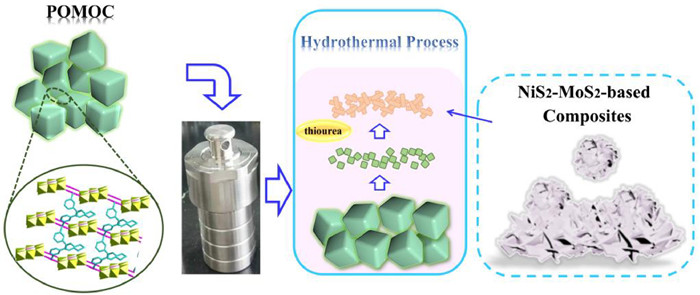
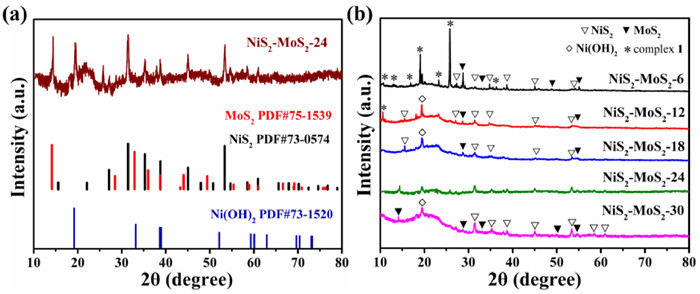
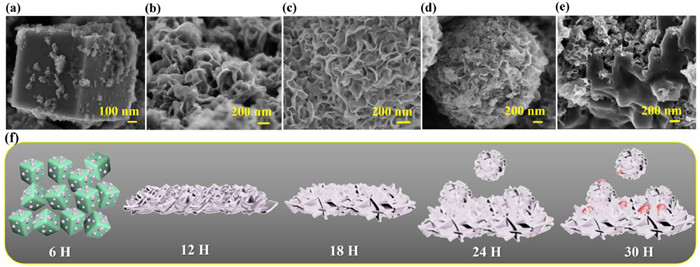
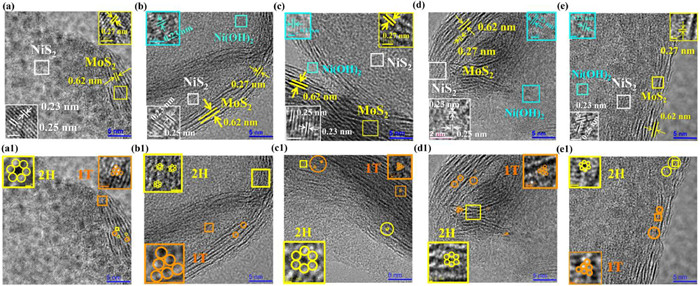
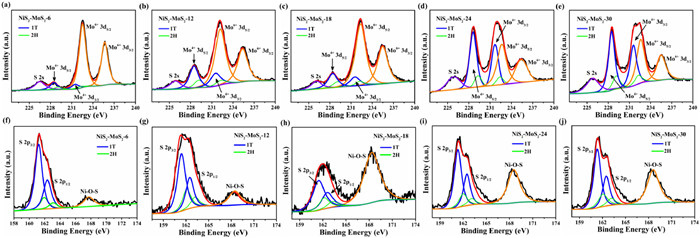
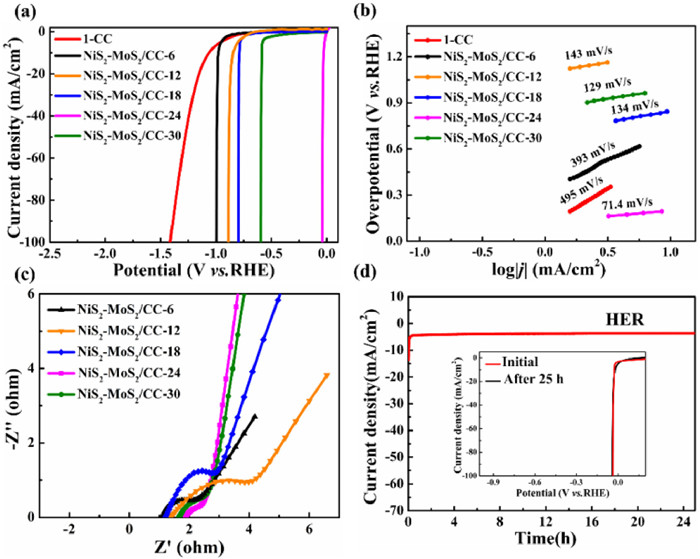
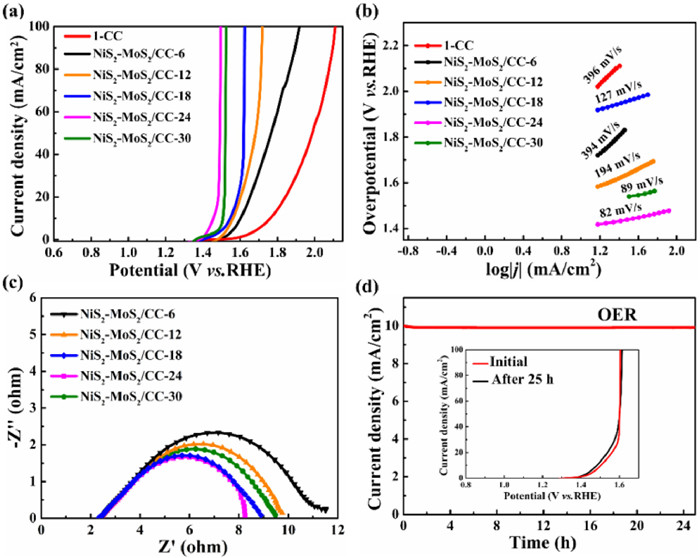
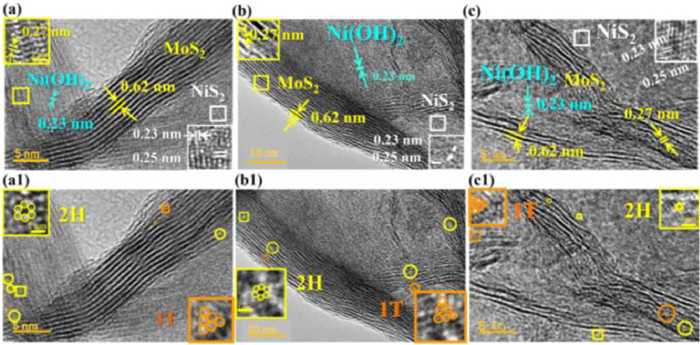
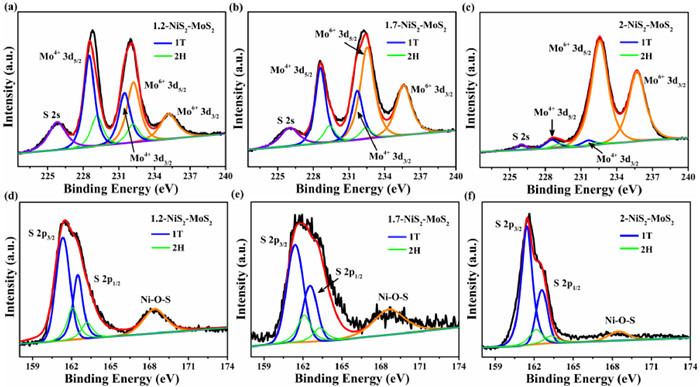
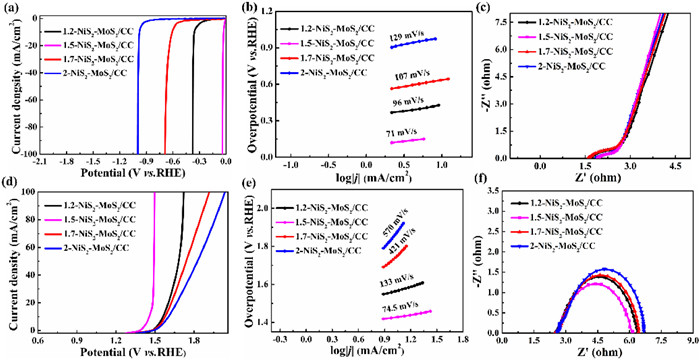
  • The fabrication of bifunctional electrocatalysts for hydrogen and oxygen evolution in aqueous environment has far-reaching significance. Especially, reasonable interface process regulation toward heterogeneous composites can make full use of the active sites and improve the electrocatalytic activity. In this study, we designed and synthesized NiS2-MoS2-based heterogeneous composites as efficient and stable electrocatalysts for hydrogen and oxygen evolution in alkaline electrolyte. The heterostructure was obtained by one-step hydrothermal ulfurization operation towards polymolybdate-based metal-organic complex. The composition and nanostructures can be tailored by modulating experiment parameter, realizing the phase-controlled synthesis and interface regulation: (1) High-percentage of 1T-MoS2 can be achieved via selecting appropriate vulcanization time and thiourea concentration, benifiting for the higher electroconductivity and more active sites; (2) Regular and orderly vulcanization time promotes the gradual growth and aggregation of nanosheets; (3) The existence of nickel hydroxide improves the electrocatalytic stability for oxygen production performance. The optimized heterogeneous interfaces provide sufficient active sites and accelerate electron transfer. Consequently, the optimal heterogeneous nanosheets present low overpotentials of 33 and 122 mV at the catalytic current densities of 10 mA/cm2 for HER and OER, respectively.
  • 加载中
    1. [1]

      S. Yu, D. Liu, C. Wang, et al., J. Colloid Interface Sci. 653 (2024) 1464–1477.

    2. [2]

      H. Shi, Y. Zhang, N. Pang, et al., Electrochem. Acta 439 (2023) 141596.

    3. [3]

      D. Merki, S. Fierro, H. Vrubel, X.L. Hu, Chem. Sci. 2 (2011) 1262–1267.

    4. [4]

      Y. Chen, G. Meng, T. Yang, et al., J. Chem. Eng. 450 (2022) 138157.

    5. [5]

      Y.X. Guo, L.F. Gan, C.S. Shang, E.K. Wang, J. Wang, Adv. Funct. Mater. 27 (2017) 1602699.

    6. [6]

      J. Timoshenko, B.R. Cuenya, Chem. Rev. 121 (2021) 882–961.  doi: 10.1021/acs.chemrev.0c00396

    7. [7]

      X.P. Han, G.W. He, Y. He, et al., Adv. Energy Mater. 8 (2018) 1702222.

    8. [8]

      J.T. Ren, L. Chen, D.D. Yang, Z.Y. Yuan, Appl. Catal. B: Environ. 263 (2020) 118352.

    9. [9]

      B. Tao, L. Yang, F. Miao, Y. Zang, P.K. Chu, J. Phys. Chem. Solids. 150 (2021) 109842.

    10. [10]

      B. Chen, P. Hu, F. Yang, et al., Small 19 (2023) 2207177.

    11. [11]

      H. Xu, J.J. Yi, X.J. She, et al., Appl. Catal. B: Environ. 220 (2018) 379.

    12. [12]

      M. Acerce, D. Voiry, M. Chhowalla, Nat. Nanotechnol. 10 (2015) 313–318.  doi: 10.1038/nnano.2015.40

    13. [13]

      Q. Li, Q. Shang, A. Khalil, et al., ChemCatChem 8 (2016) 2614–2619.  doi: 10.1007/s00167-015-3874-3

    14. [14]

      X.X. Han, X.L. Tong, X.C. Liu, et al., ACS Catal. 8 (2018) 1828–1836.  doi: 10.1021/acscatal.7b03316

    15. [15]

      C.J. Lei, Y. Wang, Y. Hou, et al., Energy Environ. Sci. 12 (2019) 149–156.  doi: 10.1039/c8ee01841c

    16. [16]

      P.Z. Li, N. Chen, A.A. Hamry, et al., Chem. Eng, J. 457 (2023) 141289.

    17. [17]

      B. Gao, Y.W. Zhao, X.Y. Du, et al., Adv. Funct. Mater. 33 (2023) 2214085.

    18. [18]

      H. Miras, L. Vila-Nadal, L. Cronin, Chem. Soc. Rev. 43 (2014) 5679–5699.

    19. [19]

      Y.J. Tang, A.M. Zhang, H.J. Zhu, et al., Nanoscale 10 (2018) 8404–8412.  doi: 10.1039/c8nr00925b

    20. [20]

      Y.T. Song, Y.W. Peng, S. Yao, et al., Chin. Chem. Lett. 33 (2022) 1047–1050.

    21. [21]

      H.Q. Yin, L.L. Yang, H. Sun, et al., Chin. Chem. Lett. 34 (2023) 1047–1050.

    22. [22]

      L. Yang, Z. Zhang, C.N. Zhang, X.L. Wang, Rare Met. 43 (2024) 236–246.  doi: 10.1007/s12598-023-02435-5

    23. [23]

      H.J. Lv, Y.V. Geletii, C.C. Zhao, et al., Chem. Soc. Rev. 41 (2012) 7572–7589.  doi: 10.1039/c2cs35292c

    24. [24]

      Y. Hou, H.J. Pang, L. Zhang, et al., J. Power Sources 446 (2020) 227319.

    25. [25]

      L.H. He, B.B. Cui, B. Hu, et al., ACS Appl. Energy Mater. 1 (2018) 3915–3928.  doi: 10.1021/acsaem.8b00663

    26. [26]

      X. Zhang, F.F. Jia, S.X. Song, Chem. Eng. J. 405 (2021)127013.

    27. [27]

      T.F. Jaramillo, K.P. Jorgensen, J. Bonde, et al., Science 317 (2007) 100–102.  doi: 10.1126/science.1141483

    28. [28]

      K.T. Le, N.N.T. Pham, Y.S. Liao, et al., J. Mater. Chem. A 11 (2023) 3481–3492.  doi: 10.1039/d2ta08461a

    29. [29]

      Z.Y. Zhang, Y.T. Dong, C. Carlos, X.D. Wang, ACS Nano 17 (2023) 17180–17189.  doi: 10.1021/acsnano.3c05014

    30. [30]

      X.M. Geng, W.W. Sun, W. Wu, et al., Nat. Commun. 7 (2016) 10672.

    31. [31]

      M.Q. Liu, J.A. Wang, W. Klysubun, et al., Nat. Commun. 2 (2021) 5260.

    32. [32]

      S.J. Deng, Y. Zhong, Y.X. Zeng, et al., Adv. Mater. 29 (2017) 1700748.

    33. [33]

      Y.F. Yu, G.H. Nam, Q.Y. He, et al., Nat. Chem. 10 (2018) 638–643.  doi: 10.1038/s41557-018-0035-6

    34. [34]

      G. Eda, H. Yamaguchi, D. Voiry, et al., Nano Lett. 11 (2011) 5111–5116.  doi: 10.1021/nl201874w

    35. [35]

      L.Y. Zeng, Z. Liu, K.A. Sun, et al., J. Mater. Chem. A 7 (2019) 25628–25640.  doi: 10.1039/c9ta08030a

    36. [36]

      C.Y. Li, M.D. Liu, H.Y. Ding, et al., J. Mater. Chem. A 8 (2020) 17527–17536.  doi: 10.1039/d0ta04586a

    37. [37]

      C. Karakaya, N. Solati, U. Savacı, et al., ACS Catal. 10 (2020) 15114–15122.  doi: 10.1021/acscatal.0c03094

    38. [38]

      X. Wang, H. Li, H. Li, et al., Adv. Funct. Mater. 30 (2020) 0190302.

    39. [39]

      M.A.R. Anjum, H.Y. Jeong, M.H. Lee, H.S. Shin, J.S. Lee, Adv. Mater. 30 (2018) 1707105.

    40. [40]

      Q. Liu, X.L. Li, Q. He, et al., Small 11 (2015) 5556–5564.  doi: 10.1002/smll.201501822

    41. [41]

      J. Peng, Y.H. Liu, X. Luo, et al., Adv. Mater. 31 (2019) 1900568.

    42. [42]

      J.J. Zhang, C.H. Zhang, Z.Y. Wang, et al., Small 14 (2018) 1703098.

    43. [43]

      T. Niyitanga, H. Kim, J. Power Sources 580 (2023) 233383.

    44. [44]

      C. McCrory, S. Jung, I.M. Ferrer, et al., J. Am. Chem. Soc. 137 (2015) 4347–4357.  doi: 10.1021/ja510442p

    45. [45]

      Z.C. Xing, D.W. Wang, T. Meng, X.R. Yang, ACS Appl. Mater. Interfaces 12 (2020) 39163–39169.  doi: 10.1021/acsami.0c10476

    46. [46]

      Y. Li, D.M. Patel, C.S. Tsang, et al., Adv. Mater. Interfaces 8 (2021) 2001665.

    47. [47]

      A. Eftekhari, Int. J. Hydrog. Energy 42 (2017) 11053–11077.

    48. [48]

      J.Q. Yan, H. Wu, P. Li, et al., J. Mater. Chem. A 5 (2017) 10173–10181.

    49. [49]

      X. Xu, F. Song, X.L. Hu, Nat. Commun. 7 (2016) 12324.

    50. [50]

      H. Zhu, J.F. Zhang, Y. Zhang, et al., Adv. Mater. 27 (2015) 4752–4759.  doi: 10.1002/adma.201501969

    51. [51]

      J. Zhang, T. Wang, D. Pohl, et al., Angew. Chem. Int. Ed. 128 (2016) 6814–6819.  doi: 10.1002/ange.201602237

    52. [52]

      S.S. Chou, N. Sai, P. Lu, et al., Nat. Commun. 6 (2015) 8311.

    53. [53]

      Q. Tang, D.E. Jiang, ACS Catal. 6 (2016) 4953–4961.  doi: 10.1021/acscatal.6b01211

  • 加载中
    1. [1]

      Yan-Rui Zhao Jin Zhang Shi-Kun Yan Guang-Zhi Zhou Ya-Hui Wang Qi-Yue Xin Ji-Xiang Hu . Solvent-coordination directed control of electron transfer dynamics in photoactive complexes. Chinese Journal of Structural Chemistry, 2025, 44(12): 100753-100753. doi: 10.1016/j.cjsc.2025.100753

    2. [2]

      Tiantian Gong Yanan Chen Shuo Wang Miao Wang Junwei Zhao . Rigid-flexible-ligand-ornamented lanthanide-incorporated selenotungstates and photoluminescence properties. Chinese Journal of Structural Chemistry, 2024, 43(9): 100370-100370. doi: 10.1016/j.cjsc.2024.100370

    3. [3]

      Tengteng WangYiming JuYao ChengHaiyang WangDejin Zang . Recent advances in polyoxometalates based strategies for green synthesis of drugs. Chinese Chemical Letters, 2025, 36(5): 109871-. doi: 10.1016/j.cclet.2024.109871

    4. [4]

      Boyuan HuJian ZhangYulin YangYayu DongJiaqi WangWei WangKaifeng LinDebin Xia . Dual-functional POM@IL complex modulate hole transport layer properties and interfacial charge dynamics for highly efficient and stable perovskite solar cells. Chinese Chemical Letters, 2024, 35(7): 108933-. doi: 10.1016/j.cclet.2023.108933

    5. [5]

      Chen LianSi-Han ZhaoHai-Lou LiXinhua Cao . A giant Ce-containing poly(tungstobismuthate): Synthesis, structure and catalytic performance for the decontamination of a sulfur mustard simulant. Chinese Chemical Letters, 2024, 35(10): 109343-. doi: 10.1016/j.cclet.2023.109343

    6. [6]

      Guoping YangZhoufu LinXize ZhangJiawei CaoXuejiao ChenYufeng LiuXiaoling LinKe Li . Assembly of Y(Ⅲ)-containing antimonotungstates induced by malic acid with catalytic activity for the synthesis of imidazoles. Chinese Chemical Letters, 2024, 35(12): 110274-. doi: 10.1016/j.cclet.2024.110274

    7. [7]

      Hanhan ChenYahao SunMingyang ZhangPengtao MaJingping WangJingyang Niu . Self-assembly of cis-trans Ta/W mixed-addendum POMs based on hexalacunary [H2P2W12O48]12− building blocks. Chinese Chemical Letters, 2025, 36(9): 110329-. doi: 10.1016/j.cclet.2024.110329

    8. [8]

      Yang ChuXiao-Hui LiZhong ZhangNa XuDan-Feng HeXiu-Li Wang . Size regulation from single-crystal to nanoscale of a polyoxometalate-based Cu-triazole complex for catalytic oxidation reaction of phenols. Chinese Chemical Letters, 2026, 37(6): 111012-. doi: 10.1016/j.cclet.2025.111012

    9. [9]

      Shaohua YANGNa'na GAOYaqiong GONG . Metal-organic framework-templated construction of FeOOH@CoMoO4/nickel foam heterostructure for enhanced oxygen evolution reaction. Chinese Journal of Inorganic Chemistry, 2025, 41(10): 2175-2185. doi: 10.11862/CJIC.20250218

    10. [10]

      Li-Min CuiWei-Hui FangJian Zhang . Polyoxometalates containing aluminum atoms. Chinese Chemical Letters, 2025, 36(10): 110386-. doi: 10.1016/j.cclet.2024.110386

    11. [11]

      Tengjia Ni Xianbiao Hou Huanlei Wang Lei Chu Shuixing Dai Minghua Huang . Controllable defect engineering based on cobalt metal-organic framework for boosting oxygen evolution reaction. Chinese Journal of Structural Chemistry, 2024, 43(1): 100210-100210. doi: 10.1016/j.cjsc.2023.100210

    12. [12]

      Haoying ZHAILanzong WENWenjie LIAOQin LIWenjun ZHOUKun CAO . Metal-organic framework-derived sulfur-doped iron-cobalt tannate nanorods for efficient oxygen evolution reaction performance. Chinese Journal of Inorganic Chemistry, 2025, 41(5): 1037-1048. doi: 10.11862/CJIC.20240320

    13. [13]

      Yingjin LiJiaming LiHongjun DongWenli ZhangLiqiu ZhangXiulian YinYun WangZuoyi LiuChunmei Li . Recent research progress on metal-organic frameworks and their derivatives heterostructure for photocatalytic CO2 reduction. Chinese Chemical Letters, 2026, 37(6): 112101-. doi: 10.1016/j.cclet.2025.112101

    14. [14]

      Ping WangTing WangMing XuZe GaoHongyu LiBowen LiYuqi WangChaoqun QuMing Feng . Keplerate polyoxomolybdate nanoball mediated controllable preparation of metal-doped molybdenum disulfide for electrocatalytic hydrogen evolution in acidic and alkaline media. Chinese Chemical Letters, 2024, 35(7): 108930-. doi: 10.1016/j.cclet.2023.108930

    15. [15]

      Feng Lin Zhongxin Jin Caiying Li Cheng Shao Yang Xu Fangze Li Siqi Liu Ruining Gu . Preparation and Electrochemical Properties of Nickel Foam-Supported Ni(OH)2-NiMoO4 Electrode Material. University Chemistry, 2025, 40(10): 225-232. doi: 10.12461/PKU.DXHX202412017

    16. [16]

      Ruikui YANXiaoli CHENMiao CAIJing RENHuali CUIHua YANGJijiang WANG . Design, synthesis, and fluorescence sensing performance of highly sensitive and multi-response lanthanide metal-organic frameworks. Chinese Journal of Inorganic Chemistry, 2024, 40(4): 834-848. doi: 10.11862/CJIC.20230301

    17. [17]

      Peiyang DuLing YuanTong BaoYamin XiJiaxin LiYin BiLuli YinJing WangChao Liu . Facet effect of metal-organic frameworks on supporting co-catalysts for photocatalytic hydrogen peroxide production. Chinese Chemical Letters, 2025, 36(11): 110472-. doi: 10.1016/j.cclet.2024.110472

    18. [18]

      Chao Jia Min Ren Yingdi Jin Xingxing Li . Hydrogen migration induced magnetic phase transitions in two-dimensional Fe-porphyrinoid metal-organic frameworks. Chinese Journal of Structural Chemistry, 2026, 45(2): 100801-100801. doi: 10.1016/j.cjsc.2025.100801

    19. [19]

      Huipeng Zhao Xiaoqiang Du . Polyoxometalates as the redox anolyte for efficient conversion of biomass to formic acid. Chinese Journal of Structural Chemistry, 2024, 43(2): 100246-100246. doi: 10.1016/j.cjsc.2024.100246

    20. [20]

      Hongzhe GUOSen WANGLu YANGFucheng LIUJiongpeng ZHAOZhaoquan YAO . Highly selective acetylene capture by a pacs-type metal-organic framework constructed using metal-formate complexes as pore partition units. Chinese Journal of Inorganic Chemistry, 2025, 41(10): 2157-2164. doi: 10.11862/CJIC.20250179

Metrics
  • PDF Downloads(0)
  • Abstract views(905)
  • HTML views(55)

通讯作者: 陈斌, bchen63@163.com
  • 1. 

    沈阳化工大学材料科学与工程学院 沈阳 110142

  1. 本站搜索
  2. 百度学术搜索
  3. 万方数据库搜索
  4. CNKI搜索
Address:Zhongguancun North First Street 2,100190 Beijing, PR China Tel: +86-010-82449177-888
Powered By info@rhhz.net

/

DownLoad:  Full-Size Img  PowerPoint
Return