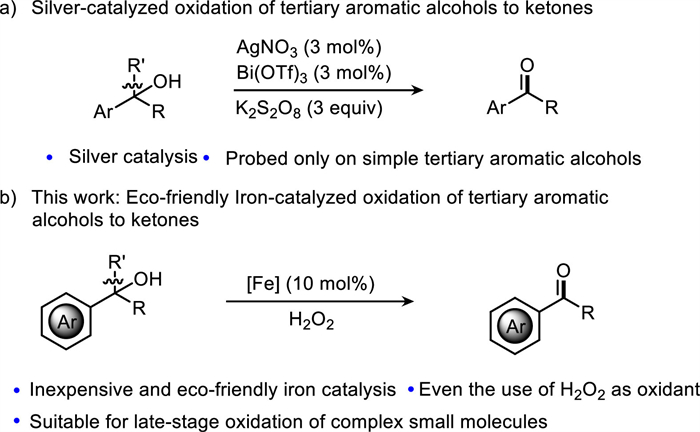
Scheme 1.
Strategies for oxidation of tertiary alcohols to ketones.

Eco-friendly iron-catalyzed oxidation of unstrained tertiary aromatic alcohols to ketones
Shanmei Zhu , Penghui Hu , Mengying Guo , Linlin Zhao , Linlin Yang , Wei-Jin Gu , Wei Han


The oxidation of alcohols to ketones and aldehydes is among the most widely used class of oxidation reactions in organic chemistry [1-3]. However, this process is mainly limited to secondary and primary alcohols. Currently, oxidation of tertiary alcohols to ketones remains a challenge, as the transformation involves inert C−C single bond cleavage [4-17]. Consequently, examples of tertiary alcohol oxidations are rather rare, and their oxidative conversion generally requires a sufficient intrinsic reactive allylic alcohols, strained cyclic alcohols, and diols [18] Thus, expanding the scope of simple tertiary alcohol oxidations remains an important challenge.
Tertiary alcohols are readily accessible alkoxy radicals, leading to a subsequent α-C−C bond cleavage through β-scission to realize deconstruction/functionalization processes [18-40]. Among them, deconstruction/hydrogenation reactions can transform tertiary alcohols to ketones. For instance, Knowles and co-workers first reported the hydrogenative C−C scission of unstrained tertiary aryl alcohols with a p-methoxyphenyl group (PMP) adjacent to the hydroxyl group to give the corresponding 4-methoxyarylketones by using an Ir photocatalyst [41,42]. Subsequently, Hu realized the transformation with a broader scope of substituted phenyl tertiary alcohols by applying FeCl3 as the photocatalyst [36]. However, the scope of the tertiary aromatic alcohols is limited to p-substituted phenyl tertiary alcohols. In addition, these examples rely on the use of the combination of a Brønsted base, and a thiol as hydrogen atom donor. Obviously, the development of new protocols with efficient catalytic activities to overcome the strict substrate limitation is highly desirable. To this end, Huang's group demonstrated Ag-catalyzed oxidation of various tertiary aromatic alcohols to arylketones by using Bi(OTf)3 as the promoter and K2S2O8 (3 equiv.) as the oxidant under mild conditions (Scheme 1a) [43], although the catalytic system is probed only on simple aromatic alcohols.
In a constant search for cleaner methods, there is a definite need for catalytic oxidations that use an inexpensive biorelevant metal as the catalyst and dioxygen (O2) or H2O2 as the stoichiometric oxidant [43-52]. Herein, we describe an unprecedented iron-catalyzed oxidation of diverse unstrained tertiary aromatic alcohols to arylketones even with H2O2 as the oxidant. This newly developed methodology utilizes inexpensive and eco-friendly reagents and tolerates oxidation-labile functional groups, and enables late-stage oxidation of complex molecules (Scheme 1b).
Encouraged by our recent studies on iron-catalyzed oxidations [53,54], we initially investigated the iron-catalyzed oxidation of 2-phenyl-2-propanol (1a) with K2S2O8 as an oxidant in MeCN/H2O and at 60 ℃ (Table 1). When Fe(acac)2 was used, 14% of the desired ketone 2a was observed (entry 1). Other iron sources such as FePc and Fe(OAc)2 resulted in poor results, whereas FeCl3 and FeCl2 can give much better results (81% and 93%, respectively) (entries 2–5). The use of various oxidants was also examined: (NH4)2S2O8, TBHP, and DTBP were inferior to K2S2O8, and environmentally benign H2O2 can give the optimal result (entries 6–9). Without H2O2, the reaction didn't work (entry 18). None of other solvents employed (MeCN, H2O, EtOH/H2O, DMSO/H2O, DMF/H2O, and CH3COCH3/H2O) could replace the MeCN/H2O (entries 10–15). No reaction was observed without an iron catalyst (entry 16). Further, the utilization of ultrapure FeCl2 (99.99% based on trace metals) resulted in a slightly better yield of 2a. These results indicated that trace quantities of other metals in the iron sources do not affect the efficiency of the transformation (entry 17).
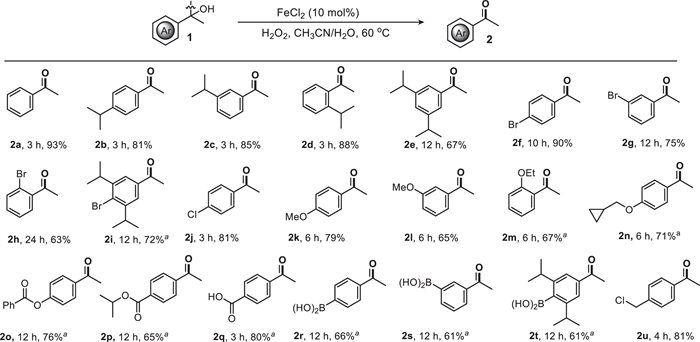
With the optimized iron-catalyzed oxidation in hand, we explored its versatility with a range of diversely substituted tertiary aromatic alcohols (Scheme 2). Tertiary aromatic alcohols having neutral, electronically activated, and deactivated moieties gave the desired arylketones in good to excellent yields with high selectivities. A variety of electron-donating groups such as isopropyl, alkoxy, benzoyloxy, and chloromethyl on the benzene ring were well tolerated (2b-2e, 2k-2o, and 2u). As seen with 2b-2e, 2f-2h and 2m, ortho-, meta-, para-substituted, as well as sterically hindered tertiary aromatic alcohols proceeded successfully. The reactions also worked smoothly with aromatic alcohols bearing ester and even reactive carboxy moieties, and provided good yields (2p-2q) in the presence of extra K2S2O8 (1 equiv.). Gratifyingly, oxidation-labile boronic acid groups were tolerated by this catalytic system, so that they can be used as a handle for further modifications (2r-2t).
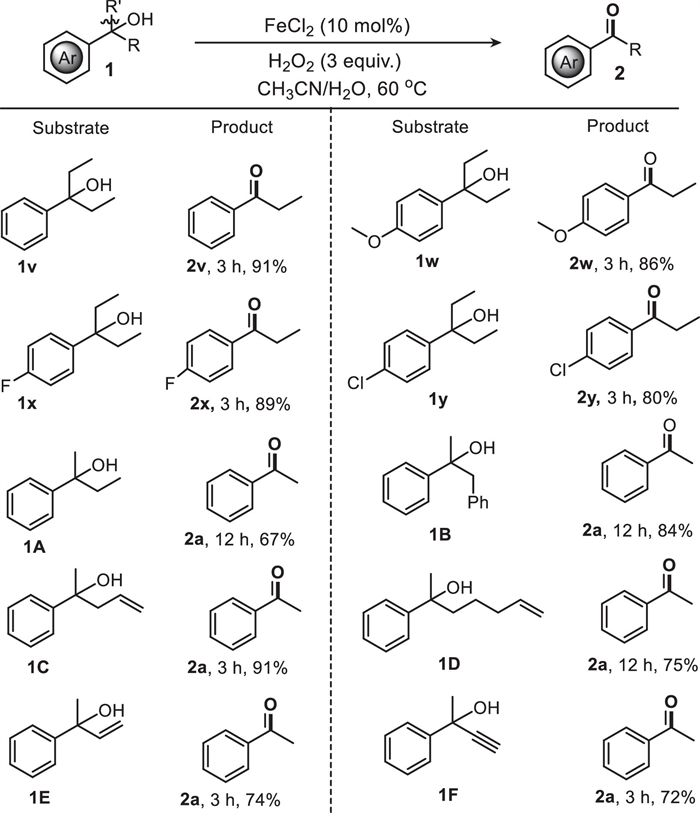
Next, we investigated the scope of the different gem‑disubstituted tertiary arylcarbinols (Scheme 3). They worked equally well to deliver aryl ketones in good to excellent yields. 3-Arylpentan-3-ols bearing neutral, electronically activated, and deactivated moieties show high reactivity (1v-1y). Generally, the high reactivity and selectivity of the C−C bond cleavage relied on the stability of the release of alkyl radicals. For instance, 1A-1C (containing ethyl, benzyl and allyl groups, respectively) transformed smoothly to the corresponding acetophenone 2a in 67%, 84%, and 91% yields. Also 1D bearing a longer alkyl chain proceeded well. In addition, 2-phenylbut-3-en-2-ol (1E) and 2-phenylbut-3-yn-2-ol (1F) underwent selective C-vinyl and C-alkynyl bond cleavages respectively, to provide the corresponding arylketones with satisfactory yields. During the reactions of 1E and 1F, we observed the formation of CO2 by GC, suggesting that vinyl and ethynyl moieties may undergo oxidation cleavage to form a carboxyl group and then decarboxylation to give the desired ketone 2a, consistent with a previous study [55].
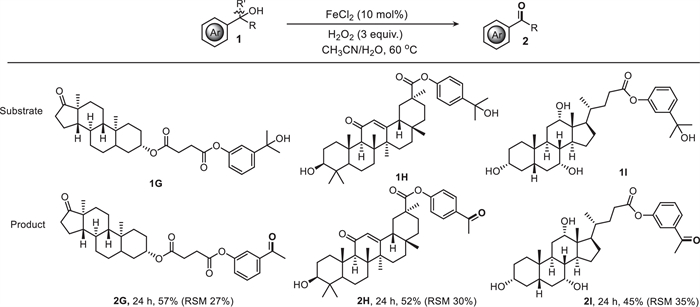
To further demonstrate the utility of this method, late-stage oxidation of complex molecules was evaluated (Scheme 4). 1G derived from bioactive epiandrosterone was a competent substrate and provided the desired ketone 2G in a synthetic useful yield. Similarly, a glycyrrhetnic acid derivative bearing an oxidation-sensitive hydroxy group also proceeded well. Remarkably, cholic acid-derived tertiary aromatic alcohol containing even three hydroxy groups was identified as a viable substrate, making this method more attractive in organic synthesis.
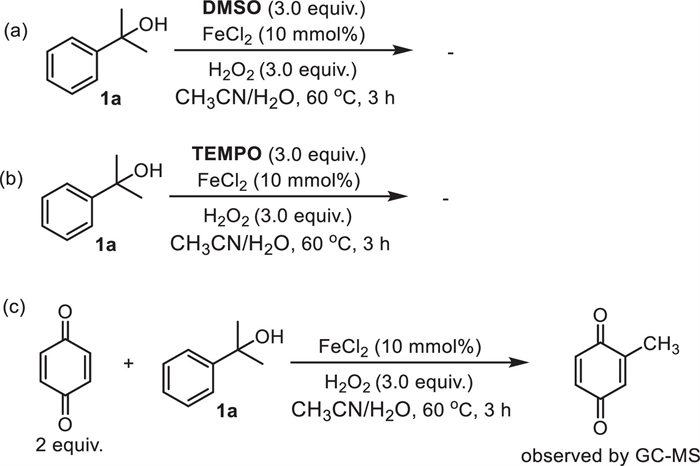
To probe the possible catalytic pathway of the transformation, controlled experiments were carried out (Scheme 5). DMSO, a hydroxyl radical scavenger, was applied with the reaction of 1a, leading to completely inhibition of the reaction [56,57]. This finding suggests that a Fenton process may be present (Scheme 5a). When the reaction was run in the presence of a radical quencher, 2,2,6,6-tetramethylpiperidine N-oxide (TEMPO) [58,59], no reaction occurred (Scheme 5b). Furthermore, introduction of a radical-capture reagent, 1,4-benzoquinone to the reaction of 1a trapped a methyl radical to give methyl-p-benzoquinone detected by GC–MS (Scheme 5c). In addition, α-methylstyrene was not observed during the reaction of 1a, suggesting that a dehydration-oxidation process might be ruled out.
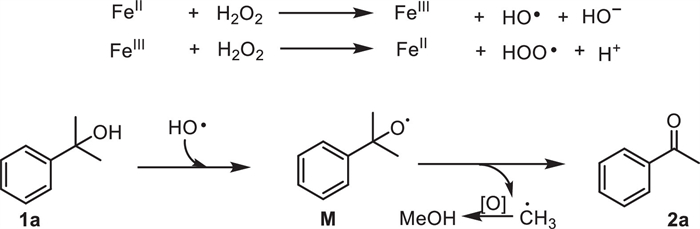
Based on these observations, we propose the mechanism depicted in Scheme 6. The reaction is initiated by a hydroxyl radical generated from a Fenton process [60-62], followed by proton abstraction of tertiary aromatic alcohol to yield the corresponding alkoxyl radical M [63]. The alkoxyl radical M can subsequently undergo β-scission to form arylketone and methyl radical that can produce methanol observed by GC [64,65].
In summary, we developed a highly efficient and eco-friendly iron-catalyzed oxidation of unstrained C−C single bond cleavage of tertiary aromatic alcohols to prepare arylketones even with H2O2 as the oxidant. The established approach is generally applicable to a wide range of tertiary aromatic alcohols and has good functional group tolerance. Notably, late-stage oxidation of structurally complex molecules containing hydroxy groups also works well, revealling great potential in practical organic synthesis.
The authors declare that they have no known competing financial interests or personal relationships that could have appeared to influence the work reported in this paper.
The work was sponsored by the Natural Science Foundation of China (No. 21776139), the “Qing Lan Project” Young and Middle-aged Academic Leaders of Jiangsu Provincial Colleges and Universities, and the Priority Academic Program Development of Jiangsu Higher Education Institutions.
Supplementary material associated with this article can be found, in the online version, at doi:
J.E. Bäckvall, Modern Oxidation Methods, 2nd ed., Wiley-VCH: Weinheim, Germany, 2011.
D. Wang, A.B. Weinstein, P.B. White, S.S. Stahl, Chem. Rev. 118 (2018) 2636–2679. doi: 10.1021/acs.chemrev.7b00334
S. Caron, R.W. Dugger, S.G. Ruggeri, J.A. Ragan, D.H.B. Ripin, Chem. Rev. 106 (2006) 2943–2989. doi: 10.1021/cr040679f
X.Y. Yu, J.R. Chen, W.J. Xiao, Chem. Rev. 121 (2021) 506–561. doi: 10.1021/acs.chemrev.0c00030
L. Chang, Q. An, L. Duan, K. Feng, Z. Zuo, Chem. Rev. 122 (2022) 2429–2486. doi: 10.1021/acs.chemrev.1c00256
Y. Xia, G. Dong, Nat. Rev. Chem. 4 (2020) 600–614. doi: 10.1038/s41570-020-0218-8
G. Fumagalli, S. Stanton, J.F. Bower, Chem. Rev. 117 (2017) 9404–9432. doi: 10.1021/acs.chemrev.6b00599
F. Song, T. Gou, B.Q. Wang, Z.J. Shi, Chem. Soc. Rev. 47 (2018) 7078–7115. doi: 10.1039/c8cs00253c
J. Wang, S.A. Blaszczyk, X. Li, W. Tang, Chem. Rev. 121 (2021) 110–139. doi: 10.1021/acs.chemrev.0c00160
M. Murakami, N. Ishida, Chem. Rev. 121 (2021) 264–299. doi: 10.1021/acs.chemrev.0c00569
M. Tobisu, N. Chatani, Chem. Soc. Rev. 37 (2008) 300–307. doi: 10.1039/B702940N
C.H. Jun, Chem. Soc. Rev. 33 (2004) 610–618. doi: 10.1039/B308864M
S.H. Shi, Y. Liang, N. Jiao, Chem. Rev. 121 (2021) 485–505. doi: 10.1021/acs.chemrev.0c00335
P. Sivaguru, Z. Wang, G. Zanoni, X. Bi, Chem. Soc. Rev. 48 (2019) 2615–2656. doi: 10.1039/c8cs00386f
M.D.R. Lutz, B. Morandi, Chem. Rev. 121 (2021) 300–326. doi: 10.1021/acs.chemrev.0c00154
P.F. Dai, H. Wang, X.C. Cui, J.P. Qu, Y.B. Kang, Org. Chem. Front. 7 (2020) 896–904. doi: 10.1039/c9qo01438a
W, Xiao, J. Wu, Chin. Chem. Lett. 31 (2020) 3083–3094. doi: 10.1016/j.cclet.2020.07.035
K. Wietzerbin, J. Bernadou, B. Meunier, Eur. J. Inorg. Chem. 2000 (2000) 1391–1406.
X. Wu, C. Zhu, Chem. Commun. 55 (2019) 9747–9756. doi: 10.1039/c9cc04785a
H. Yan, G.S. Smith, F.E. Chen, Green Synth. Catal. 3 (2022) 219–226. doi: 10.1016/j.gresc.2022.05.007
J.J. Guo, A. Hu, Y. Chen, et al., Angew. Chem. Int. Ed. 55 (2016) 15319–15322. doi: 10.1002/anie.201609035
L. Huang, T. Ji, M. Rueping, J. Am. Chem. Soc. 142 (2020) 3532–3539. doi: 10.1021/jacs.9b12490
L. Huang, T. Ji, C. Zhu, et al., Nat. Commun. 13 (2022) 809. doi: 10.5114/ada.2022.118926
J. Zhang, Y. Li, R. Xu, Y. Chen, Angew. Chem. Int. Ed. 56 (2017) 12619–12623. doi: 10.1002/anie.201707171
Z. Yang, D. Yang, J. Zhang, et al., J. Am. Chem. Soc. 144 (2022) 13895–13902. doi: 10.1021/jacs.2c05520
Y. Qiu, A. Scheremetjew, L. Ackermann, J. Am. Chem. Soc. 141 (2019) 2731–2738. doi: 10.1021/jacs.8b13692
M. Liu, Z. Zhang, J. Song, et al., Angew. Chem. Int. Ed. 58 (2019) 17393–17398. doi: 10.1002/anie.201908788
X. Wang, Y. Li, X. Wu, ACS Catal. 12 (2022) 3710–3718. doi: 10.1021/acscatal.2c00204
N. Salaverri, B. Carli, S. Díaz-Tendero, L. Marzo, J. Alemán, Org. Lett. 24 (2022) 3123–3127. doi: 10.1021/acs.orglett.2c00662
T. Xue, Z. Zhang, R. Zeng, Org. Lett. 24 (2022) 977–982. doi: 10.1021/acs.orglett.1c04365
D. Wang, J. Mao, C. Zhu, Chem. Sci. 9 (2018) 5805–5809. doi: 10.1039/c8sc01763h
Z. Xu, Z. Huang, Y. Li, et al., Green Chem. 22 (2020) 1099–1104. doi: 10.1039/c9gc03901e
Q.C. Shan, S. Liu, Y. Shen, et al., Org. Lett. 24 (2022) 6653–6657. doi: 10.1021/acs.orglett.2c02663
Y. Wang, Q. He, Z. Cao, et al., Org. Chem. Front. 9 (2022) 5592–5598. doi: 10.1039/d2qo01114j
Q. Wu, W. Liu, M. Wang, Y. Huang, P. Hu, Chem. Commun. 58 (2022) 9886–9889. doi: 10.1039/d2cc03896j
W. Liu, Q. Wu, M. Wang, Y. Huang, P. Hu, Org. Lett. 23 (2021) 8413–8418. doi: 10.1021/acs.orglett.1c03137
C. Yin, W. Liu, Q. Wu, M. Wang, P. Hu, Adv. Synth. Catal. 365 (2023) 1072–1081. doi: 10.1002/adsc.202300183
X. Zhu, Y. Huang, X, Xu, F. Ling, Chin. Chem. Lett. 33 (2022) 817–820. doi: 10.1016/j.cclet.2021.07.030
Y. Liu, L. Wang, L.H. Zeng, et al., Chin. Chem. Lett. 33 (2022) 2383–2386. doi: 10.1016/j.cclet.2021.11.009
L. Ding, K. Niu, Y. Liu, Q. Wang, Chin. Chem. Lett. 33 (2022) 4057–4060. doi: 10.1016/j.cclet.2021.12.053
E. Ota, H. Wang, N.L. Frye, R.R. Knowles, J. Am. Chem. Soc. 141 (2019) 1457–1462. doi: 10.1021/jacs.8b12552
H.G. Yayla, H. Wang, K.T. Tarantino, H.S. Orbe, R.R. Knowles, J. Am. Chem. Soc. 138 (2016) 10794–10797. doi: 10.1021/jacs.6b06517
D. Chen, Y. Zhang, X. Pan, F. Wang, S. Huang, Adv. Synth. Catal. 360 (2018) 3607–3612. doi: 10.1002/adsc.201800612
N. Jiao, S.S. Stahl, Green Oxidation in Organic Synthesis, John Wiley & Sons Ltd, 2019.
A.N. Vedernikov, Acc. Chem. Res. 45 (2012) 803–813. doi: 10.1021/ar200191k
K.P. Bryliakov, Chem. Rev. 117 (2017) 11406–11459. doi: 10.1021/acs.chemrev.7b00167
Z. Cao, Q. Zhu, Y.W. Lin, W.M. He, Chin. Chem. Lett. 30 (2019) 2132–2138. doi: 10.1016/j.cclet.2019.09.041
W.M. He, X. Cui, Chin. Chem. Lett. 32 (2021) 1589–1590. doi: 10.1016/j.cclet.2021.03.013
J. Jiang, F. Xiao, W.M. He, L. Wang, Chin. Chem. Lett. 32 (2021) 1637–1644. doi: 10.1016/j.cclet.2021.02.057
H.Y. Song, F. Xiao, J. Jiang, et al., Chin. Chem. Lett. 34 (2023) 108509. doi: 10.1016/j.cclet.2023.108509
W.H. Bao, Z. Wang, Z. Cao, et al., Adv. Synth. Catal. 363 (2021) 757–761. doi: 10.1002/adsc.202001002
H.Y. Song, J. Jiang, C. Wu, et al., Green Chem. 25 (2023) 3292–3296. doi: 10.1039/d2gc04843d
L. Chen, H. Wang, H. Cai, et al., Science 374 (2021) 77–81. doi: 10.1126/science.abj0731
P. Hu, M. Tang, L. Cheng, et al., Nat. Commun. 10 (2019) 2425. doi: 10.1038/s41467-019-10414-7
M. Irfan, T.N. Glasnov, C. Oliver Kappe, Org. Lett. 13 (2011) 984–987. doi: 10.1021/ol102984h
J. Wang, P. Liu, M. Boronat, et al., Angew. Chem. Int. Ed. 59 (2020) 17225–17228. doi: 10.1002/anie.202005715
J.E. Repine, O.W. Pfenninger, D.W. Talmage, E.M. Berger, D.E. Pettijohn, Proc. Nati. Acad. Sci. U. S. A. 78 (1981) 1001–1003. doi: 10.1073/pnas.78.2.1001
Z. Wang, Q. Liu, R. Liu, et al., Chin. Chem. Lett. 33 (2022) 1479–1482. doi: 10.1016/j.cclet.2021.08.036
N. Meng, Y. Lv, Q. Liu, et al., Chin. Chem. Lett. 32 (2021) 258–262. doi: 10.1016/j.cclet.2020.11.034
H.J.H. Fenton, H.J. Jackson, J. Chem. Soc., Trans. 75 (1899) 1–11. doi: 10.1039/CT8997500001
Z. Tang, P. Zhao, H. Wang, Y. Liu, W. Bu, Chem. Rev. 121 (2021) 1981–2019. doi: 10.1021/acs.chemrev.0c00977
Z. Wang, M. Liu, F. Xiao, et al., Chin. Chem. Lett. 33 (2022) 653–662. doi: 10.3390/machines10080653
M. Bonifačić, D.A. Armstrong, I. Štefanić, K.D. Asmus, J. Phys. Chem. B 107 (2003) 7268–7276. doi: 10.1021/jp027790e
J. Zhao, T. Shen, Z. Sun, et al., Org. Lett. 23 (2021) 4057–4061. doi: 10.1021/acs.orglett.1c01303
T. Shen, S. Liu, J. Zhao, et al., J. Org. Chem. 87 (2022) 3286–3295. doi: 10.1021/acs.joc.1c02947

Scheme 2 Scope of tertiary aromatic alcohols. Reaction conditions (unless otherwise noted): substrate (0.25 mmol), FeCl2 (0.025 mmol), H2O2 (0.75 mmol), MeCN (1.0 mL), H2O (1.0 mL), 60 ℃, air. a substrate (0.25 mmol), FeCl2 (0.025 mmol), H2O2 (0.75 mmol), K2S2O8 (0.25 mmol), MeCN 1.0 mL, H2O 1.0 mL, 80 ℃, air.

Scheme 3 Scope of tertiary aromatic alcohols. Reaction conditions (unless otherwise noted): substrate (0.25 mmol), FeCl2 (0.025 mmol), H2O2 (0.75 mmol), MeCN (1.0 mL), H2O (1.0 mL), 60 ℃, air.

Scheme 4 Late-stage oxidation of complex molecules. Reaction conditions: substrate (0.25 mmol), FeCl2 (10 mol%), H2O2 (3.0 equiv.), K2S2O8 (1.0 equiv.), MeCN/H2O (1 mL/1 mL), 80 ℃, and air. Yields of the isolated products are given; RSM: recovered starting material.

Scheme 6 Proposed pathway of iron-catalyzed oxidation of tertiary aromatic alcohols to ketones.

 扫一扫看文章


扫一扫关注我们
 DownLoad:


 下载:
下载:

 下载:
下载: