

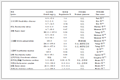
 Table1.
Homopolymerization of BIP in different conditions
Table1.
Homopolymerization of BIP in different conditions
Citation:
Di-zheng Liu, Wei-lin Sun, Rong Ren, Yan-hua Wang, Zhi-quan Shen. Synthesis of Poly[6-(2, 6-bis(1'-methylbenzimidazolyl)pyridin-4-yloxy)hexyl acrylate] (PBIP) and Magnetic Property of Its Neodymium Complex (PBIP-Nd3+)[J]. Chinese Journal of Polymer Science,
2016, 34(7): 910-918.
doi:
10.1007/s10118-016-1804-6

Synthesis of Poly[6-(2, 6-bis(1'-methylbenzimidazolyl)pyridin-4-yloxy)hexyl acrylate] (PBIP) and Magnetic Property of Its Neodymium Complex (PBIP-Nd3+)
English
Synthesis of Poly[6-(2, 6-bis(1'-methylbenzimidazolyl)pyridin-4-yloxy)hexyl acrylate] (PBIP) and Magnetic Property of Its Neodymium Complex (PBIP-Nd3+)
Abstract:
Homopolymer (PBIP) containing 2, 6-bis(1'-methylbenzimidazolyl)pyridine (MeBIP) ligands in the side chain was synthesized by RAFT polymerization and its kinetics was studied. Polymeric complex PBIP-Nd3+ was prepared by chelating PBIP with lanthanide ion Nd3+. The homopolymers and PBIP-Nd3+ complex were investigated by NMR, FTIR, GPC and TGA. The optical property of PBIP-Nd3+ complex was characterized by UV-Vis spectroscopy. The magnetic property of PBIP-Nd3+ complex was measured as a function of temperature (5 K to 300 K) and as a function of field (-3.98 × 10⁶ A/m to 3.98 × 10⁶ A/m). These results indicated that PBIP-Nd3+ complex is paramagnetic.
-
Key words:
- 2, 6-Bis(1'-methylbenzimidazolyl)pyridine
- / Magnetic
- / RAFT
- / Polymeric complex
- / Neodymium
-
INTRODUCTION
In this context, poly[6-(2, 6-bis(1'-methylbenzimidazolyl)pyridin-4-yloxy)hexyl acrylate] (PBIP) and its neodymium complex (PBIP-Nd3+) were prepared for the first time. The best condition and the kinetics of the homopolymerization were explored. Magnetic properties of PBIP-Nd3+ complex were examined as the temperature dependence (5 K to 300 K) at an external field of 2.39 x 10⁶ A/m and as the field dependence (-3.98 x 10⁶ A/m to 3.98 x 10⁶ A/m) at 5 K.
The interest in exploring new metal complexes has been aroused, because of their potential applications in magnetic[1-4], optical[5] and electrical[6] areas. Among organic magnets[7-10], magnetic polymeric metal complexes are mostly investigated for both fundamental scientific and technological reasons. Compared with nitronyl nitroxide radicals[11] and charge transfer complexes[12], magnetic polymeric complexes[13-17] can be easily prepared by various ligands chelating with rare earth or transition metal ions in diverse coordinated modes. As we all know, the basic element of all magnets is the existence of unpaired electrons and how the unpaired electrons interact with each other determines the magnetic behavior of all magnets[18]. Magnetism of polymeric complexes origins from the long range ordering of unpaired electrons through spin-spin interactions[19].
2, 6-Bis(2-benzimidazolyl)pyridine derivate is a kind of important N-containing heterocyclic compounds, which has strong capability of coordination and can form stable complexes with metal ions. The complexes can be used as biocompatible materials[20], catalysts[21], chemical sensors[22], photoelectrical materials[23] and magnetic materials[24, 25]. Up to now, synthesis and magnetic properties of some small molecular magnets with 2, 6-bis(2-benzimidazolyl)pyridine derivates as the chelating ligands have been reported[26-28]. However, preparation of homopolymer containing 2, 6-bis(2-benzimidazolyl)pyridine derivates and magnetic properties of the corresponding polymeric lanthanide complexes have rarely been studied.
EXPERIMENTAL
Synthesis of Monomer 6-(2, 6-Bis(1'-methylbenzimidazolyl)pyridin-4-yloxy)hexyl Acrylate (BIP)
6-MeBIP-OH (6.3 g, 13.8 mmol) and triethylamine (7.7 mL, 55.2 mmol) were dissolved in dry THF (100 mL) and acryloyl chloride (1.5 mL, 27.6 mmol) THF solution (10 mL) was added dropwise at 0℃into the above solution. After the addition was finished, the mixture was reacted at 0℃for 4 h and then at 30℃for 24 h. After reaction, white precipitate was filtrated and the filtrate was concentrated in vacuum. The raw product was dissolved in dichloromethane and the solution was washed successively with saturated NaHCO3, water and brine. The organic layer was collected, dried with sodium sulfate (Na2SO4) and concentrated in vacuum. The obtained crude product was further purified via chromatography (SiO2; CH2Cl2: MeOH=40:1).
Yield: 46%. 1H-NMR (400 MHz, CDCl3, d): 1.46-1.59 (m, 2H), 1.70-1.77 (m, 2H), 1.85-1.92 (m, 4H), 4.19 (t, 2H), 4.25-4.27 (m, 8H), 5.84 (dd, 1H), 6.15 (dd, 1H), 6.34 (dd, 1H), 7.35-7.41 (m, 4H, ph―H), 7.46 (d, 2H, py―H), 7.89 (d, 2H, ph―H), 7.95 (s, 2H, ph―H). 13C-NMR (100 MHz, CDCl3, d): 25.64, 25.71, 28.59, 28.80, 32.55 (CH3), 64.51, 68.49, 109.95, 111.82, 120.14, 122.85, 123.58, 128.60, 130.58, 137.18, 142.45, 150.40, 151.08, 166.34, 166.60 (C=O). FTIR (KBr, n): 2944, 2858, 1724, 1634, 1591, 1567, 1444, 1414, 1388, 1309, 1200, 1026, 878, 862, 741 cm-1. Anal. calcd for C30H31N5O3: C, 70.71; H, 6.13; N, 13.74. Found: C, 70.39; H, 6.144; N, 13.34. MS (ESI, m/z): [M+H]+ calcd for C30H31N5O3, 510.6; Found, 510.4.
Preparation of PBIP-Nd3+ Films and BIP-Nd3+ Films
To prepare PBIP-Nd3+ films, the polymer PBIP and Nd(NO3)3·6H2O were dissolved in a mixture of CH2Cl2 and ethanol (3:1, V/V) at < 1 wt% polymer in solvent. The ratio of Nd3+ to MeBIP groups is 1:1. The solution was stirred for 24 h and then dropped onto a quartz plate to build up film. A cover was placed over quartz plate and let the solvent evaporate over 2 days. BIP-Nd3+ films were prepared with the same procedure.
Materials and Apparatus
4-Hydroxypyridine-2, 6-carboxylic acid and N-methyl-1, 2-phenylenediamine dihydrochloride were purchased from TCI and used as received. 4-Hydroxy-2, 6-bis(1'-methylbenzimidazolyl)pyridine (HO-MeBIP) and 6-(2, 6-bis(1'-methylbenzimidazolyl)pyridin-4-yloxy)hexyl-1-ol (6-MeBIP-OH) were prepared according to the report[29] (supporting information). Neodymium oxide (Nd2O3) was purchased from J & K and used to prepare neodymium nitrate hexahydrate (Nd(NO3)3·6H2O). Azodiisobutyronitrile (AIBN, AkzoNobel, 98%) was recrystallized from methanol. Cyanic (S-dodecyl carbonodithioic) thioanhydride (CTA) was prepared according to the literature[30]. Chlorobenzene was purchased from Aldrich. Tetrahydrofuran (THF) was purified by distillation in the presence of sodium prior to use. Other chemicals were analytical grade and used as received.
NMR data were recorded on a Bruker Advance AMX-400 NMR instrument with deuterated chloroform (CDCl3) as the solvent and tetramethylsilane (TMS) as the internal standard. Fourier transform infrared (FTIR) spectra were obtained on a Bruker Vector 22 FTIR spectrometer using KBr pellets. Gel permeation chromatography (GPC) analyses were carried out at 40℃using THF as the eluent and PS as the standard. Elemental analysis for C, H and N was obtained on an Elementar Vario CHNS-O. Electrospray ionization mass spectrum (ESI-MS) was acquired on a Thermo Finnigan LCQ DECA XP ion trap mass spectrometer, equipped with an ESI source. Ultraviolet-Visible (UV-Vis) spectra were conducted on a UV-1601 UV-Vis spectrophotometer. Metal proportion of PBIP-Nd3+ complex was measured by inductively coupling plasma mass spectrometry (ICP-MS). Variable-temperature (5 K to 300 K) and variable-field (-3.98 x 10⁶ A/m to 3.98 x 10⁶ A/m) magnetic properties of polymeric complex PBIP-Nd3+ were examined by a physical properties measurement system (PPMS-9T) magnetometer (Quantum Design). The measured amount of complex was about 100 mg. Thermogravimetric analysis (TGA) measurements were carried out in nitrogen atmosphere with a Pyris-1 thermogravimetric apparatus at the heating rate of 10 K/min.
Synthesis of Poly[6-(2, 6-bis(1'-methylbenzimidazolyl)pyridin-4-yloxy)hexyl acrylate] (PBIP) by RAFT Polymerization (Take Run 3 of Table 1 for Example)
Conversion: 95%. 1H-NMR (400 MHz, CDCl3, d): 0.82 (s, 1H), 1.14-1.66 (m, 22H), 2.30 (s, 6H), 4.13 (s, 20H), 7.26 (m, 14H), 7.82 (s, 8H). FTIR (KBr, n): 2944, 2861, 1724, 1591, 1567, 1444, 1414, 1388, 1309, 1200, 1026, 878, 862, 741 cm-1.
Homopolymerization of monomer BIP was performed using AIBN as the initiator, chlorobenzene as the solvent, the mixture of ethyl acetate and petroleum ether (7:1, V/V) as precipitator. BIP (101.9 mg, 0.2 mmol), CTA (3.17 mg, 0.01 mmol), AIBN (0.82 mg, 0.005 mmol) and 2 mL chlorobenzene were added into a 10 mL ampule. After three freeze-thawing cycles, the polymerization was carried out at 70℃for 24 h under argon atmosphere. The resulting homopolymer (PBIP) was precipitated in a large excess of precipitator for three times to remove BIP monomer, collected by centrifugation, and dried under high vacuum to obtain a yellowish solid.
Table1.
Homopolymerization of BIP in different conditions
Run Feed ratio of [BIP]:[CTA] [BIP] (mmol/mL) Solvent T (℃) Time (h) Mn(GPC) (kDa) Conversion (%) PDI 1 20:1 0.1 DMF 70 24 4.2 95 1.24 2 20:1 0.1 toluene 70 24 3.6 95 1.26 3 20:1 0.1 CB 70 24 3.8 95 1.23 4 20:1 0.2 CB 70 24 4.0 98 1.28 5 20:1 0.8 CB 70 24 5.7 98 1.19 6 20:1 0.8 CB 65 24 4.5 88 1.24 7 20:1 0.8 CB 75 24 5.0 95 1.24 8 20:1 0.8 CB 70 7 4.9 84 1.18 9 20:1 0.8 CB 70 18 5.2 90 1.17 10 20:1 0.8 CB 70 36 5.7 98 1.20 11 5:1 0.2 CB 70 24 2.1 98 1.19 12 10:1 0.2 CB 70 24 2.8 97 1.14 13 15:1 0.2 CB 70 24 3.3 97 1.22 14 40:1 0.2 CB 70 24 4.8 96 1.28 Conditions: [CTA]:[AIBN]=1:0.5, CB=chlorobenzene Table1. Homopolymerization of BIP in different conditionsPreparation of Polymeric Complex PBIP-Nd3+
Yield: 52%. Nd (wt%)=16.8%. FTIR (KBr, n): 3384, 2934, 2858, 1724, 1605, 1562, 1488, 1383, 1311, 1185, 1131, 1027, 873, 746 cm-1.
5 mL ethanol solution of Nd(NO3)3·6H2O (131.5 mg, 0.3 mmol) was added dropwise into a solution of PBIP (153.0 mg, amount of repeating unit: 0.3 mmol) in dichloromethane under nitrogen atmosphere. The mixture was refluxed at 60℃for 24 h. The resulting precipitate was filtrated and washed with diethyl ether to remove metal ions, dried under high vacuum to obtain a white solid.
RESULTS AND DISCUSSION
Thermal Stability of Polymer PBIP and Polymeric Complex PBIP-Nd3+
The thermogravimetric (TG) curves of polymer PBIP and PBIP-Nd3+ complex are shown in Fig. 6. Due to benzimidazole ring and pyridine ring, PBIP and PBIP-Nd3+ complex show good thermal stability. For PBIP, the temperature of degradation is 370℃for 5% weight loss and the total loss from 350℃to 700℃is 81%. The TG curve of PBIP-Nd3+ exhibits a similar continuous weight loss process to that of other Nd3+ complexes[32]. For PBIP-Nd3+ complex, the weight loss from 250℃to 350℃is ascribed to the loss of coordinated small molecules. The total weight loss of 38% from 250℃to 700℃indicates that PBIP-Nd3+ doesn’t decompose completely at 700℃. Therefore, thermal stability of PBIP-Nd3+ is better than that of those previous reported Nd3+ complexes[32].

Figure 6. Thermogravimetric (TG) curves of polymer PBIP (a) and PBIP-Nd3+ complex (b)
Film-forming Property of Polymeric Complex PBIP-Nd3+
Film-forming property of PBIP-Nd3+ complex was preliminarily studied. As shown in Fig. 9(b), film of PBIP-Nd3+ complex is semi-transparent and homogeneous. But it is brittle and cracks up as the solvent evaporates. While BIP-Nd3+ complex can’t form film from solution of monomer BIP and Nd3+ (Fig. 9d). This may be due to the low viscosity of the solutions. Therefore, the film-forming property of PBIP-Nd3+ complex is not very good.

Figure 9. Quartz plates (a, c), PBIP-Nd3+ film (b) and BIP-Nd3+ complex (d) on the quartz plates
Magnetic Property of Polymeric Complex PBIP-Nd3+

Figure 7. Temperature dependence of cT and the reciprocal of magnetic susceptibility (c-1) for PBIP-Nd3+ complex at an applied magnetic field of 2.39 x 10⁶ A/m (The straight line is a fit to the Curie-Weiss law in the temperature range from 50 K to 300 K.)
The magnetic property of PBIP-Nd3+ complex was investigated as the thermal dependence between 5 and 300 K for the cT value (c is the gram magnetic susceptibility defined by M/(Hm), M being the magnetization, H the external magnetic field fixed at 2.39 x 10⁶ A/m and m the mass of measured PBIP-Nd3+ complex) and as the field dependence at 5 K for M.
From the plot of cT versus T for PBIP-Nd3+ complex (Fig. 7), we know the room temperature cT value for PBIP-Nd3+ complex is 1.3×10⁻⁵ K×m3/kg (T =25℃). With decreasing temperature, the cT product shows a constant value down to 225 K and then it decreases slowly to a value of 5.8×10⁻⁶ K×m3/kg. The magnetic susceptibility for PBIP-Nd3+ complex follows the Curie-Weiss law in the range of 50-300 K. The negative Weiss constant θ is-28.4 K and Curie constant C is 1.1×10⁻³. Below 50 K, the magnetic susceptibility generally deviates from the Curie-Weiss law, and thecT value decreases with the system cooling because of the depopulation of the Stark sublevels of Nd3+ ions.“S”shaped magnetic hysteresis loop (Fig. 8) of PBIP-Nd3+ complex at 5 K gives coercivity Hc=994 A/m and remnant magnetization Mr=0.0016 Am2/kg. From these data and the changing tendency of the plot of cT versus T, it can be referred that PBIP-Nd3+ is paramagnetic. Such behavior is typical of Nd3+ complexes[32-35].

Figure 8. Magnetic hysteresis loop (M versus H) at 5 K for PBIP-Nd3+ complex
Synthesis and Characterization of the Monomer BIP and the Homopolymer PBIP

Figure 3. The value of ln([M]0/[M]) is directly proportional to time

Figure 1. 1H-NMR spectra of BIP (a) and PBIP (b)

Figure 2. FTIR spectra of BIP (a), PBIP (b) and PBIP-Nd3+ (c)
The synthetic procedures of the monomer BIP and homopolymer PBIP are shown in Scheme 1. The structures of monomer BIP and homopolymer PBIP were characterized by 1H-NMR (Fig. 1) and FTIR (Fig. 2). For monomer BIP (Fig. 1a), peaks at d=5.84, 6.15, 6.34 are attributed to protons of the vinyl groups (―CH2=CH) and peak at d=4.19 is attributed to protons nearest to the hydroxyl (―CH2OH). The peaks between d=4.25 to 4.27 belong to protons―CH3 and―CH2O―py. FTIR spectrum of BIP shows the characteristic peaks (Fig. 2a) at 1634 cm-1 and 1724 cm-1 corresponding to the stretching vibration of the vinyl groups (C=C) and the skeletal vibration of carbonyl groups (C=O) respectively. Besides, the successful synthesis of BIP was also confirmed by elemental analysis, mass spectra and 13C-NMR (Fig. S3).
After polymerization, the peaks of the vinyl groups at d=5.84, 6.15 and 6.34 in 1H-NMR (Fig. 1b) and the characteristic peak of C=C at 1634 cm-1 in FTIR (Fig. 2b) disappear completely, indicating the successful synthesis of homopolymer PBIP. The influence of condition on the homopolymerization was investigated (Table 1). Compared to DMF and toluene, it is most likely to reach the narrowest molecular weight distribution (PDI) using chlorobenzene as solvent (Run 1-3). With increasing concentration of monomer BIP, the molecular weight of homopolymer PBIP increases (Run 3-5). Polymerization at different temperatures was also studied and the results show that 70℃is the appropriate temperature to get the highest number average molecular weight (Mn) with the narrowest PDI (Run 5-7). By varying the temperature time (run 5, 8-10) and feed ratio of BIP and CTA (Run 4, 11-14), PBIPs with different molecular weight were obtained and 24 h is long enough to achieve the highest molecular weight (conversion > 95%). All PDIs are less than 1.3, indicating the polymerization is well-controlled by cyanic (S-dodecyl carbonodithioic) thioanhydride (CTA). Furthermore, the kinetics of homopolymerization was studied. The value of ln([M]0/[M]) is directly proportional to time (Fig. 3) and the number average molecular weight (Mn) of PBIP increases linearly with conversion of monomer (Fig. 4). These phenomena follow the law of RAFT polymerization.

Figure Scheme1. Preparation of monomer BIP, homopolymer PBIP and PBIP-Nd3+ complex

Figure 4. Number average molecular weight (Mn) of homopolymer increases linearly with conversion of monomer BIP
Structural and Optical Properties of Polymeric Complex PBIP-Nd3+
UV-Vis absorption curves (Fig. 5) were obtained by adding CH3CN solution of Nd(NO3)3 into a CH2Cl2 solution of PBIP. Upon addition of Nd(NO3)3, the characteristic absorption peaks at 312 nm and 341 nm changed and became saturated. As a result, the quantity ratio of Nd3+ and MeBIP ligands at the saturation point is close to 1:1.
The structural and optical properties of PBIP-Nd3+ complex were investigated by FTIR (Fig. 2) and UV-Vis (Fig. 5). Figure 2 illustrates FTIR spectra of PBIP and PBIP-Nd3+ complex. The characteristic peaks of PBIP-Nd3+ complex are quite different from those of PBIP. After chelating with Nd3+, the vibration of the C=N bond of imidazole ring shifted from 1591 cm-1 to 1605 cm-1. These changes indicate the formation of stable complex. Though single crystal of PBIP-Nd3+ complex can’t be obtained, the structure of PBIP-Nd3+ complex can be deduced from the single crystal of small molecular neodymium complex with 2, 6-bis(1'-methylbenzimidazolyl)pyridine as ligand[31]. In PBIP-Nd3+ complex, Nd3+ is ten-coordinate, binding to three N atoms of a tridentate MeBIP ligand, six O atoms of three bidentate NO3 groups, and one molecule of CH3CH2OH. In theory, the metal content is 16.3%, nearly equal to the actual value 16.8%. It means almost all MeBIP ligands of PBIP chelate with Nd3+.

Figure 5. UV-Vis spectra of solutions of PBIP with different concentrations of Nd(NO3)3
CONCLUSIONS
In conclusion, homopolymer poly[6-(2, 6-bis(1'-methylbenzimidazolyl)pyridin-4-yloxy)hexyl acrylate] (PBIP) was synthesized and the best parameters for the homopolymerization were explored. Polymeric complex PBIP-Nd3+ was formed by MeBIP ligands of PBIP cheating with neodymium ion. 1H-NMR, FTIR and GPC were used to determine the successful preparation of homopolymers and PBIP-Nd3+ complex. Both polymer PBIP and PBIP-Nd3+ complex show good thermal stability. UV-Vis spectroscopy was used to characterize the optical property of PBIP-Nd3+. And PBIP-Nd3+ exhibits a typical paramagnetic behavior in terms of the coercive field, remnant magnetization and the plot of cT versus T.
-
-
[1]
Ungur, L., Lin, S.Y., Tang, J.K. and Chibotarub, L.V., Chem. Soc. Rev., 2014, 43(20): 6894
-
[2]
Zhang, P., Guo, Y.N. and Tang, J.K., Coord. Chem. Rev., 2013, 257(11-12): 1728
-
[3]
Guo, Y.N., Xu, G.F., Wernsdorfer, W., Ungur, L., Guo, Y., Tang, J.K., Zhang, H.J., Chibotaru, L.F. and Powell, A.K., J. Am. Chem. Soc., 2011, 133(31): 11948
-
[4]
Guo, Y.N., Xu, G.F., Gamez, P., Zhao, L., Lin, S.Y., Deng, R.P., Tang, J.K. and Zhang, H.J., J. Am. Chem. Soc., 2010, 132(25): 8538
-
[5]
Karaagac, D. and Kurkcuoglu, G.S., J. Mol. Struct., 2016, 1105: 263
-
[6]
Tartaj, J., Gil, V. and Moure, A., J. Power Sources, 2010, 195(9): 2800
-
[7]
Zhang, P., Zhang, L., Wang, C., Xue, S., Lin, S.Y. and Tang, J.K., J. Am. Chem. Soc., 2014, 136(12): 4484
-
[8]
Guo, Y.N., Ungur, L., Granroth, G.E., Powell, A.K., Wu, C., Nagler, S.E., Tang, J.K., Chibotaru, L.F. and Cui, D., Sci. Rep., 2014, 4: 5471
-
[9]
Lin, S.Y., Wernsdorfer, W., Ungur, L., Powell, A.K., Guo, Y.N., Tang, J.K., Zhao, L., Chibotaru, L.F. and Zhang, H.J., Angew. Chem. Int. Ed. Engl., 2012, 51(51): 12767
-
[10]
Guo, Y.N., Xu, G.F., Guo, Y. and Tang, J.K., Dalton Trans., 2011, 40(39): 9953
-
[11]
Sugano, T., Tamura, M. and Kinoshita, M., Synth. Met., 1993, 56(2): 3305
-
[12]
Miyasaka, H., Madanbashi, T., Sugimoto, K., Nakazawa, Y., Wernsdorfer, W., Sugiura, K.I., Yamashita, M., Coulon, C. and Clerac, R., Chem. Eur. J., 2006, 12(27): 7029
-
[13]
Zheng, R.H., Jiang, H.J., Guo, H.C. and Sun, W.L., Acta Polymerica Sinica (in Chinese), 2011, (5): 435
-
[14]
Zhou, X., Sun, W.L. and Shen, Z.Q., Acta Polymerica Sinica (in Chinese), 2014, (9): 1251
-
[15]
Ding, N.W., Sun, W.L., Lin, Y. and Shen, Z.Q., Chinese J. Polym. Sci., 2012, 30(5): 759
-
[16]
Jiang, H.J., Sun, W.L. and Zheng, R.H., Chinese J. Polym. Sci., 2006, 24(1): 81
-
[17]
Yang, J., Lin, W.H., Sun, W.L., Jiang, H.J. and Shen, Z.Q., Chinese J. Polym. Sci., 2009, 27(1): 131
-
[18]
Miller, J.S., and Epstein, A.J., MRS Bulletin, 2000, 25(11): 21
-
[19]
Maclachlan, M.J., Aroca, P., Coombs, N. and Manners, I., Adv. Mater., 1992, 4: 612
-
[20]
Lai, H.Q., Zhao, Z.N., Li, L.L., Zheng, W.J. and Chen, T.F., Metallomics, 2015, 7(3): 439
-
[21]
Chao, S.J., Bai, Z.Y., Cui, Q., Yan, H.Y., Wang, K. and Yang, L., Carbon, 2015, 82: 77
-
[22]
Li, Z.Q., Hou, Z.H., Ha, D.H. and Li, H.R., Asian J. Chem., 2015, 10(12): 2720
-
[23]
Yang, W.W. and Zhong, Y.W., Chin. J. Chem., 2013, 31(3): 329
-
[24]
Zhang, D.P., Zhuo, S.P., Zhang, H.Y., Wang, P. and Jiang, J.Z., Dalton Trans., 2015, 44(10): 4655
-
[25]
Jeon, L.R., Calancea, S., Panja, A., Pinero Cruz, D.M., Koumousi, E.S., Dechambenoit, P., Coulon, C., Wattiaux, A., Rosa, P., Mathoniere, C. and Clerac, R., Chem. Sci., 2013, 4(6): 2463
-
[26]
Qian, J., Hu, J.C., Yoshikawa, H., Zhang, J.F., Awaga, K. and Zhang, C., Eur. J. Inorg. Chem., 2015, 2015(12): 2110
-
[27]
Panja, A., Guionneau, P., Jeon, I.R., Holmes, S.M., Clerac, R. and Mathoniere, C., Inorg. Chem., 2012, 51(22): 12350
-
[28]
Nihei, M., Okamoto, Y., Sekine, Y., Hoshino, N., Shiga, T., Liu, I.P.C. and Oshio, H., Angew. Chem., 2012, 51(26): 6361
-
[29]
Wang, Z.H., Fan, W.R., Tong, R., Lu, X.L. and Xia, H.S., RSC Adv., 2014, 4: 25486
-
[30]
Chong, Y.K., Moad, G., Rizzardo, E. and Thang, S.H., Macromolecules, 2007, 40(13): 4446
-
[31]
Piguet, C., Williams, A.F., Bernardiuelli, G., Moret, E. and Biinzli, J.C., Helv. Chim. Acta, 1992, 75: 1697
-
[32]
An, H.Y., Han, Z.B. and Xu, T.Q., Inorg. Chem., 2010, 49(24): 11403
-
[33]
Lhoste, J., Perez-Campos, A., Henry, N., Loiseau, T., Rabu, P. and Abraham, F., Dalton Trans, 2011, 40(36): 9136
-
[34]
Ke, H.S., Zhao, L., Xu, G.F., Guo, Y.N., Tang, J.K., Zhang, X.Y. and Zhang, H.J., Dalton Trans., 2009, (47): 10609
-
[35]
Andruh, M., Bakalbassis, E., Kahn, O., Trombe, J.C. and Porchers, P., Inorg. Chem., 1993, 32: 1616
-
[1]
-

 扫一扫看文章
计量
- PDF下载量: 0
- 文章访问数: 1724
- HTML全文浏览量: 47
 下载:
下载: