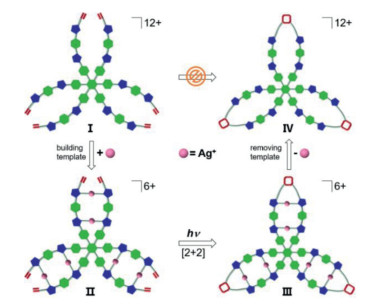
Scheme 1.
Cartoon presentation of the synthetic strategy for the construction of a trefoil-like dodecakisimidazolium cation.

A trefoil-shaped macrocycle with [12]-imidazolium cations
Le Zhang , Li-Ying Sun , Jin-Ping Chang , Hui-Yu Xie , Ya-Wen Zhang , Yi-Fan Zhang , Ying-Feng Han


The discrete macrocyclic compounds, which contain both artificial metal-macrocycles (triangles, rhomboids, squares, hexagons, etc.) [1-12] and non-metal-macrocycles (crown ethers, cyclodextrins, cyclophanes, pillararenes, etc.) [13-18], have made significant progress in the application of host-guest chemistry, selective absorption/recognition, molecular electronic devices and supramolecular catalysis fields over the past decades [19-24]. Among these macrocyclic compounds, the polyimidazolium cyclophanes have drawn considerable attention as unique receptors due to the ionic hydrogen bond (C-H)+···X− between the imidazolium units and guests recently [23, [25-31]. The polyimidazolium cyclophanes can also be utilized as precursors for the formation of functionalized assemblies bearing N-heterocyclic carbenes (NHCs) [32-47].
So far, attempts to make [n]-polyimidazolium-based (n > 4) cyclophanes by one-pot macrocyclization or stepwise macrocyclization processes have proved unsuccessful [48-50], probably due to the multiple incorporations of the dihaloalkanes and bis-imidazole precursors with required connectivity becomes more difficult as reactive sites increases. For example, Beer and co-workers isolated an organic polyimidazolium cation featuring 8 internal imidazolium units only as few crystals incidentally [48]. To overcome this limitation, our group developed a metal-carbene template approach and a series of three-dimensional [n]-imidazolium (n = 6, 12, 16 or 18) cages were controllably constructed [51-55].
In addition, most of the known polyimidazolium cationic compounds only have one macrocyclic unit of polyimidazolium. It should be noted that the increase in the number of macrocycles can bring potential properties [56-60]. For example, Stoddart and co-workers reported a trefoil-like rotaxane, which was used for a molecule elevator [57]. Therefore, the design and synthesis of the polyimidazolium-based compounds featuring more than one macrocyclic unit are imminent and challenging.
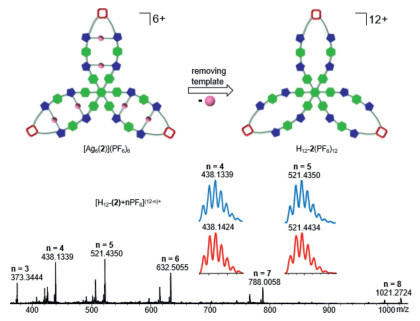
Based on these results, we attempted to construct a trefoil-like 2D C3v symmetric organic [12]-imidazolium cation featuring three [4]-imidazolium macrocycles. Unfortunately, direct synthesis of compound Ⅳ by the one-pot method using the olefin-modified dodecakisimidazolium salt Ⅰ as the precursor failed after various trials. Here, we reported an alternative method by using the precursor Ⅰ to react with Ag2O to generate the hexanuclear AgⅠ assembly Ⅱ. Then photochemically induced [2+2] cycloaddition reaction was performed with complex Ⅱ, thereby leading to a trefoil-like complex containing three closed metallacycles. Finally, all AgⅠ ions in complex Ⅲ could be eventually removed to provide the target compound Ⅳ (Scheme 1).
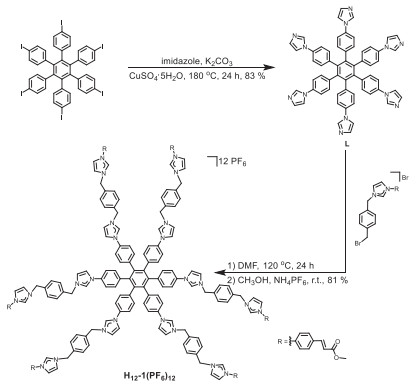
The preparation of 1, 2, 3, 4, 5, 6-hexakis(4-(1H-imidazol-1-yl)phenyl)benzene (L) and N-cinnamic-ester-appended dodecakisimidazolium precursor H12–1(PF6)12 is shown in Scheme 2. Firstly, the compound L was obtained from imidazole and 1, 2, 3, 4, 5, 6-hexakis(4-iodophenyl)benzene [61] by the solid-state reaction using an Ullmann coupling protocol (Fig. S1 in Supporting information) [62, 63]. Subsequently, compound L and N-p-bromomethylbenzene-N'-cinnamic acid methyl ester imidazolium bromide was mixed to yield the corresponding dodecakisimidazolium precursor H12–1(Br)12, followed by the anion exchanged with NH4PF6 in CH3OH to form hexafluorophosphate H12–1(PF6)12 in 81% yield as a white solid. The hexafluorophosphate salt of H12–1(PF6)12 is excellently soluble in DMSO, DMF, and CH3CN, whereas almost insoluble in ether and dichloromethane.
The formation of the dodecakisimidazolium precursor H12–1(PF6)12 was verified by nuclear magnetic resonance (NMR) spectroscopy (1H, 13C{1H}, and 2D NMR) and high-resolution electrospray ionization mass spectrometry (HR-ESI-MS) (Figs. S2-S7 in Supporting information). The 1H NMR spectrum of H12–1(PF6)12 in CD3CN reveals two characteristic resonances for the C2-H protons on imidazolium at δ 9.00 and 8.84 ppm, respectively (Fig. 1a). HR-ESI-MS spectrum provided further support for the formation of dodecakisimidazolium salt. The peaks of the highest intensity for H12–1(PF6)12 were discovered at m/z 632.4934 (calcd. for [H12–1+6PF6]6+ 632.5114), m/z 1021.2212 (calcd. for [H12–1+8PF6]4+ 1021.2495).
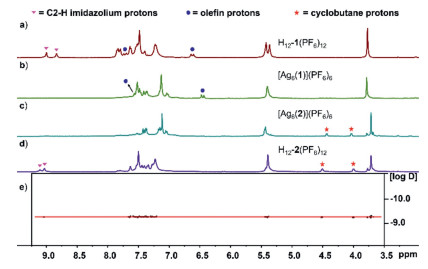
The reaction of H12–1(PF6)12 with an excess of Ag2O generated the 2D C3v symmetric hexanuclear AgⅠ dodecacarbene assembly [Ag6(1)](PF6)6 in 79% yield (Scheme 3), the compound [Ag6(1)](PF6)6 contains two triangular metal silver ions form an inner Ag3 triangle inserted inside a larger outer Ag3 arrangement. The reaction was achieved in CH3CN under the exclusion of light, and the carbene complex was separated as a white solid after workup. The formation of the hexanuclear silver complex was unambiguously confirmed by NMR and HR-ESI-MS studies (Figs. S8-S14 in Supporting information). In the 1H NMR spectra of complex [Ag6(1)](PF6)6, the characteristic resonance of the C2-H protons of H12–1(PF6)12 at δ 9.00 and 8.84 ppm were found to have disappeared (Fig. 1b). The 13C{1H} NMR spectra in CD3CN showed the two expected CNHC signals at δ 182.1 and 180.7 ppm, accompanied by two slightly different imidazolium rings. These values are within the normal range compared with previously reported for such derivatives [64-88]. Diffusion-ordered NMR spectroscopy (DOSY) confirmed the formation of a signal configuration. All proton signals of complex [Ag6(1)](PF6)6 displayed a closely related diffusion coefficient for D = 6.46 × 10⁻¹⁰ m2/s (logD = -9.19). The HR-ESI-MS spectrum further demonstrated the formation of hexanuclear silver complex. For example, the HR-ESI-MS spectrum for [Ag6(1)](PF6)6 appeared two peaks at m/z 593.4065 (calcd for [Ag6(1)]6+ 593.4365), m/z 741.0843 (calcd for [Ag6(1)+PF6]5+ 741.1168), these theoretical isotopic distributions are consistent with the experimental peaks (Fig. S14 in Supporting information). Unfortunately, all attempts to obtain single crystals of the hexanuclear silver complex [Ag6(1)](PF6)6 used for X-ray analysis failed. However, based on the related assemblies [56-60], the 2D C3v symmetric structure [Ag6(1)](PF6)6 could be speculated inScheme 3.
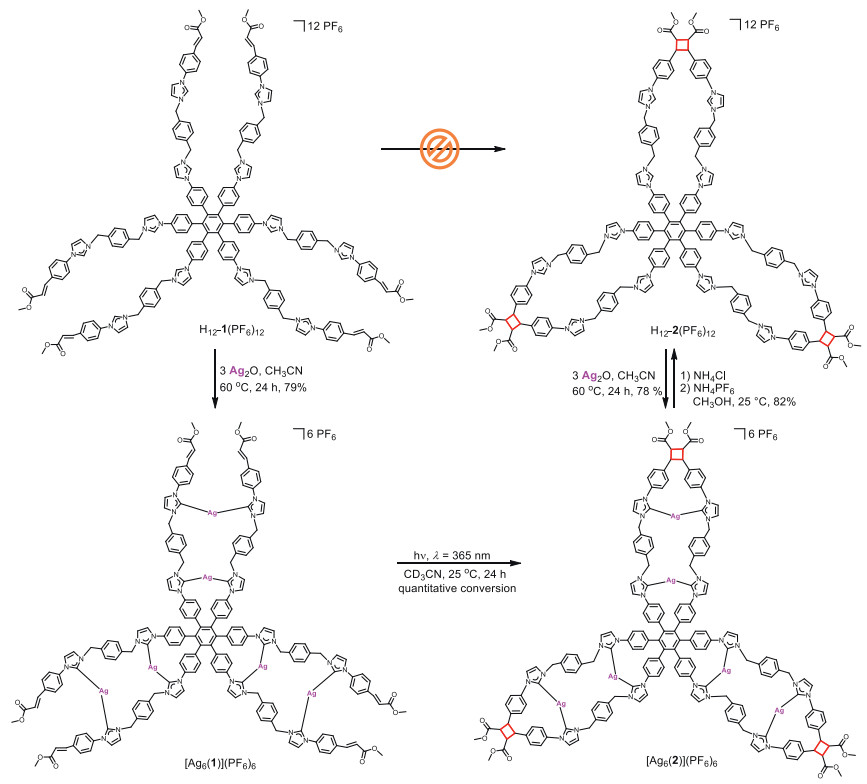
The photochemical reaction of the N-cinnamic-ester-appended hexanuclear AgⅠ dodecacarbene assembly [Ag6(1)](PF6)6 was subsequently investigated (Scheme 3). The complex [Ag6(1)](PF6)6 was treated with a Philips high-pressure mercury lamp (λ = 365 nm) in CD3CN solvent at ambient temperature converted exclusively into the organometallic complex [Ag6(2)](PF6)6. The photochemical [2+2] cyclization reaction was finished within 24 h and the conversion was easily demonstrated by 1H, 13C{1H} NMR spectroscopy.
The formation of the hexanuclear complex [Ag6(2)](PF6)6 featuring three cyclobutanes bridged was monitored by NMR spectroscopy (Figs. S15-S20 in Supporting information). Before irradiation, the 1H NMR spectrum from the olefin protons of [Ag6(1)](PF6)6 features characteristic two doublet resonances of the cinnamic ester groups at δ 7.56 (3J = 16.1 Hz, partly overlapped by other resonances) and 6.46 (3J = 16.1 Hz) ppm (in CD3CN, Fig. 1b). The 1H NMR spectrum revealed that olefin protons resonances of H12–1(PF6)12 (Fig. 1a) slightly shifted upfield after producing to [Ag6(1)](PF6)6. The 13C{1H} NMR spectrum of [Ag6(1)](PF6)6 features signals for the C=C carbon atoms were observed at δ 143.4 and 120.2 ppm (Fig. S9 in Supporting information). After UV-irradiation (λ = 365 nm) for 24 h, the intensity of the olefin doublet resonances completely vanished and two new multiplets for the cyclobutane protons of [Ag6(2)](PF6)6 generated at δ 4.43 and 4.03 (both d, 3J = 5.51 Hz) ppm (in CD3CN, Fig. 1c), while two characteristic peaks for cyclobutane carbons were also found at δ 52.7 and 46.1 ppm (Fig. S16 in Supporting information). Additionally, the formation of [Ag6(2)](PF6)6 featuring three cyclobutanes have demonstrated by the HR-ESI-MS spectrum, showed peaks of highest intensity at m/z 593.4272 (calcd for [Ag6(2)]6+ 593.4365), m/z 741.1054 (calcd. for [Ag6(2)+PF6]5+ 741.1168) (Fig. S21 in Supporting information). Subsequently, UV–vis spectra also clearly revealed the disappearance of the characteristic absorption peaks at around 280 nm, attributed to the C=C double bonds (Fig. S29 in Supporting information). The photochemical [2+2] cycloaddition reaction of precursor H12–1(PF6)12 was performed under the same experimental conditions. However, no target photoproduct was found except the trans-cis photoisomerization as indicated by 1H NMR spectroscopy (Fig. S22 in Supporting information).
In our previous work, it has been confirmed that the newly generated terminal cyclobutanes can connect two poly-NHC ligands after removing the silver ions [51-55]. Inspired by these results, the next generation of trefoil-like dodecakisimidazolium cation H12–2(PF6)12 was prepared. The addition of excess NH4Cl in CH3OH successfully bring the liberation of the six Ag+ ions from hexanuclear complex [Ag6(2)](PF6)6, followed by anion exchange with NH4PF6 provided hexafluorophosphate H12–2(PF6)12 in 82% yield as a white solid (Scheme 3). The trefoil-like dodecakisimidazolium cation H12–2(PF6)12 was fully characterized by NMR spectroscopy and HR-ESI mass spectrometry (Figs. S23-S28 in Supporting information). In the 1H NMR spectrum of H12–2(PF6)12, two resonances were observed at δ 9.10 and 9.03 ppm (Fig. 1d) because of imidazolium groups of dodecakisimidazolium salt H12–2(PF6)12 have two different chemical environments. This is consistent with the dodecakisimidazolium precursor starting material. The intensity ratio of the cyclobutane protons and the imidazolium protons was checked to be 1:1:1:1, indicating the fully de-metalation of complex [Ag6(2)](PF6)6. All proton signals of H12–2(PF6)12 showed a relatively narrow interval with a diffusion coefficient of D = 5.62 × 10⁻¹⁰ m2/s (logD = −9.25), verifying that it is a single assembly (Fig. 1e). Moreover, the HR-ESI-MS spectrum of compound H12–2(PF6)12 (positive-ion mode) revealed peaks of highest intensity at m/z = 438.1339 (calcd for [H12–2+4PF6]8+ 438.1424), m/z = 521.4350 (calcd for [H12–2+5PF6]7+ 521.4434) (Fig. 2). Furthermore, the addition of 3 equiv. Ag2O to H12–2(PF6)12 resulted in regeneration of the hexanuclear cycloaddition product [Ag6(2)](PF6)6. This reaction was achieved after 24 h at 60 ℃ under the exclusion of light (Scheme 3). The HR-ESI-MS spectrum data were similar to those of [Ag6(2)](PF6)6 obtained from the photochemical cycloaddition of [Ag6(1)](PF6)6 (Fig. S21 in Supporting information).
In summary, based on the rational design of a hexagonal poly-NHC precursor, we described the synthesis of two different discrete 2D C3v symmetric hexanuclear AgⅠ dodecacarbene metallacycles and corresponding trefoil-like 2D C3v symmetric organic [12]-imidazolium cation featuring three [4]-imidazolium macrocycles. To the best of our knowledge, this is the first example of 2D polyimidazolium derivative containing three [4]-imidazolium macrocycles. In addition, this approach potentially prepares newly functional two-dimensional polyimidazolium materials under study in our group.
The authors declare that they have no known competing financial interests or personal relationships that could have appeared to influence the work reported in this paper.
The authors gratefully acknowledge financial support from the National Natural Science Foundation of China (Nos. 22025107, 21722105, 22101225), the National Youth Top-notch Talent Support Program of China, the Key Science and Technology Innovation Team of Shaanxi Province (Nos. 2019TD-007, 2019JLZ-02), and the FM & EM International Joint Laboratory of Northwest University.
Supplementary material associated with this article can be found, in the online version, at doi:10.1016/j.cclet.2022.01.064.
P.J. Stang, B. Olenyuk, Acc. Chem. Res. 30 (1997) 502–518. doi: 10.1021/ar9602011
M. Fujita, Chem. Soc. Rev. 27 (1998) 417–425. doi: 10.1039/a827417z
R. Chakrabarty, P.S. Mukherjee, P.J. Stang, Chem. Rev. 111 (2011) 6810–6918. doi: 10.1021/cr200077m
B.H. Northrop, H.B. Yang, P.J. Stang, Chem. Commun. (2008) 5896–5908. doi: 10.1039/b811712h
T.R. Cook, P.J. Stang, Chem. Rev. 115 (2015) 7001–7045. doi: 10.1021/cr5005666
E. Zangrando, M. Casanova, E. Alessio, Chem. Rev. 108 (2008) 4979–5013. doi: 10.1021/cr8002449
D. Luo, B. Pan, J. Zhang, et al., Chin. Chem. Lett. 32 (2021) 1397–1399. doi: 10.1016/j.cclet.2020.11.002
Y.F. Han, W.G. Jia, W.B. Yu, G.X. Jin, Chem. Soc. Rev. 38 (2009) 3419–3434. doi: 10.1039/b901649j
H. Wang, X. Qian, K. Wang, et al., Nat. Commun. 9 (2018) 1815. doi: 10.1038/s41467-018-04247-z
H.B. Yang, C.A. Schalley, Org. Chem. Front. 8 (2021) 5606–5607. doi: 10.1039/d1qo90079j
L. Ma, T. Yang, Z. Zhang, et al., Chin. Chem. Lett. 30 (2019) 1942–1946. doi: 10.1016/j.cclet.2019.07.043
Z. Guo, J. Zhao, Y. Liu, et al., Chin. Chem. Lett. 32 (2021) 1691–1695. doi: 10.1016/j.cclet.2020.12.028
G. Crini, Chem. Rev. 114 (2014) 10940–10975. doi: 10.1021/cr500081p
Z. Liu, S.K.M. Nalluri, J.F. Stoddart, Chem. Soc. Rev. 46 (2017) 2459–2478. doi: 10.1039/C7CS00185A
W.A. Freeman, W.L. Mock, N.Y. Shih, J. Am. Chem. Soc. 103 (1981) 7367–7368. doi: 10.1021/ja00414a070
R. Peng, Y. Xu, Q. Cao, Chin. Chem. Lett. 29 (2018) 1465–1474. doi: 10.1016/j.cclet.2018.09.001
M. Fujita, K. Ogura, Coord. Chem. Rev. 148 (1996) 249–264. doi: 10.1016/0010-8545(95)01212-5
H.W. Schmidt, F. Würthner, Angew. Chem. Int. Ed. 59 (2020) 8766–8775. doi: 10.1002/anie.201915643
Y. Hu, S. Long, H. Fu, et al., Chem. Soc. Rev. 50 (2021) 589–618. doi: 10.1039/d0cs00642d
H. Wu, Y. Chen, L. Zhang, et al., J. Am. Chem. Soc. 141 (2019) 1280–1289. doi: 10.1021/jacs.8b10526
Y. Chen, S. Sun, D. Lu, Y. Shi, Y. Yao, Chin. Chem. Lett. 30 (2019) 37–43. doi: 10.1080/09593330.2017.1377769
D. Xia, P. Wang, X. Ji, et al., Chem. Rev. 120 (2020) 6070–6123. doi: 10.1021/acs.chemrev.9b00839
H. Zhou, Y. Zhao, G. Gao, et al., J. Am. Chem. Soc. 135 (2013) 14908–14911. doi: 10.1021/ja406638b
T.A. Barendt, L. Ferreira, I. Marques, V. Félix, P.D. Beer, J. Am. Chem. Soc. 139 (2017) 9026–9037. doi: 10.1021/jacs.7b04295
K. Chellappan, N.J. Singh, I.C. Hwang, J.W. Lee, K.S. Kim, Angew. Chem. Int. Ed. 44 (2005) 2899–2903. doi: 10.1002/anie.200500119
H.Y. Gong, B.M. Rambo, E. Karnas, V.M. Lynch, J.L. Sessler, Nat. Chem. 2 (2010) 406–409. doi: 10.1038/nchem.597
J. Yoon, S.K. Kim, N.J. Singh, K.S. Kim, Chem. Soc. Rev. 35 (2006) 355–360. doi: 10.1039/b513733k
Z. Xu, S.K. Kim, J. Yoon, Chem. Soc. Rev. 39 (2010) 1457–1466. doi: 10.1039/b918937h
J. Cai, J.L. Sessler, Chem. Soc. Rev. 43 (2014) 6198–6213. doi: 10.1039/C4CS00115J
C.C. Fan, L.J. Xu, H.Y. Gong, Chin. Chem. Lett. 25 (2014) 1125–1131. doi: 10.1016/j.cclet.2014.03.019
B. Shirinfar, N. Ahmed, Y.S. Park, et al., J. Am. Chem. Soc. 135 (2013) 90–93. doi: 10.1021/ja3112274
R. Thapa, S.M. Kilyanek, Dalton Trans. 48 (2019) 12577–12590. doi: 10.1039/c9dt02147g
M.R. Anneser, G.R. Elpitiya, X.B. Powers, D.M. Jenkins, Organometallics 38 (2019) 981–987. doi: 10.1021/acs.organomet.8b00923
T. Lu, C.F. Yang, C.A. Steren, et al., New J. Chem. 42 (2018) 4700–4713. doi: 10.1039/C7NJ04020B
P.J. Altmann, D.T. Weiss, C. Jandl, F.E. Kühn, Chem. Asian J. 11 (2016) 1597–1605. doi: 10.1002/asia.201600198
T. Lu, C.F. Yang, L.Y. Zhang, et al., Inorg. Chem. 56 (2017) 11917–11928. doi: 10.1021/acs.inorgchem.7b01896
F. Fei, T. Lu, C.F. Yang, X.T. Chen, Z.L. Xue, Eur. J. Inorg. Chem. 2018 (2018) 1595–1602. doi: 10.1002/ejic.201800088
P.J. Altmann, A. Pöthig, J. Am. Chem. Soc. 138 (2016) 13171–13174. doi: 10.1021/jacs.6b08571
C. Radloff, H.Y. Gong, C. Schulte to Brinke, et al., Chem. Eur. J. 16 (2010) 13077–13081. doi: 10.1002/chem.201002276
H.M. Bass, S.A. Cramer, A.S. McCullough, et al., Organometallics 32 (2013) 2160–2167. doi: 10.1021/om400043z
M.R. Anneser, S. Haslinger, A. Pöthig, et al., Inorg. Chem. 54 (2015) 3797–3804. doi: 10.1021/ic503043h
A.A. Massie, C. Schremmer, I. Rüter, et al., ACS Catal. 11 (2021) 3257–3267. doi: 10.1021/acscatal.0c04518
C. Kupper, B. Mondal, J. Serrano-Plana, et al., J. Am. Chem. Soc. 139 (2017) 8939–8949. doi: 10.1021/jacs.7b03255
Y. Liu, S.G. Resch, I. Klawitter, et al., Angew. Chem. Int. Ed. 59 (2020) 5696–5705. doi: 10.1002/anie.201912745
R. McKie, J.A. Murphy, S.R. Park, M.D. Spicer, S.Z. Zhou, Angew. Chem. Int. Ed. 46 (2007) 6525–6528. doi: 10.1002/anie.200702138
N.J. Findlay, S.R. Park, F. Schoenebeck, et al., J. Am. Chem. Soc. 132 (2010) 15462–15464. doi: 10.1021/ja107703n
A.A. Danopoulos, T. Simler, P. Braunstein, Chem. Rev. 119 (2019) 3730–3961. doi: 10.1021/acs.chemrev.8b00505
C.J. Serpell, J. Cookson, A.L. Thompson, P.D. Beer, Chem. Sci. 2 (2011) 494–500. doi: 10.1039/C0SC00511H
Y. Chun, N.J. Singh, I.C. Hwang, et al., Nat. Commun. 4 (2013) 1797. doi: 10.1038/ncomms2758
M. Toure, L. Charles, C. Chendo, et al., Chem. Eur. J. 22 (2016) 8937–8942. doi: 10.1002/chem.201601174
K. Hua, M.M. Gan, X.R. Liu, et al., Org. Chem. Front. 8 (2021) 1431–1436. doi: 10.1039/d0qo01617a
L.Y. Sun, N. Sinha, T. Yan, et al., Angew. Chem. Int. Ed. 57 (2018) 5161–5165. doi: 10.1002/anie.201713240
X.X. Gou, T. Liu, Y.Y. Wang, Y.F. Han, Angew. Chem. Int. Ed. 59 (2020) 16683–16689. doi: 10.1002/anie.202006569
L. Zhang, R. Das, C.T. Li, et al., Angew. Chem. Int. Ed. 58 (2019) 13360–13364. doi: 10.1002/anie.201907003
K. Hua, Y.Y. An, Y.Y. Wang, Y.F. Han, Chem. Eur. J. 26 (2020) 7190–7193. doi: 10.1002/chem.202001138
J.D. Badjić, S.J. Cantrill, R.H. Grubbs, et al., Angew. Chem. Int. Ed. 43 (2004) 3273–3278. doi: 10.1002/anie.200453963
J.D. Badjić, V. Balzani, A. Credi, S. Silvi, J.F. Stoddart, Science 303 (2004) 1845–1849. doi: 10.1126/science.1094791
Y. Yamada, M. Okamoto, K. Furukawa, T. Kato, K. Tanaka, Angew. Chem. Int. Ed. 51 (2012) 709–713. doi: 10.1002/anie.201107104
Z. Zhang, T. Hong, S. Li, et al., Organometallics 40 (2021) 1–5. doi: 10.1021/acs.organomet.0c00604
Q. Bai, T. Wu, Z. Zhang, et al., Org. Chem. Front. 8 (2021) 3244–3249. doi: 10.1039/d1qo00336d
T. Hirose, Y. Miyazaki, M. Watabe, et al., Tetrahedron 71 (2015) 4714–4721. doi: 10.1016/j.tet.2015.05.071
F. Monnier, M. Taillefer, Angew. Chem. Int. Ed. 48 (2009) 6954–6971. doi: 10.1002/anie.200804497
D. Ma, Q. Cai, H. Zhang, Org. Lett. 5 (2003) 2453–2455. doi: 10.1021/ol0346584
S. Guang, T. Pickl, C. Jandl, et al., Org. Chem. Front. 8 (2021) 4061–4070. doi: 10.1039/D1QO00588J
R. Maity, A. Rit, C. Schulte to Brinke, J. Kösters, F.E. Hahn, Organometallics 32 (2013) 6174–6177. doi: 10.1021/om400921c
L.L. Ma, Y.Y. An, L.Y. Sun, et al., Angew. Chem. Int. Ed. 58 (2019) 3986–3991. doi: 10.1002/anie.201900221
F.M. Conrady, R. Fröhlich, C. Schulte to Brinke, T. Pape, F.E. Hahn, J. Am. Chem. Soc. 133 (2011) 11496–11499. doi: 10.1021/ja205021p
Y.F. Han, G.X. Jin, F.E. Hahn, J. Am. Chem. Soc. 135 (2013) 9263–9266. doi: 10.1021/ja4032067
Y.F. Han, G.X. Jin, C.G. Daniliuc, F.E. Hahn, Angew. Chem. Int. Ed. 54 (2015) 4958–4962. doi: 10.1002/anie.201411006
M.M. Gan, J.Q. Liu, L. Zhang, et al., Chem. Rev. 118 (2018) 9587–9641. doi: 10.1021/acs.chemrev.8b00119
S. Bai, L.L. Ma, T. Yang, et al., Chem. Sci. 12 (2021) 2165–2171. doi: 10.1039/d0sc06017h
A. Rit, T. Pape, F.E. Hahn, J. Am. Chem. Soc. 132 (2010) 4572–4573. doi: 10.1021/ja101490d
D. Wang, B. Zhang, C. He, P. Wu, C. Duan, Chem. Commun. 46 (2010) 4728–4730. doi: 10.1039/c000793e
A. Rit, T. Pape, A. Hepp, F.E. Hahn, Organometallics 30 (2011) 334–347. doi: 10.1021/om101102j
C. Segarra, G. Guisado-Barrios, F.E. Hahn, E. Peris, Organometallics 33 (2014) 5077–5080. doi: 10.1021/om500729b
N. Sinha, F. Roelfes, A. Hepp, et al., Organometallics 33 (2014) 6898–6904. doi: 10.1021/om500973b
C. Mejuto, G. Guisado-Barrios, D. Gusev, E. Peris, Chem. Commun. 51 (2015) 13914–13917. doi: 10.1039/C5CC05114B
P.J. Altmann, A. Pöthig, Angew. Chem. Int. Ed. 56 (2017) 15733–15736. doi: 10.1002/anie.201709921
N. Sinha, T.T.Y. Tan, E. Peris, F.E. Hahn, Angew. Chem. Int. Ed. 56 (2017) 7393–7397. doi: 10.1002/anie.201702637
Y.S. Wang, T. Feng, Y.Y. Wang, F.E. Hahn, Y.F. Han, Angew. Chem. Int. Ed. 57 (2018) 15767–15771. doi: 10.1002/anie.201810010
Y.W. Zhang, R. Das, Y. Li, Y.Y. Wang, Y.F. Han, Chem. Eur. J. 25 (2019) 5472–5479. doi: 10.1002/chem.201806204
Y. Li, Y.Y. An, J.Z. Fan, et al., Angew. Chem. Int. Ed. 59 (2020) 10073–10080. doi: 10.1002/anie.201912322
Y.W. Zhang, S. Bai, Y.Y. Wang, Y.F. Han, J. Am. Chem. Soc. 142 (2020) 13614–13621. doi: 10.1021/jacs.0c06470
Y. Li, T. Yang, N. Li, et al., CCS Chem. 3 (2021) 957–968. doi: 10.1007/978-981-15-8049-9_58
Z.E. Zhang, Y.Y. An, B. Zheng, J.P. Chang, Y.F. Han, Sci. China Chem. 64 (2021) 1177–1183. doi: 10.1007/s11426-021-9977-5
X.X. Liu, Y. Li, X. Li, F.E. Hahn, Y.F. Han, Sci. China Chem. 64 (2021) 1709–1715. doi: 10.1007/s11426-021-1041-8
J.P. Chang, L.Y. Sun, Z.E. Zhang, et al., Chem. Commun. 57 (2021) 8584–8587. doi: 10.1039/d1cc03416b
Y. Li, J.G. Yu, L.L. Ma, et al., Sci. China Chem. 64 (2021) 701–718. doi: 10.1007/s11426-020-9937-4

Scheme 1 Cartoon presentation of the synthetic strategy for the construction of a trefoil-like dodecakisimidazolium cation.

Figure 1 Partial 1H NMR spectra (400 MHz, 298 K) in CD3CN of (a) dodecakisimidazolium salt H12–1(PF6)12; (b) complex [Ag6(1)](PF6)6 before irradiation; (c) complex [Ag6(2)](PF6)6 obtained after irradiation; (d) dodecakisimidazolium salt H12–2(PF6)12; (e) 1H DOSY spectrum of H12–2(PF6)12.

Scheme 3 Preparation of the hexanuclear AgⅠ dodecacarbene assembly [Ag6(1)](PF6)6, of the organometallic complex [Ag6(2)](PF6)6 and of the dodecakisimidazolium cation H12–2(PF6)12.

 扫一扫看文章


扫一扫关注我们
 DownLoad:
 下载:
下载:


 下载:
下载: