Three-component reaction of triphenylphosphine, dialkyl but-2-ynedioate and arylidene pivaloylacetonitrile for diastereoselective synthesis of densely substituted 2,3-dihydrofurans
Citation:
Qi Wen-Jie, Han Ying, Liu Chang-Zhou, Yan Chao-Guo. Three-component reaction of triphenylphosphine, dialkyl but-2-ynedioate and arylidene pivaloylacetonitrile for diastereoselective synthesis of densely substituted 2,3-dihydrofurans[J]. Chinese Chemical Letters,
2017, 28(2): 442-445.
doi:
10.1016/j.cclet.2016.09.014
Three-component reaction of triphenylphosphine, dialkyl but-2-ynedioate and arylidene pivaloylacetonitrile for diastereoselective synthesis of densely substituted 2,3-dihydrofurans
Three-component reaction of triphenylphosphine, dialkyl but-2-ynedioate and arylidene pivaloylacetonitrile for diastereoselective synthesis of densely substituted 2,3-dihydrofurans
Received Date:
24 June 2016 Accepted Date:
30 August 2016 Revised Date:
05 August 2016 Available Online:
01 February 2017
Abstract:
The three-component reaction of triphenylphosphine, dialkyl but-2-ynedioate and arylidene pivaloylacetonitrile in dry methylene dichloride at room temperature resulted in unexpected densely substituted 1-(triphenyl-λ5-phosphanylidene)ethyl)-2,3-dihydrofurans in satisfactory yields with high diastereoselectivity. The relative configuration of the 2,3-dihydrofurans was elucidated by determination of single crystal structures.
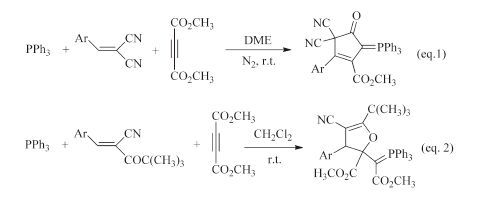
The nucleophilic phosphine catalyzed reactions has become one of most efficient synthetic methodologies in current organic synthetic chemistry [1-4]. These reactions usually started with the addition of trialkyl or triarylphosphine to various reactive alkenes, alkynes, and allenonates to generate a reactive 1, 3-dipolar intermediate. Then, these reactive 1, 3-dipolar intermediates were subsequently captured by suitable substrates to undergo a wide variety of transformations to give versatile carbocyclic and heterocyclic systems [5-15]. As a result, many highly efficient synthetic reactions including new annulations to form carbocycles and heterocycles have been successfully developed [16-29]. In this respect, it has been reported that the three-component reaction of triphenylphosphine, dialkyl but-2-ynedioate and arylidene malononitriles (ethyl cyanoacetate) afforded stable phosphanylidene cyclopentene derivatives [30] (Eq. (1) in Scheme 1). This reaction provided an efficient protocol for construction of functionalized cyclopentenyl system. We envisioned that other arylidene 1, 3-dicarbonyl compounds could be used in the reaction to give diverse functionalized cyclopentene system. Thus, we decided to employ the similar arylidene pivaloylacetonitrile in the reaction and found that the unexpected densely substituted 1-(triphenyl-λ5-phosphanylidene) ethyl)-2, 3-dihydrofurans were formed as main products instead of the functionalized cyclopentene (Eq. (2) in Scheme 1). In continuation of our research subject on nucleophilic phosphine catalyzed domino reactions [31, 32], herein we wish to report the diastereoselective synthesis of densely substituted 1-(triphenyl-λ5-phosphanylidene) ethyl)-2, 3-dihydrofurans with three-component reaction.
Scheme 1
Scheme 1
Formation of phosphanylidene cyclopentene and 2,3-dihydrofuran
Scheme 1.
Formation of phosphanylidene cyclopentene and 2,3-dihydrofuran
According to the previously reported reaction conditions, we initially used dimethyl but-2-ynedioate and benzylidene pivaloylacetonitrile and triphenylphosphine as a model reaction. The reaction was accomplished at room temperature in dry methylene dichloride in less than 1 h to give a product in 75% yield. The spectroscopic and structural analysis showed that the obtained product is the densely substituted 2, 3-dihydrofuran 1a instead of the expected cyclopentene derivatives. Through the phosphinecatalyzed reaction of electron-deficient alkynes with carbonyl group in various aldehydes and ketones to give various g-lactones have been reported in many works [33, 34], there is few examples about phosphine catalyzed synthesis of 2, 5-dihydrofuran derivatives [35, 36]. Thus, we want to explore the substrate scope of the new phosphine-catalyzed reaction by using various arylidene pivaloylacetonitriles. The results are summarized in Table 1. In all cases, the substituted 2, 3-dihydrofurans 1a-1j were produced in satisfactory yields. The electron effect of the aryl group in the substrates displayed marginal effect on the yields. Diethyl but-2-ynedioate can also be used in the reaction to give the products 1k-1m in 78%-85% yields. It should be pointed out that the reaction proceeded smoothly to give pure product, which is easily obtained from reaction mixture by simple washing with alcohol and no further chromatography separation is needed.
表 1
表 1
Synthesis of functionalized 2,3-dihydrofurans 1a–1m.a
Table 1.
Synthesis of functionalized 2,3-dihydrofurans 1a–1m.a
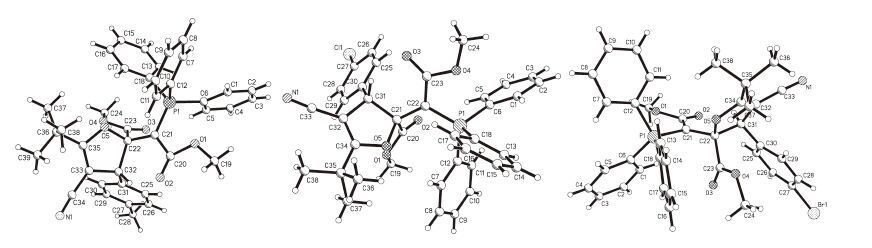
The structures of the substituted 2, 3-dihydrofurans 1a-1m were fully characterized by IR, HRMS, 1H and 13C NMR spectra. The 1H NMR spectra of the compounds 1a-1m showed some unusual feature, in which one methoxy group displayed a normal sharp singlet, while another methoxy group always showed a broad peak. Additionally the characteristic absorption of one proton in the cyclopentenyl ring usually revealed a singlet at very high magnetic field. As for an example, the 1H NMR spectra of the compound 1a showed several peaks at 7.75-7.17 ppm for four phenyl groups, a broad peak at 2.98 ppm and a singlet at 2.45 ppm for two methoxy groups. The tert-butyl group displayed a singlet at 1.33 ppm and the one proton at cyclopentenyl ring gave a singlet at much high magnetic field of 0.81 ppm. This phenomena was mostly attribute to the existence of λ5-triphenylphosphanylidene group in the molecule with the phosphine group coupling with methoxy group and the magnetic anisotropy effect on the shielded CH absorption, respectively. The single crystal structures of three compounds 1c, 1d and 1f (Fig. 1) were determined by X-ray diffraction method, which ambiguously confirmed the structures of the obtained products 1a-1m. The three compounds have same configuration, in which the 3-aryl group and the 2-carboxylate group exist at cis-positions in the newly-formed 2, 3-dihydrofuran ring. The larger 2-(2-ethoxy-2-oxo-1-(triphenyl-λ5-phosphanylidene) ethyl) group exists in the trans-position to the 3-aryl group. Based on the NMR spectra and single crystal structures, we can conclude that all obtained products 1a-1m have this kind of configuration. It might be due to the larger steric effect of 2-(2-ethoxy-2-oxo-1-(triphenyl-λ5-phosphanylidene) ethyl) group in the molecule, only the most stable isomer of product was predominately produced in the reaction and this reaction has a high diastereoselectivity.
图 1
图 1
Single crystal structure of spiro compounds 1c, 1d and 1f.
Figure 1.
Single crystal structure of spiro compounds 1c, 1d and 1f.
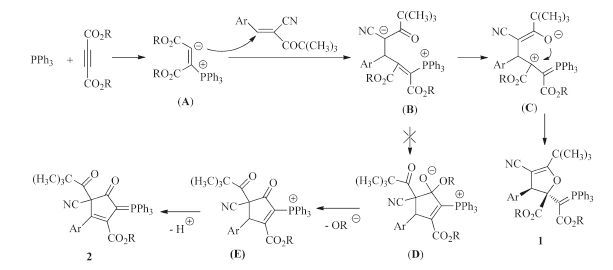
The three-component reaction proceeded straightforwardly. In order to explain this three-component reaction mechanism, a plausible domino reaction path is proposed in Scheme 2 based on the known 1, 4-dipolar addition reactions of triphenylphosphine with electron-deficient alkynes [3, 4, 17]. At first, the addition of triphenylphosphine to dialkyl but-2-ynedioate afforded the expected reactive 1, 3-dipolar intermediate (A). Then, addition of 1, 3-dipole (A) to arylidene pivaloylacetonitrile gave the adduct intermediate (B). Then, the adduct intermediate (B) was transferred to a new intermediate (C) through the enol-keto tautomerization and the migration of double bond. Thirdly, the intramolecular coupling of the positive charge with the negative charge produced the final 2, 3-dihydrofuran 1. Another possible reaction process for the formation of cyclopentene 2 as in the case of arylidene malononitrile might be occur, in which the intramolecular nucleophilic reaction of carbanion with one of ester scaffold produced the cyclic intermediate (D), sequential elimination of methoxide produced the intermediate (E) and deprotonation would give triphenylphosphanylidene cyclopentene 2. However, we did not dictate the formation of the cyclopentene 2 in the reaction, which showed that the enolate ion (C) is much more stable than the carbanion (B) and reaction proceeded to give the final product 1 according this process. The different outcome of product reflected the different reactivity of the carbonyl group in ketone and the carbonyl group in ester.
Scheme 2
Scheme 2
Proposed reaction mechanism for three-component reaction.
Scheme 2.
Proposed reaction mechanism for three-component reaction.
In summary, we have successfully developed an efficient protocol for synthesis of the densely substituted 1-(triphenyl-λ5-phosphanylidene) ethyl)-2, 3-dihydrofurans via three-component reaction of triphenylphosphine, dialkyl but-2-ynedioate and arylidene pivaloylacetonitrile. The advantages of the reaction included using readily available starting materials, mild reaction conditions, operational simplicity, satisfactory yields and with high diastereoselectivity. This reaction not only provided an efficient method for preparing substituted 2, 3-dihydrofuran derivatives, but also further demonstrated the synthetic values of triphenylphosphine catalyzed domino reaction of electrondeficient alkynes. The potential application of this reaction in synthetic and medicinal chemistry may be significant.
4.
Experimental
General procedure for the synthesis of 1', 3'-dihydrospiro[cyclopentane-1, 2'-inden]-2-enes 1a-1m: A mixture of arylidene pivaloylacetonitrile (1.0 mmol) and dialkyl but-2-ynedioate (1.2 mmol) in dry methylene dichloride (10.0 mL) was stirred at room temperature. Then, triphenylphosphine (1.2 mmol, 0.314 g) was added in potions in 10 min. The mixture was stirred at room temperature for 1 h. The solvent was removed by rotator evaporation at reduced pressure. The residue was titrated by ethanol to give the pure product for analysis.
This work was financially supported by the National Natural Science Foundation of China (No. 21172190) and the Priority Academic Program Development of Jiangsu Higher Education Institutions. We also thank the Analysis and Test Center of Yangzhou University providing instruments for analysis.
[1]
X. Lu, C. Zhang, Z. Xu. Reactions of electron-deficient alkynes and allenes under phosphine catalysis[J]. Acc. Chem. Res.,
2001, 34:
535-544.
doi: 10.1021/ar000253x
A. Marinetti, A. Voituriez. Enantioselective phosphine organocatalysis[J]. Synlett,
2010, :
174-195.
[4]
Y. Wei, M. Shi. Multifunctional chiral phosphine organocatalysts in catalytic asymmetric Morita-Baylis-Hillman and related reactions[J]. Acc. Chem. Res.,
2010, 43:
1005-1018.
doi: 10.1021/ar900271g
[5]
L.W. Ye, J. Zhou, Y. Tang. Phosphine-triggered synthesis of functionalized cyclic compounds[J]. Chem. Soc. Rev.,
2008, 37:
1140-1152.
doi: 10.1039/b717758e
[6]
B.J. Cowen, S.J. Miller. Enantioselective catalysis and complexity generation from allenoates[J]. Chem. Soc. Rev.,
2009, 38:
3102-3116.
doi: 10.1039/b816700c
[7]
S.L. Xu, Z.J. He. Reactivities of allenoates with aldehydes under the mediation of tertiary phosphines[J]. Sci. Sin. Chim.,
2010, 40:
856-868.
[8]
C. Zhang, X. Lu. Phosphine-catalyzed cycloaddition of 2,3-butadienoates or 2-butynoates with electron-deficient olefins. A novel[3+2] annulation approach to cyclopentenes[J]. J. Org. Chem.,
1995, 60:
2906.
doi: 10.1021/jo00114a048
[9]
Y.S. Tran, O. Kwon. Phosphine-catalyzed[4+2] annulation:synthesis of cyclohexenes[J]. J. Am. Chem. Soc.,
2007, 129:
12632-12633.
doi: 10.1021/ja0752181
[10]
Q.F. Zhou, F. Yang, Q.X. Guo, S. Xue. Triphenylphosphine-catalyzed isomerization of alkynyl ketones in aqueous solution[J]. Chin. Chem. Lett.,
2007, 18:
1029-1032.
doi: 10.1016/j.cclet.2007.06.024
H. Anaraki-Ardakani, M. Noei, A. Tabarzad. Facile synthesis of N-(arylsulfonyl)-4-ethoxy-5-oxo-2,5-dihydro-1H-pyrolle-2,3-dicarboxylates by one-pot three-component reaction[J]. Chin. Chem. Lett.,
2012, 23:
45-48.
doi: 10.1016/j.cclet.2011.09.010
[13]
F. Sheikholeslami-Farahani, Z. Hossaini, F. Rostami-Charati. Solvent-free synthesis of substituted thiopyrans via multicomponent reactions of α-haloketones[J]. Chin. Chem. Lett.,
2014, 25:
152-154.
doi: 10.1016/j.cclet.2013.10.016
[14]
L.Y. Cui, S.H. Guo, B. Li, X.Y. Zhang, X.S. Fan. Synthesis of cyclopentenyl and cyclohexenyl ketones via[3+2] and[4+2] annulations of 1,2-allenic ketones[J]. Chin. Chem. Lett.,
2014, 25:
55-57.
doi: 10.1016/j.cclet.2013.10.008
[15]
H.Y. Duan, J. Ma, Z.Z. Yuan. Phosphine-promoted[3+2] cycloaddition between nonsubstituted MBH carbonates and trifluoromethyl ketones[J]. Chin. Chem. Lett.,
2015, 26:
646-648.
doi: 10.1016/j.cclet.2015.03.019
[16]
X.F. Zhu, C.E. Henry, O. Kwon. Stable tetravalent phosphonium enolate zwitterions[J]. J. Am. Chem. Soc.,
2007, 129:
6722-6723.
doi: 10.1021/ja071990s
[17]
E. Mercier, B. Fonovic, C. Henry, O. Kwon, T. Dudding. Phosphine triggered[3+2] allenoate-acrylate annulation:a mechanistic enlightenment[J]. Tetrahedron Lett.,
2007, 48:
3617-3620.
doi: 10.1016/j.tetlet.2007.03.030
[18]
S. Xu, L. Zhou, R. Ma, H. Song, Z. He. Phosphane-catalyzed[3+2] annulation of allenoates with aldehydes:a simple and efficient synthesis of 2-alkylidenetetrahydrofurans[J]. Chem. Eur. J.,
2009, 15:
8698-8702.
doi: 10.1002/chem.v15:35
[19]
R. Zhou, C.J. Yang, Y.Y. Liu, R.F. Li, Z.J. He. Diastereoselective synthesis of functionalized spirocyclopropyl oxindoles via P(NMe2)3-mediated reductive cyclopropanation[J]. J. Org. Chem.,
2014, 79:
10709-10715.
doi: 10.1021/jo502106c
[20]
Y.Q. Jiang, Y.L. Shi, M. Shi. Chiral phosphine-catalyzed enantioselective construction of γ-butenolides through substitution of Morita-Baylis-Hillman acetates with 2-trimethylsilyloxy furan[J]. J. Am. Chem. Soc.,
2008, 130:
7202-7203.
doi: 10.1021/ja802422d
[21]
S. Xu, L. Zhou, S. Zeng. Phosphine-mediated olefination between aldehydes and allenes:an efficient synthesis of trisubstituted 1,3-dienes with high Eselectivity[J]. Org. Lett.,
2009, 11:
3498-3501.
doi: 10.1021/ol901334c
[22]
Z. Chen, J. Zhang. An unexpected phosphine-catalyzed regio-and diastereoselective[4+1] annulation reaction of modified allylic compounds with activated enones[J]. Chem. Asian J.,
2010, 5:
1542-1545.
doi: 10.1002/asia.v5:7
[23]
P. Xie, Y. Huang, R. Chen. Phosphine-catalyzed domino reaction:highly stereoselective synthesis of trans-2,3-dihydrobenzofurans from salicyl N-thiophosphinyl imines and allylic carbonates[J]. Org. Lett.,
2010, 12:
3768-3771.
doi: 10.1021/ol101611v
[24]
S. Xu, L. Zhou, R. Ma, H. Song, Z. He. Phosphine-mediated stereoselective reductive cyclopropanation of α-substituted allenoates with aromatic aldehydes[J]. Org. Lett.,
2010, 12:
544-547.
doi: 10.1021/ol902747c
[25]
S. Xu, W. Zou, G. Wu, H. Song, Z. He. Stereoselective synthesis of 1,2,3,4-tetrasubstituted dienes from allenoates and aldehydes:an observation of phosphineinduced chemoselectivity[J]. Org. Lett.,
2010, 12:
3556-3559.
doi: 10.1021/ol101429z
[26]
S.C. Chuang, J.C. Deng, F.W. Chan. [3+2] Cycloaddition of dialkyl (E)-Hex-2-en-4-ynedioates to[60] fullerene by phosphane-promoted tandem α(δ')-Michael additions[J]. Eur. J. Org. Chem.,
2012, 13:
2606-2613.
[27]
P.Y. Tseng, S.C. Chuang. Chemo-, regio-and stereoselective tricyclohexylphosphine-catalyzed[3+2] cycloaddition of enynes with[60] fullerene initiated by 1,4-Michael addition:synthesis of cyclopenteno[60] fullerenes and their electrochemical properties[J]. Adv. Synth. Catal.,
2013, 355:
2165-2171.
doi: 10.1002/adsc.201300255
[28]
A.S. Chavan, J.C. Deng, S. C.. Chuang, α(δ')-Michael addition of alkyl amines to dimethyl (E)-hex-2-en-4-ynedioate:synthesis of α,β-dehydroamino acid derivatives[J]. Molecules,
2013, 18:
2611-2622.
doi: 10.3390/molecules18032611
[29]
Y.W. Lin, J.C. Deng, Y.Z. Hsieh, S.C. Chuang. One-pot formation of fluorescent γ-lactams having an α-phosphorus ylide moiety through three-component α(δ')-Michael reactions of phosphines with an enyne and N-tosyl aldimines[J]. Org. Biomol. Chem.,
2014, 12:
162-170.
doi: 10.1039/C3OB41811A
[30]
V. Nair, A.Deepthi , P.B. Beneesh, S. Eringathodi. Anovel three-component reaction of triphenylphosphine, DMAD, and electron-deficient styrenes:facile synthesis of cyclopentenyl phosphoranes[J]. Synthesis,
2006, 9:
1443-1446.
[31]
Y. Han, Y.J. Sheng, C.G. Yan. Convenient synthesis of triphenylphosphanylidene spiro[cyclopent[2] ene-1,3'-indolines] via three-component reactions[J]. Org. Lett.,
2014, 16:
2654-2657.
doi: 10.1021/ol5008394
[32]
G. Hui, J. Sun, C.G. Yan. Synthesis of (triphenylphosphoranylidene) spiro[cyclopentene-1,3'-indole]s by a three-component reaction of triphenylphosphine, dialkyl acetylenedicarboxylates, and 3-(aroylmethylene)-1,3-dihydro-2H-indol-2-ones[J]. Synthesis,
2014, 46:
2327-2332.
doi: 10.1055/s-00000084
[33]
Y. Han, W.J. Qi, Y.J. Sheng, C.G. Yan. Synthesis of triphenylphosphanylidene cyclopent-2-enecaroboxylates with three-component reaction of triphenylphospine, hex-2-en-4-ynedioate, and β-nitrostyrene[J]. Tetrahedron Lett.,
2015, 56:
5196-5198.
doi: 10.1016/j.tetlet.2015.07.071
[34]
J.C. Deng, F.W. Chan, C.W. Kuo. Assembly of dimethyl acetylenedicarboxylate and phosphanes with aldehydes leading to γ-lactones bearing α-phosphorus ylides as Wittig reagents[J]. Eur. J. Org. Chem.,
2012, :
5738-5747.
[35]
J.C. Deng, S.C. Chuang. Three-component and nonclassical reaction of phosphines with enynes and aldehydes:formation of γ-lactones featuring α-phosphorus ylides[J]. Org. Lett.,
2011, 13:
2248-2251.
doi: 10.1021/ol200527t
[36]
Y. Han, L.Y. Guo, C.G. Yan. Triphenylphosphine catalyzed domino reaction of dialkyl acetylenedicarboxylate with 3-aryl-2-benzoylcyclopropane-1,1-dicarbonitrile[J]. Heterocycl. Commun.,
2015, 21:
329-333.
Scheme 1
Formation of phosphanylidene cyclopentene and 2,3-dihydrofuran



 下载:
下载:



 下载:
下载:


 下载:
下载: