

 Figure 1.
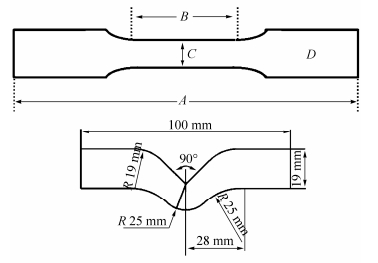
Sketches of the dumbbell specimens (upper part) used in tensile tests: A = 115 mm, B (test length) = 25 mm, C = 6 mm and D = 25 mm and the tear test specimens (bottom part)
Figure 1.
Sketches of the dumbbell specimens (upper part) used in tensile tests: A = 115 mm, B (test length) = 25 mm, C = 6 mm and D = 25 mm and the tear test specimens (bottom part)
Citation:
Hong Yao, Jia-li Niu, Jie Zhang, Nan-ying Ning, Xiao-qiu Yang, Ming Tian, Xiao-li Sun, Li-qun Zhang, Shou-ke Yan. Morphologies and Mechanical Properties of Cis-1,4-butadiene Rubber/Polyethylene Blends[J]. Chinese Journal of Polymer Science,
2016, 34(7): 820-829.
doi:
10.1007/s10118-016-1794-4

Morphologies and Mechanical Properties of Cis-1,4-butadiene Rubber/Polyethylene Blends
English
Morphologies and Mechanical Properties of Cis-1,4-butadiene Rubber/Polyethylene Blends
Abstract:
The mechanical properties and phase morphologies of cis-1,4-butadiene rubber (BR) blended with polyethylene (PE) at different blend ratios were studied. The tensile test results show that the PE exhibits excellent reinforcing capabilities towards BR. Blending BR with PE results in a remarkable enhancement of tensile strength, modulus and the elongation at break simultaneously. An increment of tensile strength from 1.11 MPa to 16.26 MPa was achieved by incorporation of 40 wt% PE in the blends. The modulus and elongation at break of 40/60 PE/BR blends are also about 5 times higher than those of the pure BR treated under exactly the same conditions. The tear test indicates that the tear strength also increases with the increase of PE content. It reaches 58.38 MPa for the 40/60 PE/BR blend, which is approximately 10 times higher than that of the pure BR. Morphological study demonstrates that the PE forms elongated microdomains finely dispersed in the BR matrix when its content is over 30 wt%, which corresponds to the remarkably enhanced mechanical properties. According to the results, reinforcement mechanism of PE toward BR dependent on the microstructure has been discussed and two different mechanisms have been proposed.
-
Key words:
- Polyethylene
- / Cis-1,4-butadiene rubber
- / Blend
- / Mechanical property
- / Morphology
-
INTRODUCTION
Materials comprised of physical mixtures of two or more polymers are very prevalent. By blending, the favorable properties of each polymer can be optimized and completely new properties may be expected. Therefore, polymer blending is regarded as a cost-effective and widely employed way to produce new materials with desired properties. Actually the ability to derive new properties from blends of polymers is a more attractive route than the synthesis of polymers having novel chemistry. This leads to the fact that the study of polymer blends has gained significant momentum over decades. It has been well documented that the macroscopic properties of all kind multicomponent and multiphase polymer systems depend largely on their microscopic phase structure and the interfacial interaction between phases. Taking the elastomeric and thermoplastic blend systems as an example, a special kind of elastomeric and thermoplastic blend generated via dynamic vulcanization, referred as thermoplastic vulcanizates (TPVs), consists of cross-linked elastomeric microdomains dispersed in a limited thermoplastic matrix, leading to the processing characteristics of thermoplastics and rubber-like elasticity. Compared with thermoset rubbers, TPVs can be much more easily processed, which is benefit for the recycling of the materials. It has, therefore, attracted much attention and become technologically very important[1-5]. On the other hand, this kind of blend with limited dispersed elastomeric microdomains is usually employed to modify the toughness of the thermoplastics, while the blends with limited dispersed thermoplastic microdomains are helpful for improving the tensile strength of the elastic materials[6-9]. For example, polyethylene (PE) and polypropylene are often used as rubber reinforcing agents, which offer the advantages of a better mixing, less reactor fouling, and easy recycle of the material[10-12]. Of course, the improvement of the properties depends on not only the structures of the dispersed phases including their dispersal as well as the size and size distribution, but also the morphology in the individual dispersed microdomains, particularly, the crystalline morphology if a semicrystalline component is involved.
Polybutadiene rubber (BR) is one of the most important synthetic elastomers with many practical applications in tire industry and mechanical goods, and has been therefore studied extensively[13, 14]. BR is commonly reinforced by inorganic compounds before use because of its low mechanical strength[15, 16]. Polyethylene, as a kind of crystalline plastics, has much lower density than carbon black and has some compatibility with BR, and thus is expected to have good reinforcing effect on BR. In a previous work[17], we have studied the phase structure and morphology of BR/PE blends with various blend ratios and preparation conditions. It was found that both the phase structure and the crystalline morphology of PE in the isolated microdomains are composition and sample preparation dependent. While round shaped and elongated PE microdomains could be produced depending on the preparation condition, the dispersity of the PE microdomains depends mainly on the PE concentration. With less than 10 wt% PE, PE microdomains separately dispersed in the BR matrix were observed. Both the number and size of the sparsely dispersed PE microdomains increase with increasing PE content. When the PE content is over 10 wt%, impingement and fusion of some PE microdomains occurred, leading to increment of the domain size. At the same time, the separated PE microdomains were connected by PE stripes composed of parallel aligned lamellar aggregates. Keeping the different microstructures in mind, different properties of the blends are expected. Therefore, in this work, the mechanical properties and morphologies of BR/PE blends were studied. High performance BR/PE blends with excellent tensile strength, modulus and elongation at break were obtained. Morphological studies revealed the remarkable dependence of the properties on the microphase structure of the PE component. The purpose of this paper is to present the experimental details and the obtained new results. The phase structure dependent reinforcing mechanism of PE toward BR is discussed accordingly and two reinforcing mechanisms have been proposed.
EXPERIMENTAL
Cis-1,4-polybutadiene (BR, trade name BR9000, cis-1,4-content > 97%, Mn = 6.6 × 10⁴ g/mol, Mw/Mn = 5.2, Mooney viscosity ML1+4 at 100 ℃ = 47) and high density polyethylene (PE, trade name HDPE7600M, a commercial bimodal PE100 resin) were obtained from Sinopec Yanshan Petrochemical Co., SINOPEC, Beijing, China. The number average molecular weight of PE is Mn = 1.0 × 10⁴ and its molecular weight distribution index is Mw/Mn = 27.4. Melt flow index (MFI) of PE is 0.04 g/10min (190 ℃, 2.16 kg) with a density of 0.949 g/cm3. All other chemicals used in this study, sulphur (S), N-cyclohexyl-2-benzothiazole sulfonamide (CZ), zinc oxide (ZnO) and stearic acid (SA) are reagent-grade commercial products.
Uncured BR/PE blends were prepared in the same way as described in previous work[17]. The sulfur-vulcanized samples of BR/PE blends were obtained by a standard mixing/curing procedure. The curing package was comprised with 1.5 parts sulfur, 1 part CZ, 5 parts ZnO and 2 parts SA per100 parts BR. Compounding was carried out in a Haake internal mixer followed by a two-roll mill at room temperature. Vulcanization activators (ZnO and SA) were first incorporated into the blends in an internal batch mixer of a Haake Polylab Reomixer 600P at 30 r/min for 20 min. Then vulcanization accelerator CZ and curing agents sulfur were added into the chamber in sequence and mixed for 10 min, respectively. The mixtures were further mixed with a two-roll mill to ensure a homogeneous dispersion and distribution of all ingredients. The compounds were cured in a XLB-D 350 × 350 hot press (Huzhou East machinery Corporation, China) under 15 MPa at 145 ℃ in a 2 mm thick plate mold. The curing times were determined by rheology curves measured by an oscillating disk rheometer (P3555B2, Beijing Huanfeng Chemical Machinery Experimental Factory, China). The molds with vulcanized test sheets were transferred from the hot press to a press at room temperature to cool down under pressure for 3 min.
Dumbbell shaped tensile test samples and 90° angle tear test specimens (Fig. 1) were punched out from the compression molded sheet. Tensile and tear tests were performed on a CMT4104 electrical tensile tester (SANS, Shenzhen, China) at a crosshead speed of 500 mm/min according to relevant ISO standards (ISO37and ISO34-1) at ambient temperature, respectively. An average of five samples is reported here.
Figure 1.
Sketches of the dumbbell specimens (upper part) used in tensile tests: A = 115 mm, B (test length) = 25 mm, C = 6 mm and D = 25 mm and the tear test specimens (bottom part)
The surface morphology of the samples was imaged by atomic force microscopy (AFM) in air at room temperature and scanning electron microscopy (SEM). AFM characterization was performed in tapping mode, using a peak force tapping atom force microscope (PF-AFM) (Nanoscope Ⅲa, Bruker Corporation, Germany). All images were collected with a scanning raster rate of 1 Hz. Before the observations, the samples were polished at -130 ℃ to get a smooth surface by using a cryo-ultramicrotome (Leica EM UC7; Germany). SEM was performed on a JEOL JSM 6700F instrument to observe the surface morphology of tensile fractured samples. The specimens were sputtered with a thin layer of gold before observation.
RESULTS AND DISCUSSION
Stress-strain experiments were conducted to illustrate the influence of PE component on the mechanical properties of the BR rubber. The characteristic mechanical properties for each sample were obtained through the average of five stress-strain curves. We show here only a selected subset of the stress-strain curves. Engineering stress of representative examples plotted against nominal strain of the blends with various blend ratios are shown in Fig. 2. For clarity, the stress-strain curve of cured BR homopolymer is also presented in Fig. 2 as a reference. The average values of the mechanical parameters of blends and neat BR obtained from tensile tests are summarized in Table 1. From Fig. 2, one can see that, for all of the samples, no yielding point in the stress-strain curves was observed, indicating a typical elastic deformation. The neat BR rubber exhibits a nonlinear rubbery behavior typical for cross-linked polymers above their glass transition temperatures. It suffers a brittle break-up at the elastic region at a strain of ~160%. The tensile modulus and strength are very low (0.85 and 1.11 MPa, respectively) and no strain hardening was observed. This is reasonable if the strain-induced crystallization is considered as the origin of strain hardening. Gent and coworkers reported that the BR could crystallize at low temperatures, e.g., lower than -15 ℃, only to a rather low degree of about 20%. It was further found that even though the crystallization of BR under tension is remarkably accelerated at low temperatures, no crystallization takes place for BR samples at room temperature until strain is 400%-600%. Even at high strain of 650%-750%, the degree of BR crystallinity is only about 6%-11%[18].
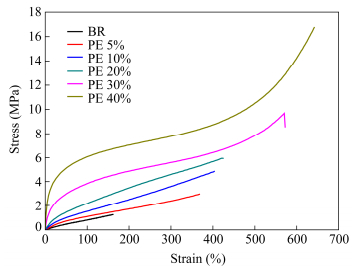 Figure 2.
The stress-strain curves of PE/BR blends with different blend ratios as indicated
Figure 2.
The stress-strain curves of PE/BR blends with different blend ratios as indicated
 Table 1.
Average values of tensile strength, elongation at break, Young’s modulus at different strains and tear strength of BR/PE blends with different PE contents
Table 1.
Average values of tensile strength, elongation at break, Young’s modulus at different strains and tear strength of BR/PE blends with different PE contents
PE (wt%) Tensile strength (MPa) Elongation at break (%) 100% Modulus (M100) (MPa) 200% Modulus (M200) (MPa) 300% Modulus (M300) (MPa) 500% Modulus (M500) (MPa) Tear strength (kN/m) 0 1.11 ± 0.08 141 ± 11 0.85 - - - 6.67 ± 0.72 5 2.59 ± 0.14 315 ± 29 1.10 1.74 2.39 - 14.25 ± 0.74 10 4.06 ± 0.24 339 ± 23 1.53 2.50 3.59 - 21.13 ± 0.85 20 5.24 ± 0.26 353 ± 36 2.45 3.81 4.81 - 28.12 ± 0.77 30 8.38 ± 0.45 528 ± 42 3.25 4.53 5.54 7.97 46.55 ± 1.48 40 16.26 ± 0.48 600 ± 42 5.89 6.83 7.61 11.06 58.38 ± 1.63 Table 1. Average values of tensile strength, elongation at break, Young’s modulus at different strains and tear strength of BR/PE blends with different PE contentsFrom both Fig. 2 and Table 1, it can be seen that there are significant improvements in mechanical properties of the PE blended BR composites, compared with those of the neat BR. The values of several tensile parameters of the blends and neat BR, evaluated from the stress-strain curves of Fig. 2, are presented in Figs. 3(a)-3(d) as a function of PE concentration. From Fig. 3(a) and Table 1, it is clear that the tensile strength of the blends increases remarkably with increasing PE contents. A loading of 5 wt% PE leads to the increases of the tensile strength from 1.11 MPa for the pure BR to 2.59 MPa for the blend. With further increase of the PE content, continuous increment of the tensile strength is observed. When the PE content reaches 40 wt%, the tensile strength of the blend has been increased to 16.26 MPa, which is about 16 times higher than that of the pure BR. According to these results, it is clear that the introduction of PE in BR leads to a remarkable improvement of tensile strength.
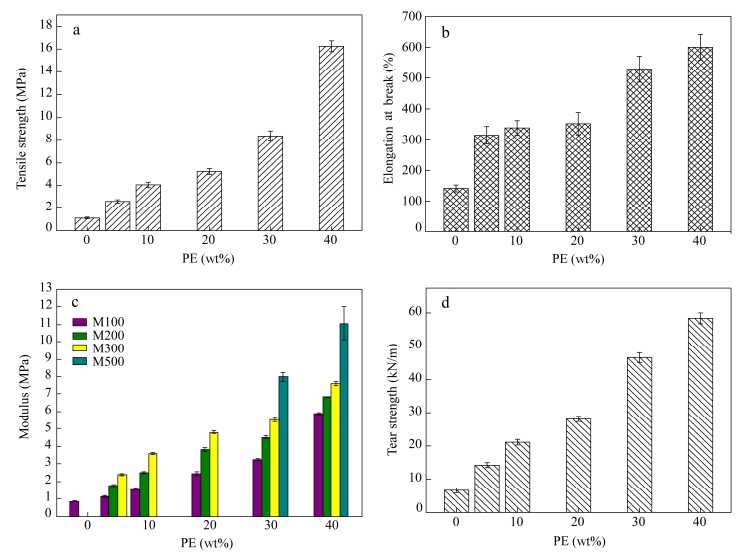 Figure 3.
Average values of (a) tensile strength, (b) elongation at break, (c) Young’s modulus and (d) tear strength of BR/PE blends versus PE content
Figure 3.
Average values of (a) tensile strength, (b) elongation at break, (c) Young’s modulus and (d) tear strength of BR/PE blends versus PE content
The improved tensile strength is related to the presence of hard PE domains. It is well known that the strength increases generally with hard domain content at the expense of the toughness. Therefore, a critical challenge is to increase the stiffness and the strength of the blends without decreasing their extensibility. The change of elongation at break of the BR/PE blends with different blend ratios is shown in Fig. 3(b). Like the case of tensile strength, a 5 wt% PE also induces an increment for about 2-fold of the elongation at break as compared to the pure BR. A high elongation at break of > 500% is obtained for the samples with PE content higher than 30 wt%. The elongation at break increased up to 600% for the 60/40 BR/PE blend, which is about 5 times higher than that of the pure BR. This implies that blending PE with BR provides an efficient approach to produce BR based composites with superior strength and toughness.
Another improved property is the tear strength. As presented in Fig. 3(d), the tear strength of the 95/5 BR/PE blend is 2 times higher than that of pure BR as well. A change of about order of magnitude in tear strength, from 6.67 kN/m to 58.38 kN/m, is achieved when PE content reaches 40 wt%. Figure 3(c) shows the variation trend of the modulus at different elongations. From Fig. 3(c), it can be seen that at low PE content, e.g. 5 wt%, only a slight increase in modulus is achieved at each elongation measured. For the 60/40 BR/PE blend, the modulus is enhanced for several times with respect to the pure BR. The above tensile test results indicate that blending PE with BR provides an effective way to reinforce the BR, which leads to simultaneous increase of tensile and tear strengths, modulus as well as elongation at break. The simultaneous improvement of modulus, strength and toughness is very intriguing.
It was further found during experiment that even though the blends present good ductility with similar values of strain at break and good elastomeric properties, a 100% recovery of the sample after the break is never reached. The permanent sets of the samples with less than 10 wt% PE are found to be within the range of 4%-8%, indicating that the sample blended even with a small amount of PE undergoes already some tiny extent irreversible plastic deformation upon stretching. For the 80/20 BR/PE blend, the permanent set increases slightly up to 10%-12%. With further increase of PE to 30 wt% or 40 wt%, the permanent set sharply increased with the increase of stress and the initial modulus. The permanent set value increased to about 60% for 70/30 BR/PE blend and 120% for 60/40 BR/PE blend, respectively. The large residual deformation should be related to the high crystallinity of the PE component.
Moreover, in the stress-strain curves of the blends with less than 30 wt% PE, no strain hardening phenomenon was observed as the BR rubber itself. The stress-strain curves of the blends with more than 30 wt% PE exhibit sigmoid shape with a sharp rise of the initial modulus and an evident strain hardening. This can be understood in the following way. The samples with less than 30% PE exhibit an elongation at break lower than 400%. In this case, strain-induced crystallization does not take place for the BR. As a consequence no strain hardening was observed. With increasing amounts of PE in BR, the improved extensibility ensures the sample to deform more than 500% before break. Therefore, strain-induced crystallization takes place at high strain, resulting in strain hardening of the materials. Moreover, the strain hardening is also associated with interfacial slippage of multiphase materials due to the formation of interpenetrated networks of PE and rubber at high PE content, which cause a relief in the accumulation of stress in the matrix.
From the above mechanical test results, it is clear that blending PE with BR results in remarkable enhancements of tensile strength, tear strength, modulus as well as the elongation at break. This means that PE exhibits excellent reinforcing capabilities of the BR. Of course, as mentioned in the Introduction part, the macroscopic properties of multicomponent and multiphase polymer systems depend largely on both the microscopic morphology and phase structure. In an early study the morphology of the BR/PE blends demonstrated phase structure of the material dependent on a blend ratio[17]. It was found that, in the blends with less than 10 wt% PE, the PE component exists in small microdomains with diameters less than 2 μm dispersed separately in the BR matrix. The number and size of the PE domains increase with increasing PE contents. When the PE content is over 20 wt%, larger PE domains of ~10 μm in diameter connected by the narrow stripes with parallel aligned lamellar aggregates were observed. Taking these into account, the composition dependent mechanical performance of the BR/PE blends should essentially be related to the different multiscale structures. To verify the validity of this hypothesis, the morphologies of the samples after curing used for mechanical property measurements were studied by scanning electron and atomic force microscopies.
Figure 4 shows the AFM height and amplitude images of vulcanized PE/BR blends with different blend ratios. At low PE loading, e.g., less than 20 wt%, the morphologies of the vulcanized PE/BR blends are similar to those observed for pristine PE/BR blends. Finely dispersed isolated PE microdomains with dimension ranging from hundreds of nanometers to micrometers can be clearly recognized, as seen in Figs. 4(a) and 4(b). With increasing PE contents, the size of the PE microdomains increases. At the same time, the PE domains get elongated, seen in Figs. 4(c) and 4(d). For the samples with 40 wt% PE, see Fig. 4(e), approximately parallel aligned lathlike PE domains are recognized. The aspect ratio of the PE domains is estimated to be over 10. It should be pointed out that the PE in BR matrix exhibits still crystallinity after vulcanizing. The crystallinity is confirmed by DSC measurement to be increased with increasing PE component, similar to those observed before vulcanization.
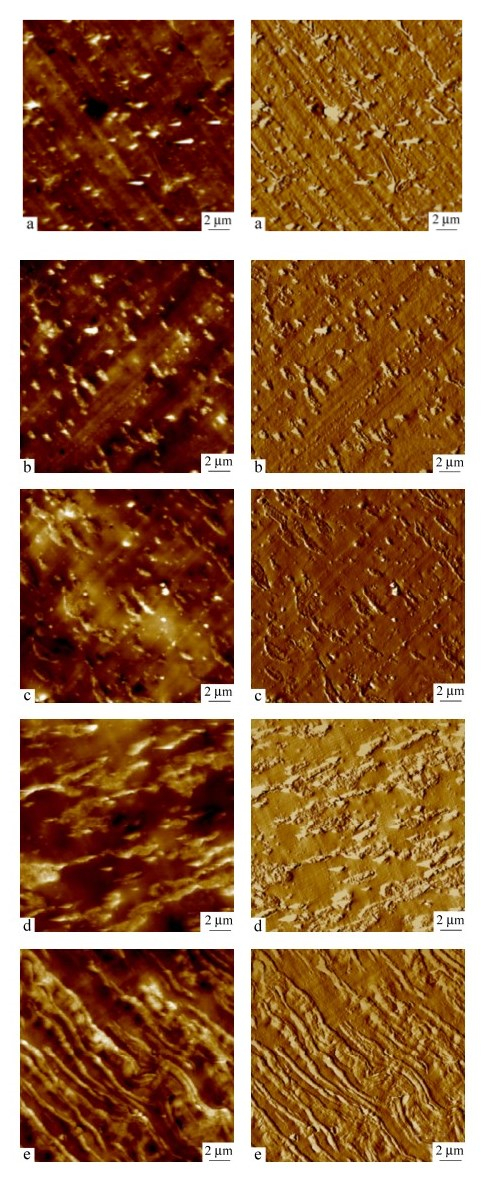 Figure 4.
AFM height (left) and amplitude (right) images of vulcanized PE/BR blends with different blend ratios: (a) 5/95, (b) 10/90, (c) 20/80, (d) 30/70 and (e) 40/60
Figure 4.
AFM height (left) and amplitude (right) images of vulcanized PE/BR blends with different blend ratios: (a) 5/95, (b) 10/90, (c) 20/80, (d) 30/70 and (e) 40/60
According to the above morphological feature, the reinforcement mechanism of PE toward the BR is different depending on the PE content, which can be explained in the following way. When the content of PE is lower than 20%, the crystalline PE phase with submicron size is dispersed in BR continuous phase. In this case, the reinforcing mechanism of PE on BR is similar with that of carbon black on rubber, as reported in previous studies[19, 20]. When the content of PE is 20%, some PE sheets (lamella domains) are created in the blend. With further increase in the content of PE, more and more PE lamella domains are formed with increasing aspect ratios. As a result, the stress-strain curves of the blends exhibit three different stages. When the strain is lower than 10%, the stress increases sharply with the increase in strain, indicating high elastic modulus of the blends. This is ascribed to the effective load transfer of PE lamella with large aspect ratio on BR at the interface. As the strain is in the range of 50%-400%, the stress increases slightly with the increase in strain, ascribed to the slippage of PE lamella domains at the interface. In this case, the stress transfer of PE lamella on BR obviously weakens and the large deformation is almost irreversible. As the strain is larger than 400%, the stress again increases sharply with the increase in strain, ascribed to the orientation of PE lamella and the strain induced crystallization of BR, as evidenced by X-ray diffraction as well as the existence of a large number of lamellar structure on the fracture surface as well as the wrinkle textures of the PE lamella and void on the side surface.
Figure 5 shows a two dimensional X-ray diffraction pattern of a 30/70 PE/BR blend after tensile test. The innermost and strongest reflection corresponds to the (110) PE diffraction with displacing of 0.37 nm, as accounted for by an orthorhombic unit cell with parameters of a = 0.74, b = 0.494, and c = 0.2534 nm[21]. It can be clearly seen that except for the weak (110) diffraction ring attributed to the non-oriented PE crystals, diffraction maximum can be identified in the horizontal direction. This means the existence of some preferred orientation of the PE crystals embedded in the BR matrix and is better illustrated by the arced (200) diffractions. The ordered structure should correspond to the lathlike PE microdomains composed of ordered lamellar aggregates. The similar result is obtained for the 40/60 PE/BR blend. These well-arranged PE lamellar aggregates may take response for the enhanced mechanical properties.
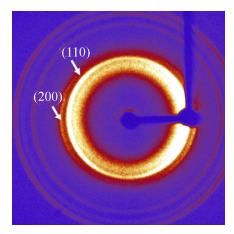 Figure 5.
Two dimensional X-ray diffraction of a PE/BR (30/70) blend sample after tensile test
Figure 5.
Two dimensional X-ray diffraction of a PE/BR (30/70) blend sample after tensile test
The morphology of fracture surface was studied by SEM. Figure 6 shows the micrographs of the fracture surface. From Fig. 6(a), it can be seen that the small PE microdomains in the PE/BR blend with only 5 wt% PE were finely dispersed in the BR matrix. The fracture surface is quite smooth, reflecting the poor mechanical performance of the sample. The PE domain size and the roughness of the fracture surfaces increase with increasing PE loadings, see Figs. 6(b) and 6(c). For the blends with PE content more than 30 wt%, as seen in Figs. 6(d) and 6(e), rugged and ruptured areas can be observed, which are more clearly displayed in the enlarged micrograph presented in Fig. 6(f). There exist also elongated grooves, suggesting pull-out patterns. The morphologies observed correlate well with the mechanical behavior. The lateral surface morphologies of the fractured samples were also monitored by SEM. As presented in Fig. 7, the lateral surfaces of the PE/BR blends with PE component less than 20 wt% exhibit essentially the same phase structure as the fracture surfaces, see Figs. 7(a) and 7(b). This demonstrates that the small PE microdomains do not deformed evidently. Therefore, the improvement of the mechanical properties is also limited. On the other hand, the 30/70 and 40/60 PE/BR blends exhibit a ductile type response to tensile strain with high extent of deformation as evidenced by the presence of fibrils (Figs. 7d and 7e). The formation of fibrils is a characteristic feature of ductile type failure and the length of the fibrils indicates the degree of deformation of the material during failure[22]. Deformation of PE lamellar aggregates formed by glide and the holes, which were caused by interfacial debonding under large extension, can be recognized. The elongated holes arranged preferentially in tensile direction and form slits. These characteristics correspond to the remarkably improved mechanical properties of the PE/BR blends with more than 30 wt% PE.
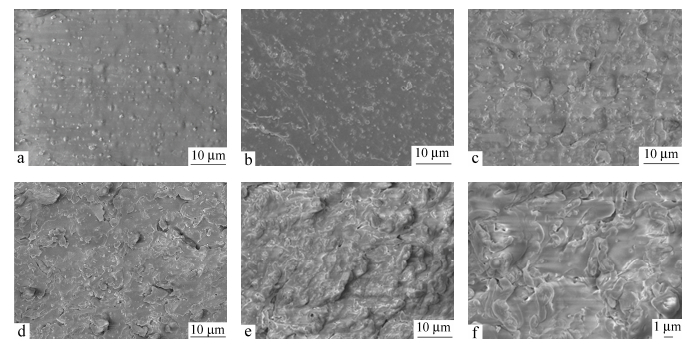 Figure 6.
SEM micrographs of the tensile fracture surfaces of PE/BR blends with compositions: (a) 5/95, (b) 10/90, (c) 20/80, (d) 30/70 and (e) 40/60 (Part (f) is an enlarged picture of (e).)
Figure 6.
SEM micrographs of the tensile fracture surfaces of PE/BR blends with compositions: (a) 5/95, (b) 10/90, (c) 20/80, (d) 30/70 and (e) 40/60 (Part (f) is an enlarged picture of (e).)
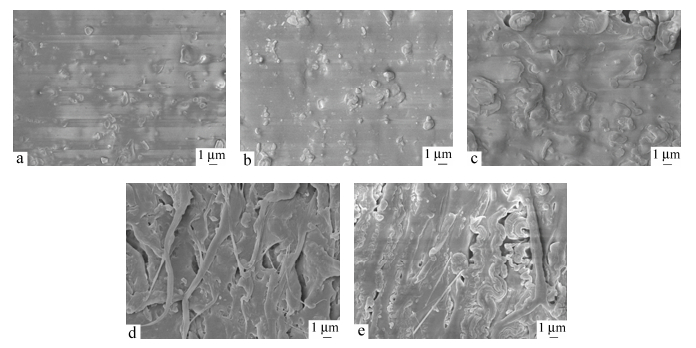 Figure 7.
SEM micrographs of the lateral fracture surfaces of fractured PE/BR blends with compositions: (a) 5/95, (b) 10/90, (c) 20/80, (d) 30/70 and (e) 40/60
Figure 7.
SEM micrographs of the lateral fracture surfaces of fractured PE/BR blends with compositions: (a) 5/95, (b) 10/90, (c) 20/80, (d) 30/70 and (e) 40/60
CONCLUSIONS
In summary, blends of BR with PE were prepared and sulfur-vulcanized according to the standard mixing and curing procedure. The mechanical properties of the cured blends were characterized through tensile and tear tests. The results show that the tensile strength, tear strength, modulus as well as the elongation at break of BR increase gradually with the increase of PE component. While an increase of a factor of magnitude in tensile strength is achieved for the 40/60 PE/BR blends, the tear strength, modulus as well as the elongation at break are enhanced by 5-10 folds as compared to those of the pure BR treated under same conditions. These results confirmed that the PE exhibits an effective reinforcing capability towards BR.
Morphological studies show that PE as separated phase is well-dispersed in the BR matrix in forms of microdomains. The domain size increases with increasing PE content. At the same time, the PE domains become elongated at high PE loading, e.g., over 30 wt%. Moreover, the PE in the cured BR matrix is identified to be in the crystalline state. It is found that these elongated PE domains take the response of the improved mechanical performance.
-
-
[1]
Ghosh, P., Chattopadhyay, B. and Sen, A.K., Polymer, 1994, 35(18): 3958
-
[2]
Li, Y.J., Oono, Y., Kadowaki, Y.J., Inoue, T., Nakayama, K. and Shimizu, H., Macromolecules, 2006, 39: 4195
-
[3]
Antunes, C.F., Machado, A.V. and van Duin, M., Eur. Polym. J., 2011, 47: 1447
-
[4]
George, S., Ramamurthy, K., Anand, J.S., Groeninckx, G., Varughese, K.T. and Thomas, S., Polymer, 1999, 40: 4325
-
[5]
George, J., Varughese, K.T. and Thomas, S., Polymer, 2000, 41: 1507
-
[6]
Muraki, T. and Tajima, M., 1989, Eur. Pat., 324554 A1
-
[7]
Mukai, U., 2000, U.S. Pat., 6028143A
-
[8]
Buonerba, A., Cuomo, C., Speranza, V. and Grassi, A., Macromolecules, 2010, 43: 367
-
[9]
Kumar, S., Rath, T., Mahaling, R.N., Das, C.K., Srivastava, R.B. and Yadaw, S.B., Polym. Compos., 2009, 30(5): 655
-
[10]
Maiti, M., Jasra, R.V., Kusum, S.K. and Chaki, T.K., Ind. Eng. Chem. Res., 2012, 51(32): 10607
-
[11]
Zou, Z., Sun, Z. and An, L., Chinese J. Polym. Sci., 2014, 32(3): 255
-
[12]
Guo, K., Xiang, S., Sun, J. and Meng, C., Chinese J. Polym. Sci., 2014, 32(3): 315
-
[13]
Kar, S. and Greenfield, M.L., Polymer, 2015, 62: 129
-
[14]
Liu, W., Dong, X., Zou, F.S., Yang, J., Wang, D.J. and Han, C.C., Polymer, 2014, 55: 2744
-
[15]
Rath, S.K., Aswal, V.K., Sharma, C., Joshi, K., Patri, M., Harikrishnan, G. and Khakhar, D.V., Polymer, 2014, 55: 5198
-
[16]
Zhang, Y., Mark, J.E., Zhu, Y.W., Ruoff, R.S. and Schaefer, D.W., Polymer, 2014, 55: 5389
-
[17]
Yao, H., Liu, J., Zhang, L. and Yan, S., Chinese J. Polym. Sci., 2015, 33(3): 386
-
[18]
Gent, A.N. and Zhang, L.Q., J. Polym. Sci., Part B: Polym. Phys., 2001, 39: 811
-
[19]
Liu, J., Wu, S., Zhang, L., Wang, W. and Cao, D., Phys. Chem. Chem. Phys., 2011, 13: 518
-
[20]
Wang, Z., Liu, J., Wu, S., Wang, W. and Zhang, L., Phys. Chem. Chem. Phys., 2010, 12: 3014
-
[21]
Minke, R. and Blackwell, J.J., Macromol. Sci., Phys.,1980, B18: 233
-
[22]
Kausch, H.H., “Polymer fracture”, Springer-Verlag: Berlin, Heidelberg, New York, 1978
-
[1]
-

 扫一扫看文章
计量
- PDF下载量: 0
- 文章访问数: 2006
- HTML全文浏览量: 107
 下载:
下载: