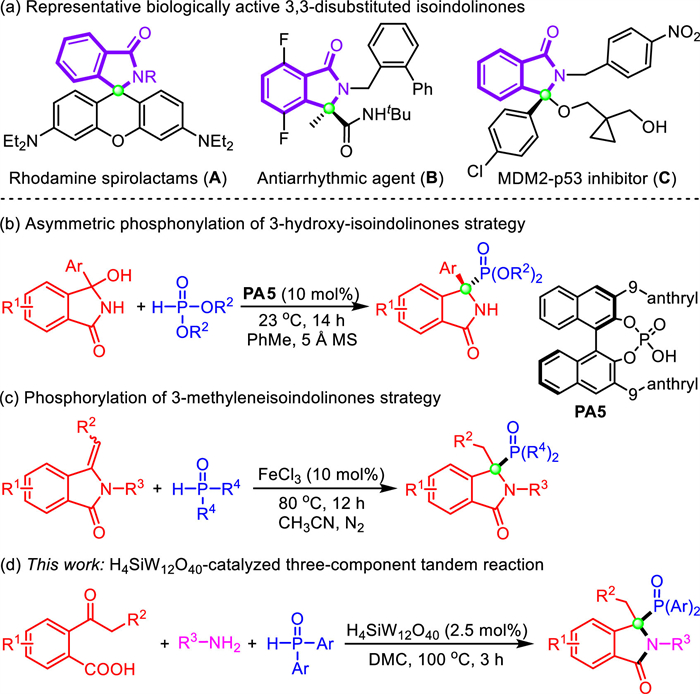
Scheme 1.
Background of 3,3-disubstituted isoindolinones synthesis and our strategy.

A H4SiW12O40-catalyzed three-component tandem reaction for the synthesis of 3,3-disubstituted isoindolinones
Yufeng Liu , Guodong Zeng , Yutao Cheng , Lei Chen , Yunhai Liu , Yongge Wei , Guoping Yang


The 3,3-disubstituted isoindolinone compounds featuring quaternary carbon centers at the C3-position are ubiquitous heterocyclic motifs in many synthetic and naturally occurring molecules [1,2]. The skeleton of 3,3-disubstituted isoindolinones is the core of numerous bioactive and pharmaceutically active compounds [3,4]. For instance, Rhodamine spirolactam (A) exhibits great superiority for subcellular imaging [5,6]. Drug B is used to treat cardiac arrhythmias [7]. Furthermore, the 3,3-disubstituted isoindolinones with a heteroatom-functionality at the C3-position also show unique biological activities such as compound C acting as an MDM2-p53 inhibitor (Scheme 1a) [8-10]. On the other hand, organophosphorus compounds are widely used in organic synthesis, medicinal chemistry, agricultural chemistry, and materials science [11-16]. Notably, phosphorus substituents can modulate important biological functions by mimicking the carboxylic acid functionality [17]. Phosphorus-substituted isoindolinones that combine the advantage of both phosphorus moiety and isoindolinone scaffold, represent an important class of organophosphorus compounds [18]. Therefore, the development of compound libraries based on phosphorus-substituted isoindolinone motifs is of great value for drug discovery [19,20]. However, only a few methods have been reported for the preparation of 3,3-disubstituted isoindolinones with a phosphorus-functionality at the C3-position. Singh's group developed a chiral phosphoric acid PA5 catalyzed asymmetric synthesis of C3-phosphorylated 3,3-disubstituted isoindolinones using 3‑hydroxy-3-phenylisoindolinones as raw material (Scheme 1b) [21]. Recently, Xu and co-works reported FeCl3-catalyzed phosphorylation of 3-methyleneisoindolinones for the construction of phosphorus-functionalized 3,3-disubstituted isoindolinones (Scheme 1c) [22]. Both approaches applied the strategy of direct functionalization of parent isoindolinones, which is not conducive to the diversity and complexity of the constructed products. It is still challenging to develop efficient and practical methods to construct C3-phosphinoyl-functionalized 3,3-disubstituted isoindolinones from simple starting materials, especially in a green and sustainable manner.
Multicomponent reactions (MCRs) consist of a process involving the condensation of three or more reactants. The obtained products are formed in a single step from simple starting materials in high atom efficient reactions. The possibility of applying diverse reagents makes them ideal for creating new molecular libraries [23-27]. In this regard, MCRs is one of the most useful and ideal tools for the synthesis of versatile 3,3-disubstituted isoindolinones. In addition, polyoxometalates (POMs) are a well-known class of anionic metaloxo clusters with diverse structures and excellent properties [28-35]. Given their tunable acidity and redox properties, good thermal stability and environmental friendliness, POMs were widely used as a kind of green catalyst in organic synthesis [36-42]. Particularly, our previous works demonstrated that POMs are practical and excellent catalysts for the construction of heterocyclic compounds [43-47]. In this regard, POMs would be a promising catalyst for the synthesis of 3,3-disubstituted isoindolinones.
Based the above considerations, we described the first MCRs for the preparation of C3-phosphorylated 3,3-disubstituted isoindolinones via the condensation of 2-acylbenzoic acids, primary amines and phosphine oxides using H4SiW12O40 as an environmentally benign and inexpensive catalyst, and DMC as the green solvent (Scheme 1d). The simple starting materials, green catalyst and solvent, and water as the sole by-product make this method suitable for the 3,3-disubstituted isoindolinones library synthesis.
Initially, 2-acetylbenzoic acid (1a), hexylamine (2a) and diphenylphosphine oxide (3a) were employed as the model substrates to optimize the reaction conditions (Table 1, Tables S1–S5 in Supporting information for more details). A variety of heteropolyacids (HPAs) (2 mol%) as Brønsted acid catalysts were screened in PhCl (1 mL) in a sealed tube at 100 ℃ for 2 h at first. It was revealed that H4SiW12O40 performed better than other HPAs such as H3PW12O40 and H3PMo12O40, affording product 4a in 61% yield (entries 1–3). Other Brønsted acids like p-TSA and PA5 did not improve the yields compared to HPAs (entries 4 and 5). In addition, Lewis acids such as CuCl2, CoCl2 and FeCl3 were also tested as catalysts, but none of them could catalyze this transformation with higher yield (entries 6–8). Control experiments indicated that H4SiW12O40 played a crucial and essential role in this three-component reaction. Subsequently, the solvents screening showed the transformation was strongly influenced by the solvents, and DMC turned out to be the best choice resulting in a 73% yield (entries 9–13). The yield of 4a could not be increased by changing the reaction temperature (entries 14 and 15). Applying a longer reaction time (3 h) and more catalyst loading (2.5 mol%), led to the desired product 4a with 80% and 89% yield, respectively (entries 16 and 17). Finally, the optimum results were obtained when 2-acetylbenzoic acid (1a, 0.2 mmol), hexylamine (2a, 0.2 mmol) and diphenylphosphine oxide (3a, 0.2 mmol) were treated with 2.5 mol% of H4SiW12O40 in DMC (1 mL) in a sealed tube at 100 ℃ for 3 h.
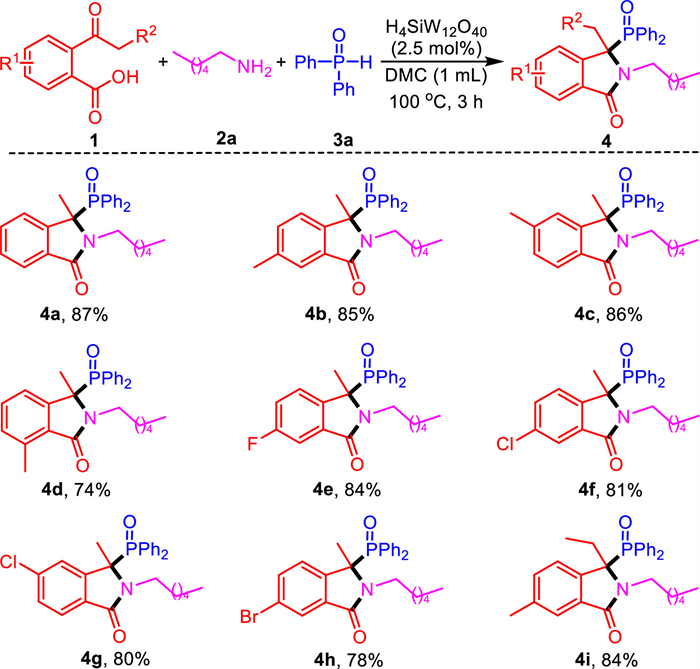
Next, the substrate scope of this three-component reaction process was investigated under the optimized conditions. We first explored a range of 2-acetylbenzoic acids (1) with hexylamine (2a) and diphenylphosphine oxide (3a) as partners. As shown in Scheme 2, 2-acetylbenzoic acids bearing either electron-withdrawing or electron-donating groups are efficient substrates, giving the desired 3,3-disubstituted isoindolinones 4a-4h in good yields. Furthermore, 2-propionylbenzoic acid was also tolerated well, delivering the corresponding product 4i in 84% yield.
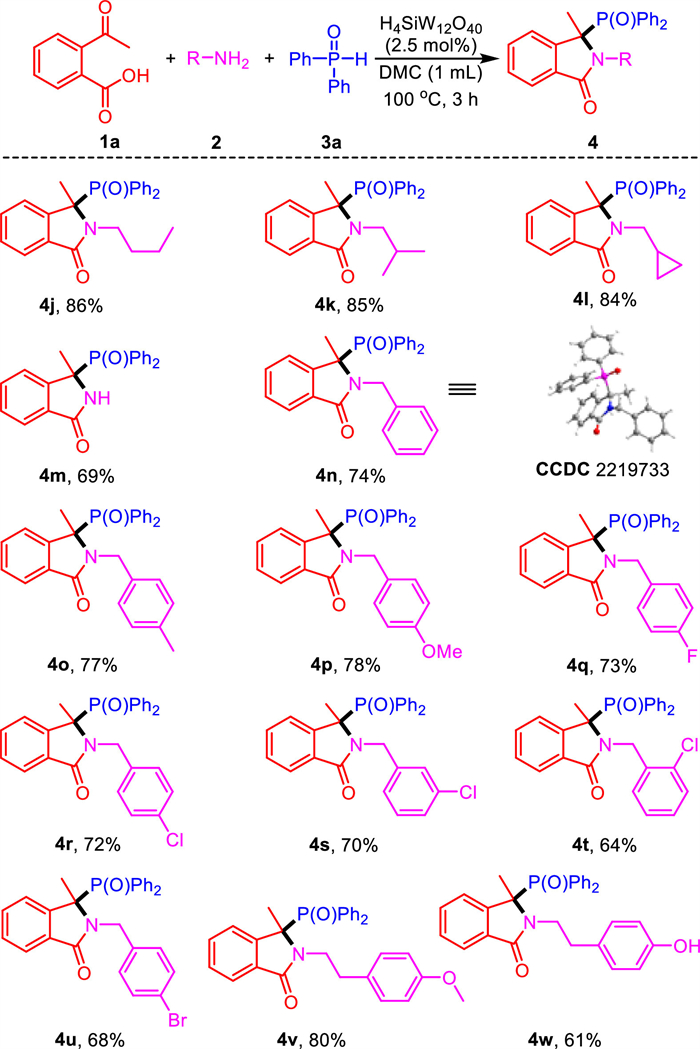
After having exhibited a broad scope for substituted 2-acetylbenzoic acids, a variety of primary amines (2) were next investigated to react with 1a and 3a under the same optimized conditions and the results are summarized in Scheme 3. A wide variety of structurally and electronically diverse primary alkyl amines can be successfully subjected to this transformation. The n-butylamine, i-butylamine, and cyclopropanemethylamine are competent coupling partners, furnishing the desired products in good isolated yields (4j-4l). Interestingly, unprotected N–H isoindolinone (4m) can be prepared by using ammonium acetate as substrate. For the substrate of benzylamines, a slightly increased amount of 2 and 3a was necessary to reach full conversion. Benzylamines with electron-donating or -withdrawing groups reacted smoothly to afford the desired products with moderate yields (4n-4u). The structure of product 4n was characterized by single-crystal X-ray diffraction analysis. Substituents such as −CH3, −OCH3, −F, −Cl, −Br on the benzene ring of 2 were well tolerated, the electronic property of which slightly affected the reactivity of amine and electron-rich amine afforded better yields. In the case of phenethyl amines, the corresponding product 4v and 4w were obtained in the yield of 80% and 61%, respectively.
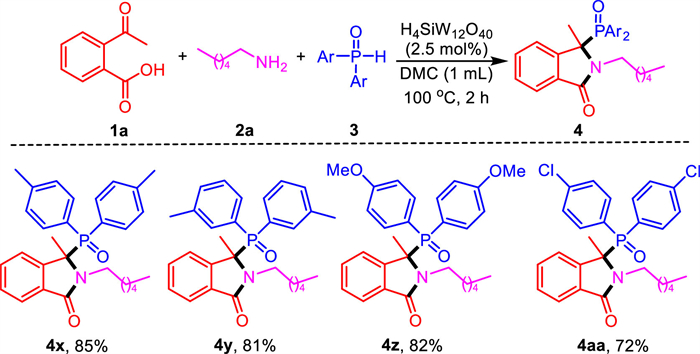
Furthermore, we examined the scope of H-phosphine oxides 3 using 1a and 2a as coupling partners (Scheme 4). Generally, H-phosphine oxides substituted with electron-donating (−Me, −OMe) or electron-withdrawing group (−Cl) were both suitable reaction partners, and the corresponding products were obtained in 72%–85% yields (4x-4aa).
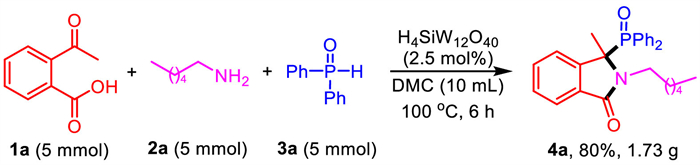
To determine the practicability of this method, a gram-scale reaction was performed with 1a (5 mol), 2a (5 mol) and 3a (5 mol) to synthesize 4a and the reaction proceeded smoothly to give the product in good yield (4a, 80%, 1.73 g). The result demonstrated the potential application of this protocol in large-scale production (Scheme 5).
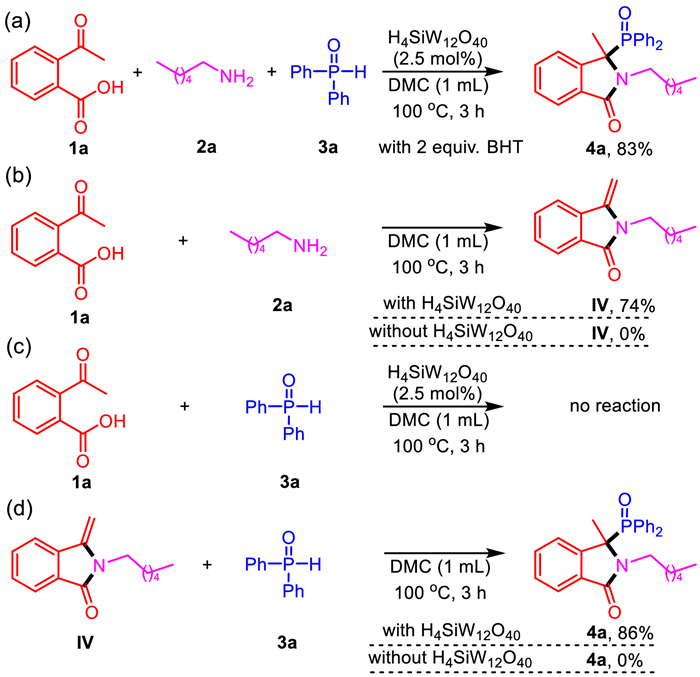
In order to have a deeper understanding on how the three compounds combine together, and get some insight into the mechanism, several control experiments were conducted (Scheme 6). In the presence of radical inhibitor: BHT, 4a was still obtained in 83% yield, indicating that a radical pathway should be excluded (Scheme 6a). The reaction of 1a and 2a led to the formation of the compound Ⅳ (Scheme 6b). On the other hand, the reaction of 1a and 3a in the absence of 2a was performed, no reaction was observed (Scheme 6c). Furthermore, when 3a was reacted with compound Ⅳ under standard conditions, the desired product 4a obtained in 86% yield (Scheme 6d). These results proved that Ⅳ would be the key intermediate for this transformation. Without H4SiW12O40, 1a could not be converted to Ⅳ, and Ⅳ could also not be converted to 4a, which means H4SiW12O40 plays an essential role in the whole reaction process.
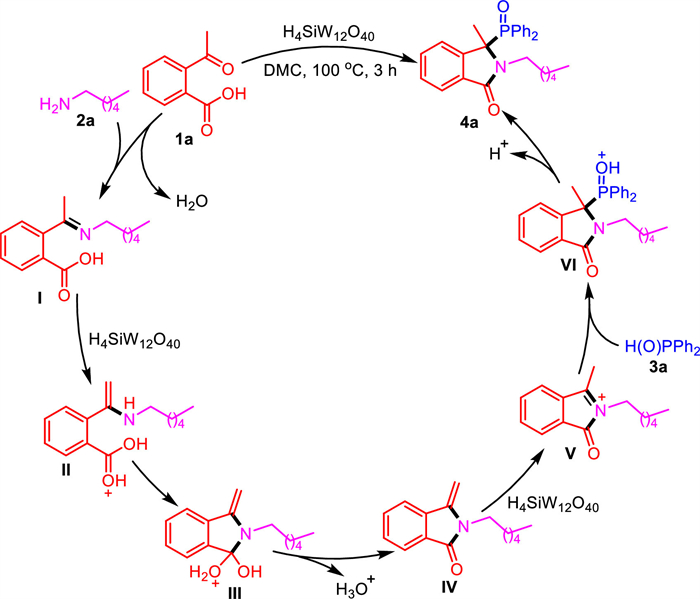
Based on the above experimental results and previous literature reports [22,48,49], a plausible mechanism was proposed in Scheme 7. The reaction initially goes through the formation of imine Ⅰ, which was protonated by H4SiW12O40 to generate a higher electrophilic intermediate Ⅱ. Next, the nucleophile imine attacked carbonyl to provide the intermediate Ⅲ, followed by the elimination of H2O and regeneration of catalyst H4SiW12O40 to afford the key intermediate Ⅳ. The acyliminium intermediate Ⅴ is generated from Ⅳ in the presence of Brønsted acid H4SiW12O40. Then, 3a as the nucleophile reacts with the acyliminium intermediate Ⅴ to form intermediate Ⅵ, which produces the product 4a along with releasing the catalyst H4SiW12O40.
In conclusion, we have developed the first facile and efficient H4SiW12O40-catalyzed three-component tandem reaction for the synthesis of 3-phosphoryl-substituted isoindolinones from readily accessible 2-acylbenzoic acids, primary amines and phosphine oxides in one pot. Importantly, the environmentally benign and inexpensive catalyst, green organic carbonate solvent DMC, available starting materials and water as the sole by-product mean that this protocol provides a green and efficient cyclization pattern for the synthesis of potential biologically active C3-phosphinoyl-functionalized 3,3-disubstituted isoindolinones, which promises potential applications in synthetic and medicinal chemistry.
The authors declare that they have no known competing financial interests or personal relationships that could have appeared to influence the work reported in this paper.
This work was supported the National Natural Science Foundation of China (No. 22001034), Jiangxi Provincial Natural Science Foundation (No. 20212BAB213001).
Supplementary material associated with this article can be found, in the online version, at doi:
K.R. Bhatia, Curr. Top. Med. Chem. 17 (2017) 189–207.
K. Speck, T. Magauer, Beilstein J. Org. Chem. 9 (2013) 2048–2078. doi: 10.3762/bjoc.9.243
P.R. Gentry, M. Kokubo, T.M. Bridges, et al., J. Med. Chem. 56 (2013) 9351–9355. doi: 10.1021/jm4013246
N.A.L. Pereira, Â. Monteiro, M. Machado, et al., ChemMedChem 10 (2015) 2080–2089. doi: 10.1002/cmdc.201500429
Q. Qi, W. Chi, Y. Li, et al., Chem. Sci. 10 (2019) 4914–4922. doi: 10.1039/c9sc01284b
Z. Ye, H. Yu, W. Yang, et al., J. Am. Chem. Soc. 141 (2019) 6527–6536. doi: 10.1021/jacs.8b11369
A. Björe, J. Boström, Ö. Davidsson, et al., Patent, WO2008/008022 A1, 2008
I.R. Hardcastle, S.U. Ahmed, H. Atkins, et al., J. Med. Chem. 49 (2006) 6209–6221. doi: 10.1021/jm0601194
I.R. Hardcastle, J. Liu, E. Valeur, et al., J. Med. Chem. 54 (2011) 1233–1243. doi: 10.1021/jm1011929
C. Riedinger, J.A. Endicott, S.J. Kemp, et al., J. Am. Chem. Soc. 130 (2008) 16038–16044. doi: 10.1021/ja8062088
D.J. Figueroa-Villar, C.E. Petronilho, K. Kuca, et al., Curr. Med. Chem. 28 (2021) 1422–1442. doi: 10.2174/0929867327666200425213215
G. Mercey, T. Verdelet, J. Renou, et al., Acc. Chem. Res. 45 (2012) 756–766. doi: 10.1021/ar2002864
K. Musilek, M. Dolezal, F. Gunn-Moore, et al., Med. Res. Rev. 31 (2011) 548–575. doi: 10.1002/med.20192
J.B. Rodriguez, C. Gallo-Rodriguez, ChemMedChem 14 (2019) 190–216. doi: 10.1002/cmdc.201800693
W. Cai, Y. Huang, Chin. J. Org. Chem. 41 (2021) 3903–3913. doi: 10.6023/cjoc202106004
Y.Y. Zhu, Y. Niu, Y.N. Niu, et al., Org. Biomol. Chem. 19 (2021) 10296–10313. doi: 10.1039/d1ob01566d
A. Piperno, A.M. Chiacchio, D. Iannazzo, et al., Curr. Med. Chem. 13 (2006) 3675–3695. doi: 10.2174/092986706779026110
G.O. Kachkovskyi, O.I. Kolodiazhnyi, Tetrahedron 63 (2007) 12576–12582. doi: 10.1016/j.tet.2007.10.022
L. Chen, X.Y. Liu, Y.X. Zou, Adv. Synth. Catal. 362 (2020) 1724–1818. doi: 10.1002/adsc.201901540
L. Chen, Y.X. Zou, Adv. Synth. Catal. 363 (2021) 4159–4176. doi: 10.1002/adsc.202100522
A. Suneja, R.A. Unhale, V.K. Singh, Org. Lett. 19 (2017) 476–479. doi: 10.1021/acs.orglett.6b03623
W. Li, R. Shi, X. Zhang, et al., J. Org. Chem. 87 (2022) 9769–9781. doi: 10.1021/acs.joc.2c00829
A. Dömling, W. Wang, K. Wang, Chem. Rev. 112 (2012) 3083–3135. doi: 10.1021/cr100233r
B.H. Rotstein, S. Zaretsky, V. Rai, et al., Chem. Rev. 114 (2014) 8323–8359. doi: 10.1021/cr400615v
P. Wu, M. Givskov, T.E. Nielsen, Chem. Rev. 119 (2019) 11245–11290. doi: 10.1021/acs.chemrev.9b00214
X. Zhang, M. Liu, W. Qiu, et al., ACS Sustain. Chem. Eng. 6 (2018) 5574–5579. doi: 10.1021/acssuschemeng.8b00555
C. Ma, Y. Ji, J. Zhao, et al., Chin. J. Catal. 43 (2022) 571–583. doi: 10.1016/S1872-2067(21)63917-7
L. Qin, C.Y. Zhao, L.Y. Yao, et al., CCS Chem. 3 (2022) 259–271. doi: 10.31635/ccschem.021.202000741
Z. Li, Z.H. Lv, H. Yu, et al., CCS Chem. 4 (2022) 2938–2945. doi: 10.31635/ccschem.021.202101573
J.H. Ge, Y.T. Zhu, Z. Zeb, et al., Acta Phys. Chim. Sin. 36 (2020) 1906063. doi: 10.3866/pku.whxb201906063
H.Y. Wang, S.R. Li, X. Wang, et al., Sci. China Chem. 64 (2021) 959–963. doi: 10.1007/s11426-021-9986-1
D. Zang, H. Wang, Polyoxometalates 1 (2022) 9140006. doi: 10.26599/pom.2022.9140006
L. Qin, R.J. Wang, X. Xin, et al., Appl. Catal. B Environ. 312 (2022) 121386. doi: 10.1016/j.apcatb.2022.121386
L. Jiao, Y.Y. Dong, X. Xin, et al., J. Mater. Chem. A 9 (2021) 19725–19733. doi: 10.1039/d1ta02792a
H.P. Xiao, Y.S. Hao, X.X. Li, et al., Angew. Chem. Int. Ed. 61 (2022) e202210019. doi: 10.1002/anie.202210019
W. Chen, X. Yi, J. Zhang, et al., Polyoxometalates 1 (2022) 9140012. doi: 10.26599/POM.2022.9140012
L. Lian, H. Zhang, S. An, et al., Sci. China Chem. 64 (2021) 1117–1130. doi: 10.1007/s11426-020-9957-0
J. Wang, H. Yu, Z. Wei, et al., Research. 2020 (2020) 3875920.
S.S. Wang, G.Y. Yang, Chem. Rev. 115 (2015) 4893–4962. doi: 10.1021/cr500390v
X.D. Liu, N. Xu, X.H. Liu, et al., Chem. Commun. 58 (2022) 12236–12239. doi: 10.1039/d2cc02748h
Q.Y. Zhang, L.Y. Zhou, Y.Y. Ma, et al., Chem. Sci. 12 (2021) 1886–1890. doi: 10.1039/D0SC05277A
Y.F. Liu, C.W. Hu, G.P. Yang. Chin. Chem. Lett. 34 (2023) 108097. doi: 10.1016/j.cclet.2022.108097
Y.F. Liu, G.M. Cao, L. Chen, et al., Adv. Synth. Catal. 364 (2022) 1460–1464. doi: 10.1002/adsc.202200081
G.P. Yang, K. Li, X. Lin, et al., Chin. J. Chem. 39 (2021) 3017–3022. doi: 10.1002/cjoc.202100397
G.P. Yang, X. Xie, M. Cheng, et al., Chin. Chem. Lett. 33 (2022) 1483–1487. doi: 10.1016/j.cclet.2021.08.037
G.P. Yang, X.L. Zhang, Y.F. Liu, et al., Inorg. Chem. Front. 8 (2021) 4650–4656. doi: 10.1039/d1qi00485a
K. Li, X.L. Lin, K. Zeng, et al., Tungsten 4 (2022) 149–157. doi: 10.1007/s42864-021-00119-0
X.J. Dai, M. Liu, J.Y. Zhang, et al., ChemistrySelect 4 (2019) 4458–4461. doi: 10.1002/slct.201900759
S. Sharma, O.S. Nayal, A. Sharma, et al., ChemistrySelect 4 (2019) 1985–1988. doi: 10.1002/slct.201804009

Scheme 2 Scope of 2-acylbenzoic acids for the synthesis of 3,3-disubstituted isoindolinones. Reaction conditions: 2-acylbenzoic acid (1, 0.2 mmol), hexylamine (2a, 0.2 mmol), diphenylphosphine oxide (3a, 0.2 mmol), DMC (1.0 mL), H4SiW12O40 (2.5 mol%) for 3 h.

Scheme 3 Scope of primary amines for the synthesis of 3,3-disubstituted isoindolinones. Reaction conditions: 2-acetylbenzoic acid (1a, 0.2 mmol), primary amines (2, 0.3 mmol), diphenylphosphine oxide (3a, 0.3 mmol), DMC (1.0 mL), H4SiW12O40 (2.5 mol%) for 3 h.

Scheme 4 Scope of diarylphosphine oxides for the synthesis of 3,3-disubstituted isoindolinones. Reaction conditions: 2-acetylbenzoic acid (1a, 0.2 mmol), hexylamine (2a, 0.2 mmol), diphenylphosphine oxide (3, 0.2 mmol), DMC (1.0 mL), H4SiW12O40 (2.5 mol%) for 3 h.

 扫一扫看文章


扫一扫关注我们
 DownLoad:



 下载:
下载:


 下载:
下载: