Efficient N-heterocyclic carbene nickel pincer complexes catalyzed cross coupling of benzylic ammonium salts with boronic acids
Citation:
Efficient N-heterocyclic carbene nickel pincer complexes catalyzed cross coupling of benzylic ammonium salts with boronic acids[J]. Chinese Chemical Letters,
2017, 28(2): 350-353.
doi:
10.1016/j.cclet.2016.09.006
Efficient N-heterocyclic carbene nickel pincer complexes catalyzed cross coupling of benzylic ammonium salts with boronic acids
English
Efficient N-heterocyclic carbene nickel pincer complexes catalyzed cross coupling of benzylic ammonium salts with boronic acids
Received Date:
25 July 2016 Accepted Date:
09 September 2016 Revised Date:
29 August 2016 Available Online:
01 February 2017
Abstract:
Pyridine-bridged bis-benzimidazolylidene nickel complexes exhibited very high catalytic activity toward cross coupling of inactive (hetero)aryl benzylic ammonium salts with (hetero)aryl and alkenyl boronic acids under mild reaction conditions. Even at 2 mol% catalyst loading, a wide range of substrates for both coupling partners with different steric and electronic properties were well tolerated.
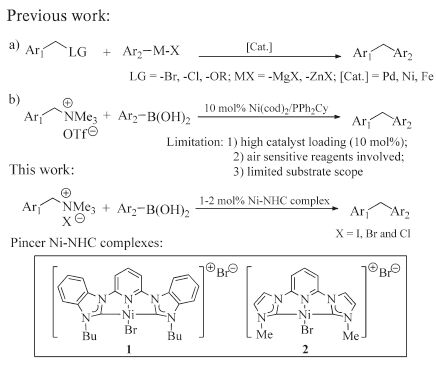
As essential building blocks and intermediates for bioactive organic molecules [1, 2] and pharmaceuticals [3-5], diarylmethanes have drawn considerable attentions. Tremendous efforts have been devoted to develop efficient, straightforward and practical protocols to access these valuable targets. The transition metal catalyzed cross coupling of benzylic electrophiles with Grignard or organozinc reagents represents one of the most powerful approaches for this purpose, however, the electrophiles usually restricted to benzylic halides, acetates, carbonates and phosphates (Scheme 1a) [6-13]. Recently, benzylic ethers and alcohols were also found as good coupling partners, which may be regarded as one of significant advances in this research field [14, 15], whereas, the air-sensitive Grignard reagents were still required and gravely hampered their feasibility. Therefore, it is highly desirable to explore an efficient catalytic system to produce a variety of diarylmethanes by cross couplings of benzylic substrates without Grignard reagents.
Scheme1
Scheme1
Transition-metal catalyzed cross-coupling reactions for accessing diarylmethanes.
Scheme1.
Transition-metal catalyzed cross-coupling reactions for accessing diarylmethanes.
In contrast, robust organoboron agents have been gradually employed as crucial coupling partners in various transition metal catalyzed carbon-carbon bond formation reactions using benzylic electrophiles [16-21]. In recent, Watson and coworkers firstly realized the nickel-catalyzed cross coupling of benzylic ammonium salts, readily prepared from amine precursors, with aryl boronic acids, and good yields were observed with a number of diarylmethanes by using air sensitive Ni (cod)2 [22, 23] and luxury phosphine ligands [23]. Besides high catalyst loading (10 mol%) was required to achieve satisfactory results, active benzylic ammonium triflates have to be involved, whereas, the ammonium salts with other inactive counter-ions (I, Br or Cl) are not well tolerated. Although, N-heterocyclic carbene ligands have been regarded as suitable replacements for the traditional air-sensitive phosphine ligands and exhibited high activity in a number of transformations [24], the catalyst derived from IMes·HCl and Ni (cod) 2 only resulted in 28% yield under the identical reaction conditions [23].
Recently, we successfully developed pyridine-bridged bis-NHC nickel complexes and unveiled excellent outcomes in the Suzuki- Miyaura couplings of inactive ArCl under mild reaction conditions with broad substrate scopes. Remarkably, inert and inexpensive ArOTs, ArOMs and ArOPiv could be successfully coupled via selective C-O activation [25-27]. Following our recent research interests in exploring their applicability of pincer metal complexes in catalysis and material sciences [28-34], herein, we sought to extend their applicability of pyridine-bridged bis-NHC nickel complexes in the cross-coupling of steric hindered (hetero) arylbenzylic ammonium salts with (hetero) aryl boronic acids via C- N activation of benzylic substrates without Grignard reagents.
2.
Results and discussion
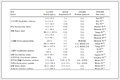
Initially, the coupling of benzylic ammonium iodide 3a with para-methoxyphenylboronic acid 4 was selected as model reaction to investigate the catalytic activity of the selected pincer complexes. In the presence of 5 mol% pincer complex 1, 20 mol% PPh3 and 4.5 equiv. K2CO3, only trace amount of diarylmethane 5 was detected in dioxane at 80 8C for 24 h (Table 1, entry 1). Similar outcome was obtained when strong base t-BuOH was applied (Table 1, entry 2). Delightedly, when CsF was used instead, the product 5 was isolated in a moderate yield (63%, Table 1, entry 3). The yield could be further enhanced to 92%, when K3PO4 was employed (Table 1, entry 4). Unexpectedly, further decreasing the catalyst loading to 2 mol% and 1 mol% did not hamper the coupling process, whereas, the yields were further increased to 97% and 94%, respectively (Table 1, entries 5 and 6, respectively). The alternation of solvents showed less impact on the yields of product 5, slightly inferior outcomes were observed when other solvents were involved (87%-91%, Table 1, entries 7-10). Additional information for the optimization of solvents and temperature was depicted in the Supporting information. Interestingly, other ammonium salts containing bromide and chloride are also active in this transformation (94% and 92%, respectively, Table 1, entries 11 and 12), highlighting the catalytic efficiency of pincer complex 1. In contrast, its imidazolium analog 2 only afforded a moderate yield (83%, Table 1, entry 13), which further confirmed our previous observation that the NHC ligands with p-extended aromatic rings act as stronger s-donors and weaker p-acceptors and increase the electron density of the catalytic center leading to higher catalytic activity [25-34]. When the reaction was performed in the absence of PPh3, only 37% yield was found, which demonstrated the significance of PPh3 as reductant in this transformation (Table 1, entry 14) [26]. As expected, no reaction took place in a blank test under the identical reaction conditions (Table 1, entry 15).
表 1
表 1
Optimization of the reaction conditions.a
Table 1.
Optimization of the reaction conditions.a
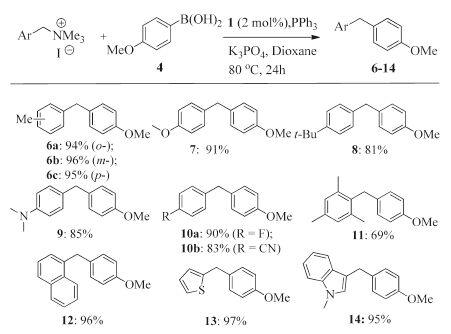
With the optimized reaction conditions in hand, the substrate scope with a series of aryl benzylic ammonium iodide was investigated (Scheme 2). Both electron-rich and electron-deficient substituents on the phenyl ring of ammonium salts were well tolerated (6-11). Especially, the substrates with meta-, para-, and ortho-substituents resulted in similar good yields for the corresponding diarylmethanes 6a-c. Other para-substitutes even with strong electron-donating and electron-withdrawing only unveiled slightly impacts on the coupling process, up to 91% yields were afforded (7-10). Unexpectedly, steric hindered substrate, anaphthylbenzylic ammonium salt even gave out an excellent result (96% for 12). However, when the substrate with two orthopositions substituted (2, 4, 6-trimethylbenzylic salt), the yield was dramatically dropped to 69% (11). Remarkably, heterocyclic salts were also well tolerated. Excellent results were observed with the couplings of 2-thienyl and N-methyl-3-indolylbenzylic ammoniums as substrates (97% and 95% for products 13 and 14, respectively), which clearly indicated the protocol efficiency.
Scheme2
Scheme2
Scope of various (hetero) aryl ammonium iodide. (Reaction was carried out with 0.5 mmol scale with 1 equiv. aryl benzylic ammonium iodide, 4 equiv. 4, 4.5 equiv. base, 2 mol% nickel pincer complex 1 and 20 mol% PPh3 at 80 8C for 24 h N2. Isolate yield based on aryl benzylic ammonium iodide.)
Scheme2.
Scope of various (hetero) aryl ammonium iodide. (Reaction was carried out with 0.5 mmol scale with 1 equiv. aryl benzylic ammonium iodide, 4 equiv. 4, 4.5 equiv. base, 2 mol% nickel pincer complex 1 and 20 mol% PPh3 at 80 8C for 24 h N2. Isolate yield based on aryl benzylic ammonium iodide.)
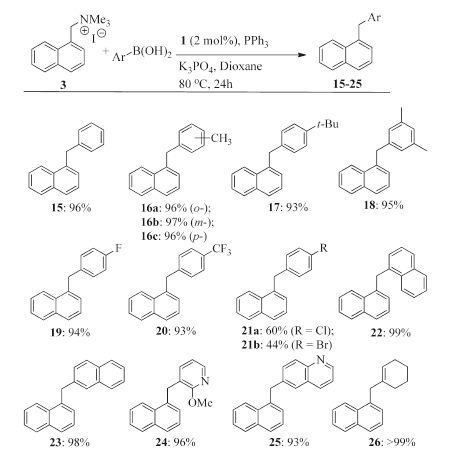
In consideration that steric hindered substrates are challenging and less studied in the Suzuki-Miayara coupling reactions, anaphthylbenzylic ammonium iodide was selected to investigate the scope of aryl boronic acids (Scheme 3). With 2 mol% pincer nickel complex 1, all selected aryl boronic acids were good coupling partners, even in the case of heterocylic ones (15-25). The position and electronic properties of the substitutes of aryl bronic acids hardly hampered the coupling process; excellent yields were produced in all tested cases (93%-97%, 16-20). When 4- bromophenylboronic acid and 4-chlorophenylboronic acid were involved, 60% and 44% yields were still obtained for 21a and 21b, respectively, which provided a possibility for the further transformation of these products, although small amount of inevitable homo-coupling products were also produced. Again, steric encumbered 1-napthalylboronic acid produced the corresponding product 22 in excellent isolated yield (99%), whereas, less bulky 2- substituted isomer delivery 98% yield for product 23. In the heterocyclic cases, 2-methoxypyridine-3-boronic acid and quinoline-6-boronic acid all resulted in excellent yields for products 24 and 25 (96% and 93%, respectively). Intriguingly, when a challenging alkenyl substrate (1-cyclohexenylboronic acid) was applied, the corresponding product 26 was produced even in a quantitative yield.
Scheme3
Scheme3
Reaction scope with (hetero) aryl boronic acids. (Reaction was carried out with 0.5 mmol scale: 3 (1 equiv.), arylboronic acid (4 equiv.), 1 (2 mol%), PPh3 (20 mol%) and K3PO4 (4.5 equiv.) were dissolved in 2.0 mL solvent and stirred at 80 8C in 24 h under atmosphere of N2. Isolate yield based on 3.)
Scheme3.
Reaction scope with (hetero) aryl boronic acids. (Reaction was carried out with 0.5 mmol scale: 3 (1 equiv.), arylboronic acid (4 equiv.), 1 (2 mol%), PPh3 (20 mol%) and K3PO4 (4.5 equiv.) were dissolved in 2.0 mL solvent and stirred at 80 8C in 24 h under atmosphere of N2. Isolate yield based on 3.)
In summary, robust pincer nickel NHC complexes unveiled high catalytic activity in the cross coupling of (hetero) aryl benzylic ammonium halides and (hetero) aryl boronic acids under mild reaction conditions. Even with 2 mol% catalyst loading, a wide range of substrates for both coupling partners with different steric and electronic properties were well tolerated, which provides an efficient, straightforward and practical approach to access various functional diarylmethanes. These results indicate, similar as its feasibility in selective C-O bond activation [25-27], pyridinebridged bis-benzimidazolylidene nickel complex exhibit its potential for C-N bond in the cross coupling reactions.
4.
Experimental
All commercial reagents were used directly without further purification, unless otherwise stated. Dry dimethylsulfoxide (DMSO) and N, N-dimethylformamide (DMF) were purchased from J & K chemical, stored over 4 Å molecular sieves and handled under N2. PPh3 are used as purchased without special treatment. Acetonitrile and tert-butanol (t-BuOH) were distilled from anhydrous calcium chloride prior to use. Anhydrous methanol (MeOH) was distilled from anhydrous calcium chloride, Dioxane, tetrahydrofuran (THF) and toluene were distilled from sodium/ benzophenone, 1, 2-dimethoxyethane (DME) was distilled from calcium hydride prior to use. t-BuOH was purchased from J & K chemical. All Schlenk tubes and sealed vessels (50 mL) were purchased from Beijing Synthware Glass. CDCl3 was purchased from Cambridge Isotope Laboratories. 1H NMR, 13C NMR and 19F NMR spectra were recorded on Jeol ECA-400 and Bruker 400 DRX spectrometers. 13C NMR spectra were referenced to the carbon signal of CDCl3 (77.0 ppm). GC-MS spectra were recorded on Agilent Technologies 1890A GC system and 5975C inert MSD with Triple-Axis Detector.
General procedure for diarylmethanes from benzylic ammonium iodide and arylboronic acid: To a 50 mL Schlenk tube containing sodium benzylic ammonium iodide (0.5 mmol), arylboronic acid (2.0 mmol), K3PO4 (2.25 mmol), castalyst (5 mol%) and PPh3 (20 mol%) were added and the tube was purged with N2 for 3 times. Then 1, 4-dioxaxe (2.0 mL), subsequently, was introduced to the tube. The resulted mixture was allowed to stir for 24 h at 80 ℃ under atmosphere of N2. After the completion of the reaction, the resulting mixture was filtered through a Celite pad and concentrated under the vacuum and directly purified by flash chromatography to give the desired product.
Acknowledgments
Financial support from the National Natural Science Foundation of China (Nos. 21572036, 21172045 and 91127041), the Changjiang Scholars and Innovative Research Team in University (No. IRT-15R12), the Shanghai International Cooperation Program (No. 14230710600), the Doctoral Fund of Ministry of Education of China (No. 20130071110032) and Department of Chemistry Fudan University is gratefully acknowledged.
Scheme2
Scope of various (hetero) aryl ammonium iodide. (Reaction was carried out with 0.5 mmol scale with 1 equiv. aryl benzylic ammonium iodide, 4 equiv. 4, 4.5 equiv. base, 2 mol% nickel pincer complex 1 and 20 mol% PPh3 at 80 8C for 24 h N2. Isolate yield based on aryl benzylic ammonium iodide.)
Scheme3
Reaction scope with (hetero) aryl boronic acids. (Reaction was carried out with 0.5 mmol scale: 3 (1 equiv.), arylboronic acid (4 equiv.), 1 (2 mol%), PPh3 (20 mol%) and K3PO4 (4.5 equiv.) were dissolved in 2.0 mL solvent and stirred at 80 8C in 24 h under atmosphere of N2. Isolate yield based on 3.)



 下载:
下载:


 下载:
下载:


 下载:
下载: